
In a rural parish where national events were marked through local initiative, the coronation of Edward VII in 1902 provided an opportunity for Hardington to express loyalty, community spirit, and a sense of shared occasion.
Preparations in the village
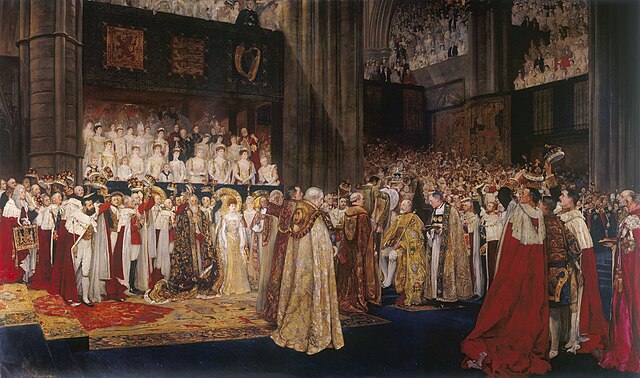
The coronation of Edward VII and his wife Alexandra of Denmark did not go according to plan. Originally scheduled for 26 June 1902, it was postponed until 9 August after the King fell seriously ill and required urgent surgery. The delay caused widespread disruption to celebrations across the country.
At Hardington, preparations had been thorough. The Coronation Committee had arranged a marquee, a cold luncheon, a band, dancing, games, and a bonfire. Abraham Genge of Manor Farm had generously offered the use of a field, while villagers contributed funds towards the festivities.
By the end of May, enough money had been raised not only for the celebrations but also for a permanent memorial. The committee decided on a commemorative lamp, fitted with an inscribed plate, to be placed outside the school.
Coronation Day
Despite the earlier uncertainty, the revised coronation day was marked with ceremony. At 10.30 a.m., Mrs Hembrow of Bridge Close Farm unveiled the lamp outside the school, greeted by enthusiastic cheers for the King. The gathering then moved to the churchyard, where “God Save the King” was sung. Mrs Sercombe, the village schoolmistress, raised a new Union Jack on the church tower flagstaff, after which a Coronation service was held in the church, conducted by the Reverend Cleife.
There is no surviving record of the other planned entertainments, and it is possible that the altered timetable curtailed them. Nevertheless, the rector ensured that the children did not go without celebration. He provided tea in the rectory grounds and organised races, swings, and other amusements, which continued until nightfall.
In perspective
Hardington’s celebration of the coronation shows how national events were refracted through village life. The postponement disrupted plans, but it did not diminish the determination to mark the occasion. The creation of a permanent memorial, the central role of the school and church, and the attention given to the children all point to a community that understood such moments not simply as spectacle, but as opportunities to reinforce shared identity and continuity.