Introduction
Albert Clement Hembrow’s life was shaped by both stability and change within the farming communities of the Somerset Levels and South Somerset. He was born into an established farming family and received an education that was uncommon for a tenant farmer. During the 1890s, he secured a series of substantial tenancies, but later experienced a period of uncertainty in mid-life. His later career, conducted largely on the Somerset Levels, reflected a return to family connections and resources, through which he rebuilt a stable position in local agriculture. His experiences illustrate the mixture of independence, family support, and local reputation upon which many farming careers depended in the late nineteenth and early twentieth centuries.
Childhood
Albert was born on 10 April 1864 at Stoke St Gregory, probably at Slough Farm, which his father, Thomas Hembrow, occupied from the early 1860s until his death in 1908.[1] The Hembrow family had lived in the parish since at least the early sixteenth century.[2] Thomas married his first cousin, Eliza Hembrow, and they had five children, of whom Albert was the fourth.[3] The family remained close-knit, with several children still living at home into adulthood.[4]
Albert attended the Devon County School, West Buckland, which was founded in 1858 to provide a public-school education for the sons of farmers and the provincial middle class. Between 1878 and 1880, he passed several national examinations, including in mathematics, receiving an education that set him apart from many contemporaries who were tenant farmers.[5] After leaving school, he initially worked for his father at Slough Farm before moving to Dykes Farm within the same parish by June 1887.[6] By April 1891, he had returned to Slough Court, suggesting a continued involvement in the family farming enterprise as he prepared to establish his own career.[7]
Marriage and Crock Street Farm, Donyatt
On 4 April 1893, Albert married Ellen Martha Small, his first cousin once removed at Curry Rivel.[8] Ellen’s father, William Small of Wick Farm, Curry Rivel, had died the previous year, leaving an estate valued at £1,169 5s.[9] Shortly after their marriage, the couple moved to Crock Street Farm, Donyatt, which Albert leased from Lady Day, 1893.[10] In advance of taking possession, he advertised a dairy of 20 to 25 cows to let in February 1893.[11] Though the size of the holding is unclear, the previous tenant sold 200 sheep and 50 cows in his farm sale when he left.[12]
Albert quickly became involved in village affairs, attending the Club dinners in May 1893 and May 1894. He was appointed overseer in April 1894 and was elected to Donyatt’s first parish council in December 1894.[13] Their first two children were born at Donyatt: Frank Albert in 1894 and Kathleen Eliza in 1895.
Bridge Close Farm, Hardington
In 1896, the family moved to Bridge Close Farm, Hardington, which was part of the Portman Estate and one of the largest farms in the parish, comprising 389 acres by 1903.[14] The village club visited them during their perambulation of the parish in June 1896.[15]
Albert specialised in Devon Cattle. In February 1902, he purchased a pure-bred Devon bull for 25 guineas at the Devon Cattle Breeders Show, Exeter, and in September 1902, he sold ten steers and three heifers, by a pedigree Devon bull, at Yeovil market.[16] On 18 March 1904, he advertised for a cowman, preferably with a wife or son to help milk and wash up.[17]
In the late 1890s, Albert and Ellen won several prizes at local farming shows. At the Crewkerne Christmas Stock Show in December 1896, Albert won prizes for sheep, while at Yeovil Agricultural Show in September 1897, he received a commendation for a young bull.[18] Ellen won awards for her butter at Yeovil Agricultural Society in 1897 and 1899.[19]
Albert’s position as the tenant of Bridge Close Farm gave him social standing. In April 1897, he was elected to the committee responsible for organising the village’s celebrations for the Queen’s Diamond Jubilee.[20] In March 1898, he was named one of the “village mourners” who attended the funeral of the rector’s father.[21] In April 1902, he presided over a large meeting in the schoolroom to plan for the Coronation and was elected to the organising committee.[22] The Coronation celebrations included the erection of a commemorative lamp outside the school, which Ellen unveiled at the opening of the festivities.[23]
The rector, Rev. Cleife, regarded Albert highly enough to propose him as chairman of the parish council despite Albert not yet being a councillor. However, the proposal was not seconded. Albert nonetheless served as overseer and was elected to the parish council in 1898.[24] His tenure was short-lived following an altercation at a parish meeting with another candidate, Charles William Roper Thomas, after which he resigned without attending the council’s first meeting.[25] The disagreement arose when Thomas reacted angrily after Albert, confused by his long name, questioned the identity of a candidate named Roper.[26]
Two further children were born at Hardington: Thomas in 1898 and Edith May in 1901. Although the 1901 census recorded no servants resident in the farmhouse, an advertisement from August 1901 states “servant kept.”[27] From 1901 to 1903, Ellen placed several advertisements to find a nursery governess to help care for her children.[28] She was also an active supporter of the parish church, helping to decorate it for the harvest festival in 1903 and 1904 and for Christmas in 1904.[29] In August 1904, she and Mrs Genge of Manor Farm ran a stall together at a church bazaar.[30]
Albert and his family left Bridge Close Farm, probably at Lady Day 1905, as the next tenant, Henry Hinks, was there by May 1905.[31] No records of a farm sale have been found, which raises the possibility that Albert may have been forced to leave.
The hazy years
The end of his Hardington tenancy marked a turning point in Albert’s career. Little is known about the next few years. In October 1907, while resident at Aller, he advertised mangold wurzels and after grass for sale and around this time, he stood down from the Aller Moor Drainage Board as they needed to elect his replacement.[32]
Albert’s fortunes may have been revived by his father’s death in September 1908. He left an estate valued at £21,379 0s 0d gross, which he divided among his five children. Albert inherited property at Stoke St Gregory, North Curry, and Lyng, subject to mortgages of £2,250, together with one-third of his father’s real estate that was not otherwise bequeathed.[33]
Oath Farm, Aller
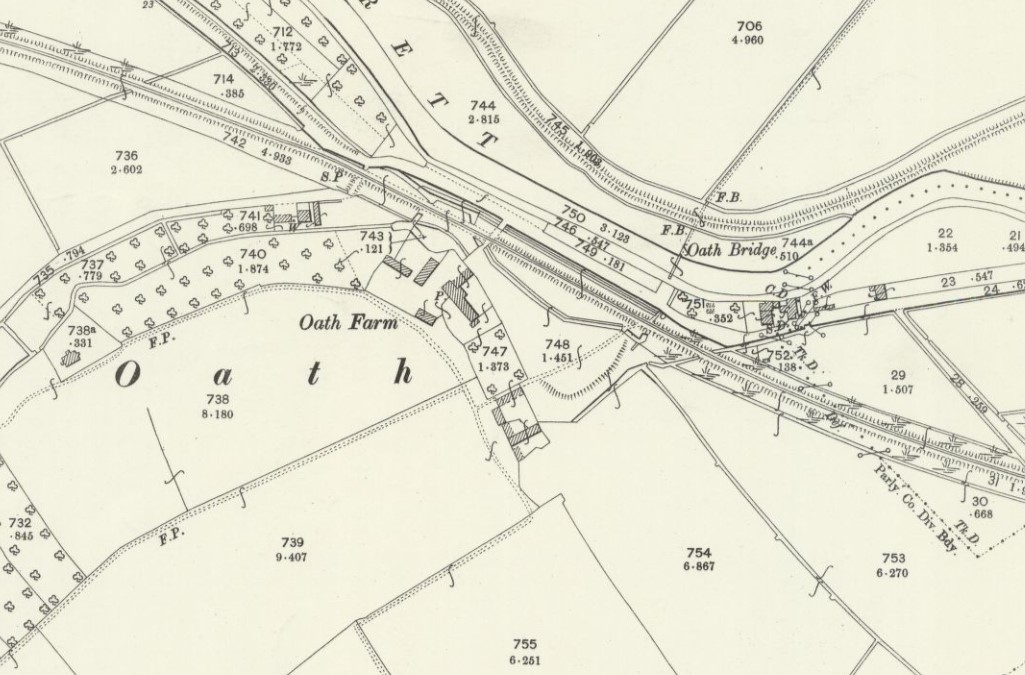
The next phase of Albert’s life was characterised by re-establishment. By December 1909, he and his family had moved to Oath Farm, Aller.[34] This farm was previously occupied by Frank Gent, Albert’s first cousin and Ellen’s uncle, who died in June 1907 at the age of 50.[35] Albert’s tenancy thus kept the farm within the extended family. In February 1910 and again in February 1913, Albert advertised for a labourer, stating that he sold milk at both times.[36]
Impact of World War I
The First World War brought personal loss. Albert’s oldest son, Frank, serving as a private with the 7th Battalion of the Somerset Light Infantry, was killed in action on 23 March 1918 and is commemorated on the Pozieres Memorial.[37] Albert received his son’s back pay of £13 15s 8d along with a war gratuity of £15 10s.[38] In 1921, Albert and Ellen donated a litany desk to Curry Rivel Church in Frank’s memory.[39]
In March 1917, Albert lodged an appeal for the exemption of his son, Thomas, from military service, but it was dismissed.[40] Though little is known about Thomas’s war service, he survived the war and by October 1926, was working in partnership with Albert.[41]
Portfield Farm, Langport
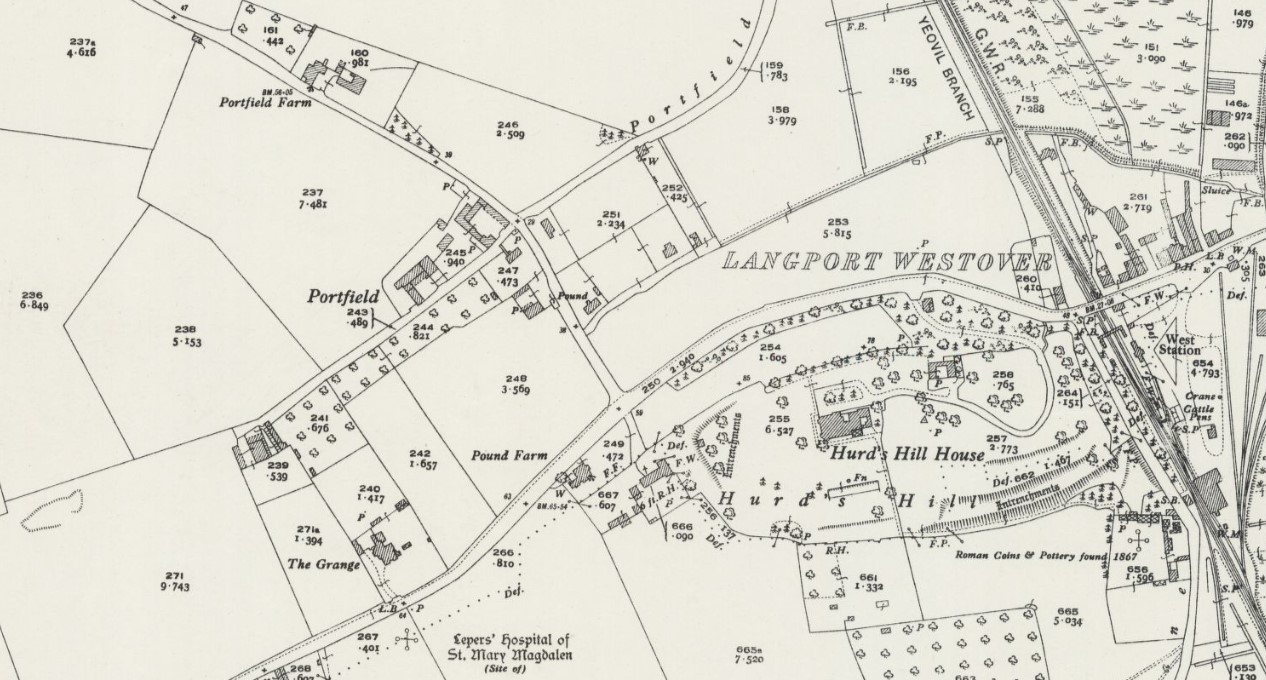
At this time, Albert’s farming life appears to have entered a more settled and collaborative phase. At Michaelmas 1915, he took over Portfield Farm, Langport, from Francis Griffin who was retiring from business.[42] In December 1915, a firm of auctioneers used his premises to hold a Christmas auction, as all markets were closed due to foot-and-mouth restrictions.[43]
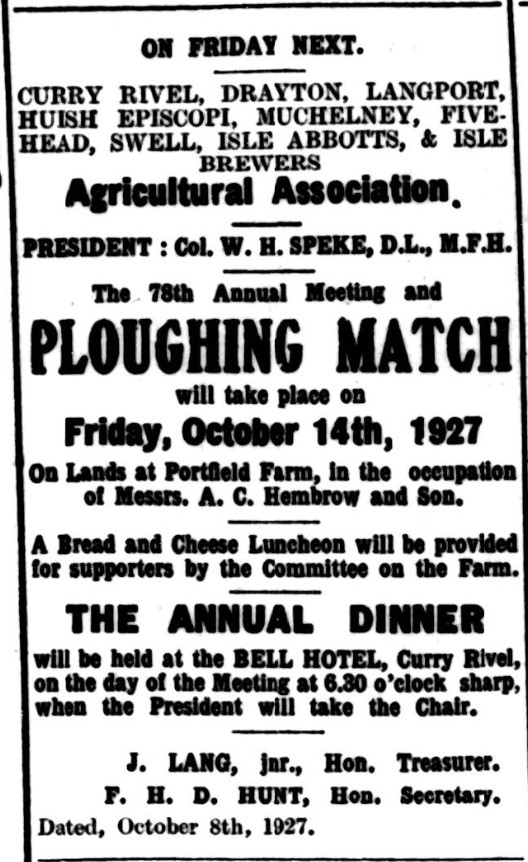
Throughout the 1920s and 1930s, Albert was an active member of the local farming community, participating in various organisations including the Langport branch of the National Farmers’ Union (established 1914), the Langport Christmas Fat Stock Society (revived 1898) and the West Sedgemoor Drainage Board.[44] In October 1927, he hosted a ploughing match at the farm.[45]
Final years
By September 1939, Albert had passed his farm to his son Thomas and retired to 6, The Avenue, Langport, next door to Kathleen and her husband. Ellen died on 20 March 1944 at the age of 77, and Albert died on 23 January 1946 at the age of 81. His estate was valued at £1,960 13s.
Their daughter, Edith, continued living at 6, The Avenue until her death in 1984.[46] Like many daughters of farming households, Edith remained part of the family’s domestic and farming economy. Educated at Dartmouth High School and recorded as a student in 1911, she never married and lived at home.[47] She was buried alongside her parents at Curry Rivel.[48]
Conclusion
Albert Hembrow’s life illustrates the career of a capable tenant farmer whose fortunes were shaped by both personal effort and family circumstances. After achieving prominence as the tenant of one of Hardington’s largest farms, his departure around 1905 marked the beginning of a period of uncertainty. Gradually, he rebuilt his life on the Somerset Levels, aided in part by family inheritance and local connections. In later years, he maintained a secure and respected position within the agricultural community, participating in its institutions and ultimately passing the farm to the next generation. His career reflects the resilience of established farming families in the late nineteenth and early twentieth centuries, where continuity of position, reputation, and kinship networks often mattered more than dramatic economic advancement.
Appendix
The probate values of the estates of Albert, his father and his four siblings. These are not reliable indicators of economic prosperity, as they fail to take account of capital transfers made before death.
Thomas (1908) £21,379
Thomas (1917) £15,775
Herbert Morris (1923) £9,234
Aramita Eliza (1932) £3,774
Isabella Mary (1935) £3,218
Albert Clement (1946) £1,960.
References
[1] Civil Registration Birth Index; Stoke St Gregory baptism register; RG9, Stoke St Gregory, ED13, piece 1615, folio 61, p.20; RG10, Stoke St Gregory, ED 14, piece 2369, folio 51, p.2, 1939 Register.
[2] Vearncombe/Drew Family Tree on Ancestry, accessed 28 February 2026.
[3] Family reconstitution.
[4] RG13, Stoke St Gregory, ED 11, piece 2275, folio 35, p.11.
[5] Express and Echo, 20 August 1878, p.3; Western Times, 2 September 1878, p.3; Western Times,18 March 1879, p.5; Western Times, 2 September 1879, p.7; North Devon Journal, 18 March 1880, p.8.
[6] RG11, Stoke St Gregory, ED14, piece 2365, folio 146, p.4; Langport & Somerton Herald, 18 June 1887, p.5; Langport & Somerton Herald, 9 June 1888, p.5; Kelly’s Directory of Somerset, 1889, p.343.
[7] RG12, Stoke St Gregory, ED 11, piece 1874, folio 113, p.10.
[8] Curry Rivel marriage register; family reconstitution.
[9] National probate calendar.
[10] Pulman’s Weekly News and Advertiser, 10 January 1893, p.1
[11] Western Gazette, 17 February 1893, p.5.
[12] Taunton Courier and Western Advertiser, 1 February 1893, p.1.
[13] Western Chronicle, 12 May 1893, p.6; Weymouth Telegram, 15 May 1894, p.7; Chard and Ilminster News, 7 April 1894, p. 5; Weymouth Telegram, 11 December 1894, p.2.
[14] Hardington Guardian Valuations, 1903.
[15] Western Gazette, 19 June 1896, p.6.
[16] Western Times, 21 February 1902, p.10; Western Gazette, 12 September 1902, p.1.
[17] Western Gazette, 18 March 1904, p.6.
[18] Bridport News 11 December 1896 p. 8 (the newspaper recorded Albert’s name as J. Hambro, Hardington); Weymouth Telegram 7 September 1897, p.7.
[19] Weymouth Telegram 7 September 1897, p.7; Western Gazette 8 September 1899, p. 6.
[20] Pulman’s Weekly News and Advertiser 4 May 1897, p 6.
[21] Pulman’s Weekly News and Advertiser, 15 March 1898, p. 6.
[22] Western Chronicle, 25 April 1902, p.7.
[23] Western Chronicle 30 May 1902 p. 5; Western Chronicle 15 August 1902 p.6.
[24] Pulman’s Weekly News and Advertiser, 20 April 1897, p.7; Langport & Somerton Herald, 9 April 1898, p.5.
[25] Pulman’s Weekly News and Advertiser, 19 April 1898, p.6.
[26] Pulman’s Weekly News and Advertiser, 22 March 1898, p.7;
[27] RG13, Hardington, ED 4, piece 2297, folio 41, p.2.
[28] Devon and Somerset News, 19 March 1903 p.4; Western Gazette, 5 July 1901, p. 4; Western Gazette, 30 Aug 1901 p. 4; Western Gazette, 2 May 1902, p. 6; Western Gazette, 9 May 1902, p. 6; Western Gazette, 26 June 1903, p.6; Western Gazette, 3 July 1903, p. 6.
[29] Taunton Courier and Western Advertiser, 16 Sept 1903, p. 6; Western Chronicle 16 September 1904, p. 6; Western Gazette, 30 Dec 1904, p. 6.
[30] Western Chronicle 19 August 1904, p. 6.
[31] Western Gazette, 12 May 1905, p.7.
[32] Central Somerset Gazette, 4 October 1907, p.4; Western Gazette, 25 September 1908, p.4.
[33] The will of Thomas Hembrow, dated 2 May 1906, proved in London on 21 November 1908.
[34] Langport & Somerton Herald, 11 December 1909, p.8.
[35] National probate calendar; Western Chronicle, 21 June 1907, p.8.
[36] Devon and Somerset News, 10 February 1910; p.4; Devon and Somerset News, 27 February 1913, p.4; Devon and Somerset News, 6 March 1913; p.4; Devon and Somerset News, 20 March 1913, p.4.
[37] Soldiers Died in the Great War, 1914-1919; Commonwealth War Graves, 1914-1921.
[38] Army Registers of Soldiers’ Effects, 1901-1929.
[39] Langport & Somerton Herald, 9 April 1921, p.5.
[40] Taunton Courier and Western Advertiser, 28 March 1917, p.3.
[41] Langport & Somerton Herald, 30 October 1926, p.8.
[42] Western Gazette, 10 September 1915, p.1.
[43] Western Gazette, 24 December 1915, p.9.
[44] Langport & Somerton Herald, 17 December 1921 p.3; Langport & Somerton Herald, 13 April 1929 p.8; Langport & Somerton Herald, 1 October 1932, p.5;
[45] Langport & Somerton Herald, 8 October 1927, p.4.
[46] Civil Registration Death Index; family grave at Curry Rivel.
[47] RG14, Dartmouth, ED6, piece 12816.
[48] Family grave at Curry Rivel.