Introduction
Albert George Chester spent his life in Hardington Mandeville, adapting to changing circumstances by working as a farm labourer, an under-gardener at the rectory, a smallholder, and later as a council roadman. His 47-year marriage produced one child, who, despite being severely deformed, played a significant role in bringing the enjoyment of coach outings to many local people.
Childhood
Albert was born on 26 September 1878 at Hardington Mandeville, probably in one of the railway cottages at Hardington Marsh.[1] His father, George, worked as a railway labourer. His mother, Frances, came from Luppitt in Devon, where she was born out of wedlock and raised by her mother and stepfather. By 1891, Albert’s brother, John, who worked as a farm labourer, also lived with the family.
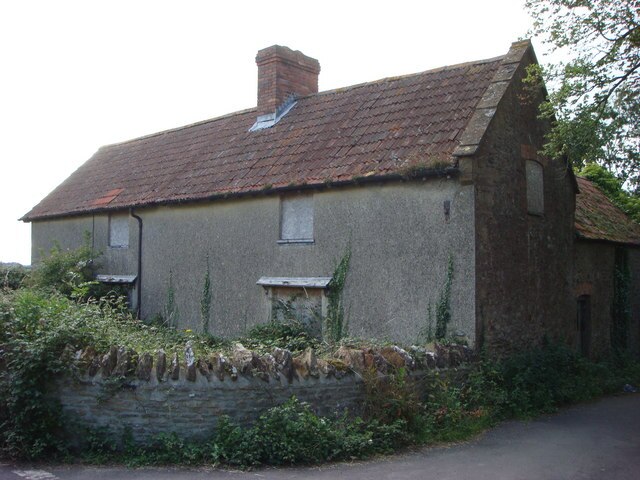
George’s father, Benjamin Chester, was a small-scale farmer who lived in Barry House. After Benjamin died in 1896, George moved into his former home. He gave up his job with the railway, and he and John became self-employed general labourers. Frances worked as a self-employed dressmaker, and Albert was employed as a farm labourer.
Under-gardener at the rectory
By early 1913, Albert was working as an under-gardener at Hardington Rectory, serving under the head gardener, George Hamlin. That year, the two men helped decorate the church for Easter, Harvest Thanksgiving, and Christmas.[2]
Albert’s work as an under-gardener brought him into regular contact with the Rev. Cleife and his family. It also helped him establish a close relationship with his first cousin, Alice Mabel Hawker, who was the cook at the rectory and a fellow member of the church choir. Born on 19 March 1885 at Little Windsor, where her father worked as a farm labourer, Alice had previously worked as a domestic servant at Venn’s Farm, Chard, before moving to Hardington.
On 10 September 1913, Albert and Alice married at Hardington parish church by the Rev. Charles Ralph Milligan.[3] Albert was 34, while Alice was 28. The following December, the choir gathered at the rectory to present them with a leather easy chair as a wedding gift. The rector’s wife wished the couple every happiness and a long life in which to enjoy the gift.[4]
Albert continued working at the rectory throughout 1914. His position as one of the three male servants led to his involvement in two important funerals that year. He acted as a bearer for the curate, the Rev. Charles Godfrey MacCarthy, who died in January 1914 and for the Rev. Cleife, who died in December 1914.[5]
The guardian valuation of 1915 recorded Albert as the occupier of a cottage in Rectory Lane.
Smallholder
After Cleife’s death, Albert appears to have worked with his father, who was a small-scale farmer.
In 1914 or early in 1915, Albert’s mother suffered a stroke or major brain injury that led to a long illness.[6] She died on 7 February 1915 at the age of 61. Albert, who was with her when she died, registered her death.[7]
George was deeply affected by his wife’s death, falling into “a low and depressed state” that prevented him from working. On 19 November 1915, Albert discovered his father in a hay loft on his hands and knees, with blood running down his whiskers. George had cut his own throat, which, although not immediately fatal, led to exhaustion and septic absorption from which he died five days later.[8]
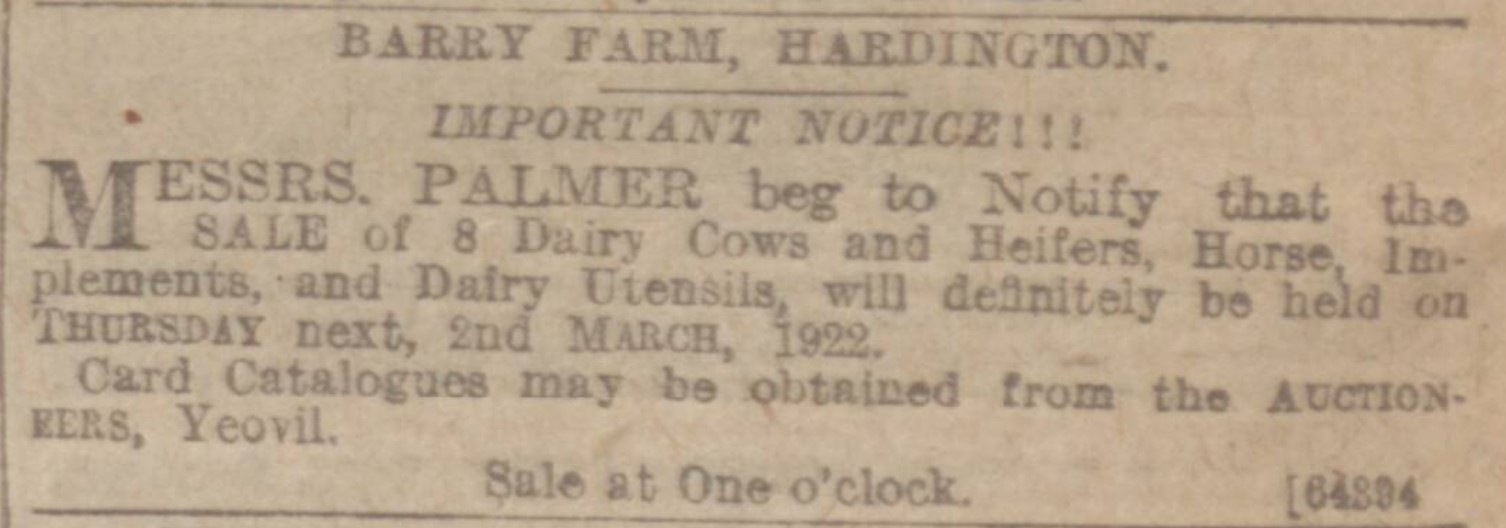
His father died intestate, leaving an estate valued at £205 13s 4d, which Albert administered and probably inherited. The 1920 estate sale catalogue recorded Albert as the occupier of 44 acres 2 roods 22 perches, including Barry House. The 1921 census listed him as a smallholder. However, he succumbed to the postwar economic slump. On 2 March 1922, he held a farm sale that included eight dairy cows and heifers, a horse, farm implements, and dairy utensils.[9]
Hill End
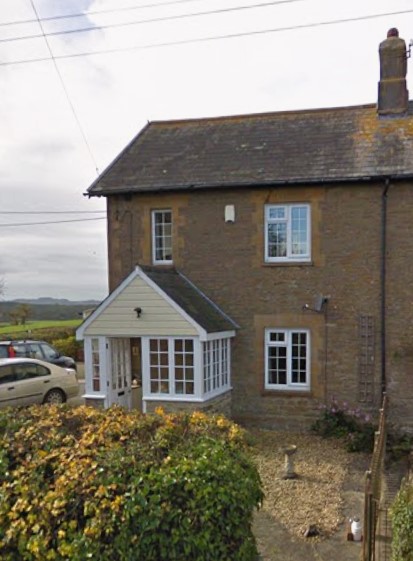
After the sale, Albert and Alice moved to Hill End. On 25 January 1927, Alice gave birth to their only son, Leonard Alan, at the age of 41. Her age and the fact that she was married to her first cousin may have contributed to the risk of birth defects, resulting in Leonard being born with a humped back. Nonetheless, he grew up to be pleasant and sociable.
By 1939, Albert was working as a roadman for the Rural District Council.[10]
Albert died at Town View Hospital, Wincanton, on 3 January 1961, at the age of 82, leaving an estate valued at £535.
Leonard’s later life
Leonard continued living with his mother at Hill End. Although the author of this article cannot remember what he did for a living, he can recall him travelling around on a black bicycle and wearing bicycle clips to keep his trousers in. During the 1950s and 1960s, he organised coach trips once or twice a year to places such as Windsor Castle, Runnymede, Symonds Yat, Bourton-on-the-Water, and Bucklers’ Hard. Wakes of Sparkford provided the coaches, which were driven by Stan Paine of Babcary. Stan would pick up passengers from West Coker, Hardington, and Haselbury before embarking on a day-long journey, with stops at a café in the morning and a pub on the way home. The home trip usually includes an impromptu sing-along.
Leonard’s medical condition contributed to his early death. He died intestate on 19 January 1971 at the age of 43. Alice survived him by six years, living alone and being fiercely independent. In her later years, she had a hostile manner and a sharp tongue. She died at Summerlands Hospital, Yeovil, on 1 May 1977 at the age of 92.
Conclusion
Although Albert’s life contained tragedy and setbacks, it was sustained by resilience and continuity. He remained closely tied to Hardington throughout his life, adapting his work as circumstances required. His happiest time may have been as an under-gardener at the rectory in the years before the First World War, when he helped decorate the church, sang in the choir, and met his future wife.
References
[1] Civil registration birth index; 1939 Register.
[2] Western Chronicle 28 March 1913 p. 6; Western Chronicle 26 September 1913 p. 5; Western Chronicle 2 January 1914 p. 6.
[3] Western Gazette, 9 September 1938, p.16 (Silver wedding).
[4] Western Chronicle 12 December 1913 p. 7.
[5] Western Chronicle 6 February 1914 p. 6; Western Chronicle 18 December 1914 p. 3.
[6] Western Chronicle, 3 December 1915, p.6. This report states that Frances was ill for a long time before her death.
[7] Death certificate of Frances Chester. The certificate, which recorded her age as 60, gave the cause of death as (1) cerebral softening and (2) coma.
[8] Western Chronicle, 3 December 1915, p.6.
[9] Western Gazette, 24 February 1922, p.1.
[10] 1939 Register.