Introduction
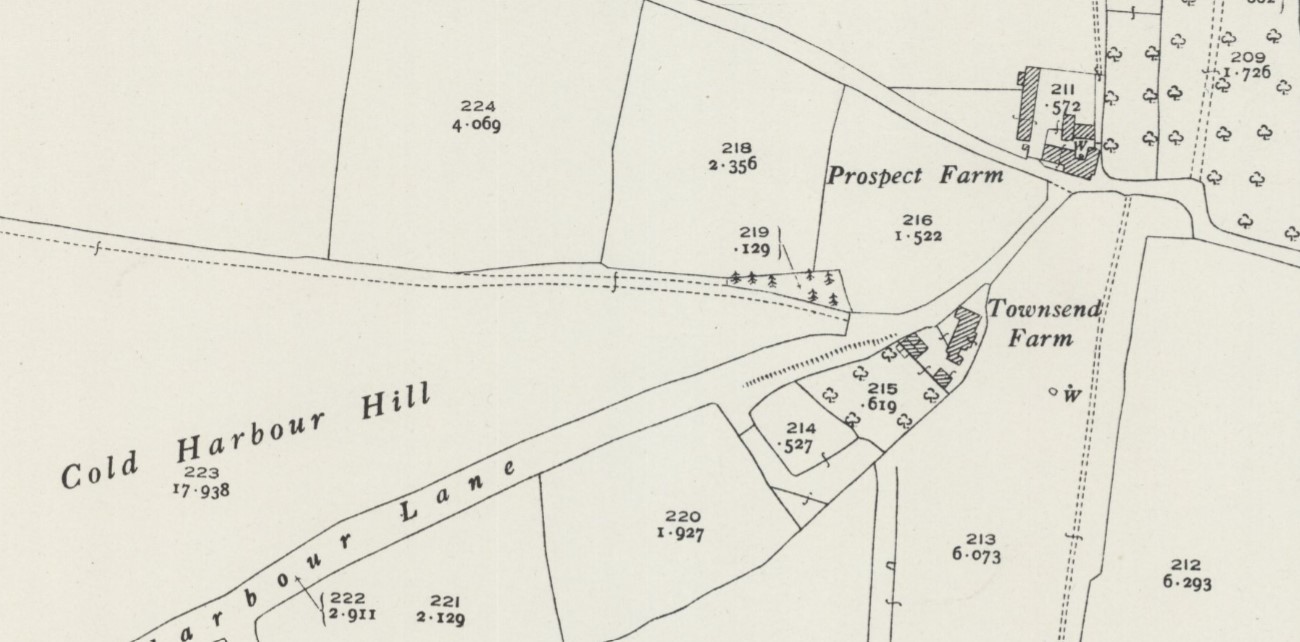
Alexander Chetwynd Hayes lived at Prospect Farm, Hardington, from about 1939 to 1943. This study examines his origins in Essex and outlines how he came to move to South Somerset to take up farming.
Childhood
Alex was born on 15 May 1907 in Walthamstow, the first of five children born to Henry Chetwynd Hayes and his wife, Florence. “Chetwynd” was a family name derived, with a slight variation, from his great-grandfather, William Chetwin Hayes, who came from Sedgley in Staffordshire.
Henry and Florence were both born in Walthamstow in 1887. Henry’s father had his own business making walking sticks and later umbrellas. Florence’s father, who died just six months before Alex was born, was a self-employed boot maker in his final years.
In 1911, Henry and Florence, along with their first two children, Alex and Eileen, occupied three rooms at 91 Livingstone Road, with a house decorator and his wife living in the other three rooms.
Henry worked as an actor under the name “H. Chetwynd Hayes.” A short piece published in November 1916 mentioned that he had five years of acting experience and served as the stage and acting manager at the Grand Theatre, Forest Gate.[1] The only performance found was on 22 April 1909, when he played the doctor in a production of “The Passing of Paul Dombey” at the Borough Theatre, Stratford.[2]
Henry’s acting career transitioned into cinematography and management during the early days of cinema. He held positions on the Silverman and Vance Circuit and at Highams Park Electric Theatre in 1912, at the Twickenham Picture Palace in October 1913, the Picture Palladium in Deptford by November 1916, and the Broadway Picture Palladium in Deptford by April 1917.[3] Through his father’s career, Alex may have seen cinema films from a young age.
Henry’s family moved to meet the demands of his career. When his daughter, Kathleen Daisy, was born in December 1915, they lived at 123 Brookmill Road, Deptford.
War and family disintegration
This exciting life in the entertainment industry came to an abrupt halt in April 1917 when Henry was called up for military service.[4] He served with the Labour Corps until June 1920, spending 286 days in France.[5] Alex was nine when his father was called up and thirteen when he was discharged.
The family life Alex had previously known would never return, as Henry and Florence separated. Henry moved in with his parents and only sister at 45 St Mary’s Road, while Florence and the children lived at 7 Sedgwick Road, Leyton. There, Florence worked as a self-employed dressmaker. For reasons that remain unclear, their daughter, Kathleen Daisy, was adopted by a carpenter and his wife who lived in Isleworth.
During the early 1920s, Henry and Florence divorced. In the third quarter of 1928, Florence married Alfred John Course, a brewery labourer. He had served with the Royal Field Artillery during the First World War and been discharged due to exhaustion and psychosis.[6] In the fourth quarter of 1928, Henry married Winifred Clara Klein, a former Post Office telephonist, and they settled in Hackney.[7] Henry became a civil servant in the Ministry of Health and died in 1955.
Early married life
While living in Leyton, Alex began courting Elsie Louisa Cook, the daughter of Alfred Leonard Cook, a carriage inspector who worked for the Great Eastern Railway. When Alfred and his wife retired to Wood Close, Normandy, in Surrey in 1928, Elsie went with them.[8] This move set the pattern for Alex’s life for most of the 1930s.
On 27 December 1930, Alex and Elsie Louisa Cook married at St Mark’s Church, Wyke, Surrey. At the time. Alex was a secretary living at 70 Fairlop Road, Leytonstone. He was 23, and Elsie was 21.
They initially settled in Guildford, living in a house named Glenmornan in Manor Road. Their son, Michael Paul Chetwynd, was born at Guildford in 1931. By 1937, they had moved to Shalford, a parish located two miles south of Guildford, where they lived at Wyke Cottage, Stonebridge.
Hardington
In the late 1930s, Alex and Elsie moved to Somerset. His next venture may have been a radical departure from his previous life, as he became a pig farmer at Prospect Farm, Hardington. He and Elsie are recorded there on the 1939 Register, and in February 1940, he advertised three ricks of hay for sale by auction on 1 March.[9]
The 1939 Register also recorded Alex’s mother, Florence, and sister, Winifred, living at 167 Glenthorne Avenue, Yeovil. Since Florence’s second husband was living in Leyton with her son Brian, this was probably a temporary measure to keep them safe from enemy action. In 1940, Winifred married and moved away, while Florence probably returned to Essex. She died in the Southend-on-Sea district in 1974.
In May 1942, Alex ceased pig production and changed to dairy farming. He sold his entire herd of Wessex pigs in a pedigree pig sale at Yeovil and included some pig huts and fencing in a sale at Landground Farm.[10] He entered the Ministry of Agriculture’s Victory Churn contest for 1942-43 and was awarded a certificate of merit for increasing his milk production by 20 per cent or more.[11]
Despite this success, Alex left the farm in 1943. According to an auctioneer’s report in the Western Gazette in October 1943, the farm was sold with vacant possession at Michaelmas 1943. It is not clear if Alex owned the land and buildings or if someone else did. After this sale, Alex instructed R B Taylor & Sons to sell his livestock, including 27 cattle, and various implements, including a Fordson tractor, which sold for £57 10s. [12]
Later married life
In the late 1940s and early 1950s, Alex and Elsie lived in St Andrew’s Road, Great Malvern, and later Bath Road, Worcester.
Alex died intestate in 1988 at the age of 81, leaving an estate valued at £58,015. His last address was 4 Lakes Court, Old Fore Street, Sidmouth. Elsie died in Warwickshire in 1990 at the age of 81.
Conclusion
Unfortunately, much of Alex’s life after his marriage remains a mystery, making it difficult to fully understand his time at Prospect Farm. Key questions—such as when and why he moved there, how he financed the venture, and why he eventually left—remain unanswered.
References
[1] Kinematograph Weekly, 16 November 1916, p.19.
[2] The Era, 1 May 1909, p.14.
[3] Kinematograph Weekly, 4 July 1912, p.21;16 October 1913, p. 61;16 November 1916, p.19; 5 July 1917, p.76.
[4] Kinematograph Weekly, 5 July 1917, p.76.
[5] British Army World War I Service Records, 1914-1920.
[6] British Army World War I Service Records, 1914-1920.
[7] Royal Mail Pension and Gratuity Records, 1834-1970; 1936 Hackney voters’ list; 1939 Register.
[8] Aldershot News, 6 March 1953, p.9, Wyke marriage register.
[9] Western Gazette, 23 February 1940, p.1.
[10] North Devon Journal, 21 May 1942, p. 5; Western Gazette, 15 May 1942, p.1.
[11] Western Daily Press, 2 September 1943, p. 2.
[12] Western Gazette, 8 October 1943, p. 7.