Introduction
Arthur Baker was one of many young men from Hardington Mandeville who left Somerset in search of better-paid work in the South Wales coalfield. A pre-war Special Reservist, he was among the first British soldiers sent to France in August 1914. After the war, he returned to his native district and spent the rest of his working life in the building trade.
Early life
Arthur Baker was born at Hardington Mandeville on 19 January 1892, the second of six children of Thomas Baker and his wife Charlotte (née Marsh).[1] His father worked as a farm labourer. During Arthur’s childhood, the family moved between several homes in the village, living at Cowcroft Farm in 1891, at Hill End by 1896, and near the New Inn by 1911.
Military career
This section about his military career is based partly on circumstantial evidence. On 27 January 1910, at age eighteen, Arthur enlisted in the 3rd (Special Reserve) Battalion, Dorsetshire Regiment and was given the Special Reserve service number 6644. He underwent six months of initial full-time training at the regiment’s home depot.
After training, he returned to civilian life and moved to the Rhondda Valley to work in the South Wales coal industry. In April 1911, he was employed as an underground labourer at a colliery in Porth and lodged with his uncle, William Marsh, at 48 Nyth Bran Terrace.[2] For the next few years, his only military obligation was to attend a three-and-a-half-week training camp each summer.
Following the outbreak of war, Arthur was mobilised and recalled to the depot. He was drafted straight into the 1st Battalion and landed at Le Havre, France, on 16 August 1914—just 12 days after war broke out.[3] In January 1915, he was included in Hardington’s Roll of Honour.[4]
On 27 January 1916, his six-year Special Reserve contract officially ended, and he was discharged.[5] It is unclear whether he returned immediately to coal mining, although his pre-war occupation would have made him valuable in an industry of considerable wartime importance. According to a pension index card, he may have lived in Blackwood for a time.[6] After the war, he received the Victory Medal, the British War Medal, and the 1914 Star with clasp and roses, the latter reflecting his early service in France.[7]
The First World War affected Arthur’s family directly when his brother, Henry George Baker, serving with the Dorset Regiment, was killed in action on 4 August 1915.
By 1921, Arthur had returned to Hardington and was living with his parents near the New Inn. He had exchanged coal mining for construction work and was employed as a bricklayer’s labourer on the Yeovil Corporation Housing Scheme at Kingston, Yeovil.
Marriage and family
In 1922, Arthur married Emily Axe of East Chinnock, a glover who was six years his senior. Their daughter, Nora, was born the following year. The family settled at College, East Chinnock, and Arthur remained in the building trade, progressing from labouring work to employment as a bricklayer. By 1939, he was recorded in that occupation.
Death
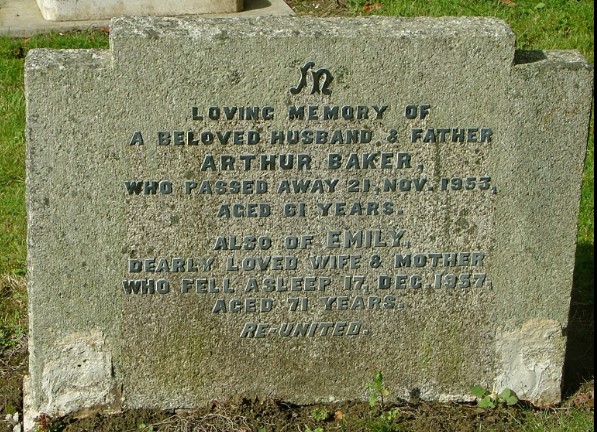
Arthur died intestate on 21 November 1953 at the age of sixty-one, leaving an estate valued at £222 9s. 3d.[8] Emily survived him by four years and died in Yeovil Hospital on 17 December 1957. Their daughter Nora administered her mother’s estate, which was valued at £639 12s. 1d.[9]
Conclusion
Arthur’s life was characterised by movement between occupations and places. He left rural Somerset for the South Wales coalfield, served in France early in the First World War, and eventually returned to his home district. There, he left mining behind, established himself in the building trade and spent the remainder of his life at East Chinnock.
References
[1] Civil registration birth index; 1939 Register; family reconstitution.
[2] RG14, Llanwonno, ED10, schedule 53, piece 32256.
[3] British Army World War I Medal Rolls Index Cards, 1914-1920.
[4] Western Chronicle, 5 February 1915, p.6.
[5] World War I Service Medal and Award Rolls, 1914-1920.
[6] World War I Pension Ledgers and Index Cards, 1914-1923.
[7] British Army World War I Medal Rolls Index Cards, 1914-1920.
[8] National Probate Calendar.
[9] National Probate Calendar.