Introduction
Arthur Simeon Rendell was one of several men who lived at Hardington during the early twentieth century while working for building firms in Yeovil. He combined a long residence in the village with daily travel to Yeovil, and later made an unsuccessful attempt to establish himself there as a builder.
Childhood and family background
Arthur was born on 12 December 1881, the eldest of two children born to Simeon and Charlotte Rendell. Charlotte had five more children from her previous marriage to William Partridge. Simeon was a labourer and an army pensioner.
In April 1881, the family lived at Hardington Moor, along with Simeon’s father, Thomas.[1] Thomas died in late 1889 or early 1890 at the age of 93. By April 1891, Simeon was a labourer residing in a house in Pools Lane, owned by Arthur Reynolds. By March 1901, the family had returned to Hardington Moor, where they lived in a four-room house in Moor Lane. By then, Arthur’s only full sister, Susan, had left home to work in Hampshire. She married a railway employee in 1909 and settled in Eastleigh.
The only children still living at home were Arthur and his half-brother George William Partridge. George was employed as a stone mason and Arthur as a mason’s labourer, so they may have worked together. George served with the Royal Engineers and the Royal Flying Corps during the First World War, and in 1930, he became the landlord of the Queen’s Arms, Corton Denham.[2] His sons, Norman and Clement, established a building firm in Yeovil in the 1930s.
Marriage and life at Hardington
In late 1905 or early 1906, Arthur married Alice Mary Meech in the Yeovil registration district. Born at Broadwindsor in 1881, Alice was the daughter of a shepherd. After her mother’s death in 1900, she lived with her married sister at Melcombe Regis for a time.
Arthur and Alice settled at Hill End, Hardington, where they had two children: Olive Florence Margaret, born in 1906, and Cecil Leslie, born in 1909.[3] The 1911 census recorded the family living in a five-room house with Alice’s widowed father. Arthur recorded his occupation as a bricklayer. The 1921 census listed him as a mason employed by J W & H Childs of Kingston, Yeovil.
Arthur probably travelled to and from Yeovil by bicycle. In January 1919, a gardener from Hardington named Arthur Rendell was fined five shillings for having ridden his bicycle on the pavement on Hendford Hill the previous month. He said he did so to get home quicker.[4]
The Estate Sale catalogue of 1920 listed “A. Rendell” as occupying a garden of one rood at Hill End on a monthly tenancy, part of Ordnance Survey plot 178 near Partway House. The parish rate book for 31 December 1923 recorded him as the owner-occupier of 3 acres 2 roods 5 perches at Hill End, suggesting a degree of modest advancement. His two children attended Hardington School.
Move to Yeovil and later life
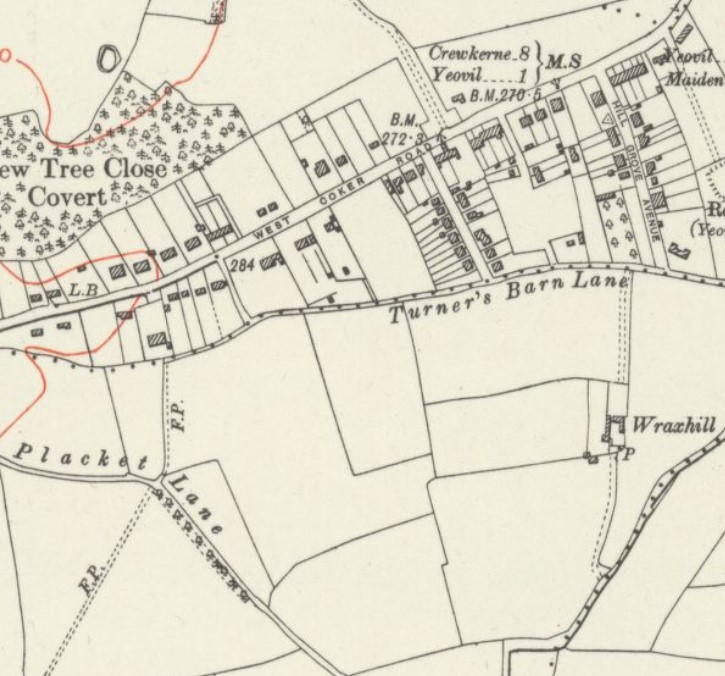
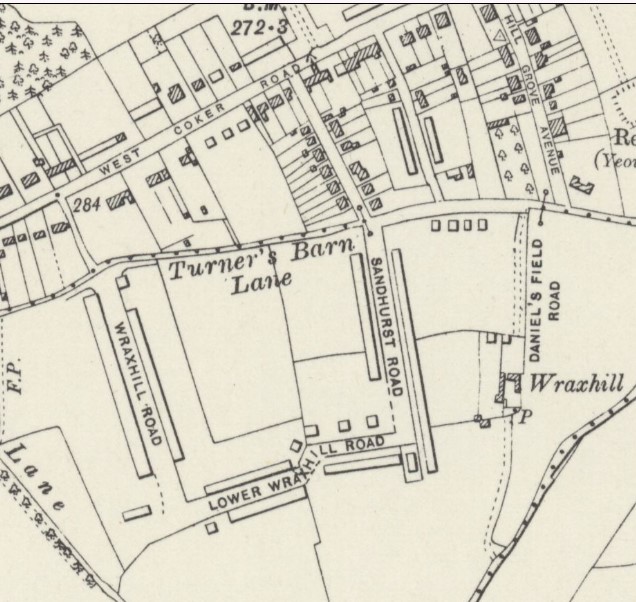
By May 1936, the family was living at 21 Wraxhill Road, Yeovil, near Norman Partridge, who lived at number 15.[5] That month, Arthur advertised a six-room house for sale in Lower Wraxhill Road. The house had a bathroom, a separate toilet, electric light and gas, modern drainage and a garden.[6] The house appears to have been a speculative building project that he undertook. However, he overstretched himself financially, and in June 1937, he was declared bankrupt.
More misfortunes followed. On 26 September 1937, Alice passed away intestate at the age of 55, leaving an estate valued at £175 10s 3d. In June 1938, Olive and her husband, Thomas Baulch, suffered fatal injuries when their motorcycle collided with another motorcycle at Podymore crossroads. Arthur provided evidence of identification at the inquest. At that time, his address was The Bungalow, Lower Wraxhill Road.[7]
After Olive’s death, Arthur moved in with his son at 11 Station Road, Ilminster. By 1939, he had reverted to his old occupation as a bricklayer following the failure of his building business. He died in the Chard registration district in 1964 at the age of 82.
Conclusion
Arthur’s life illustrates the growing importance of Yeovil as a source of work for the inhabitants of Hardington. For over two decades, he remained in Hardington while working in Yeovil, his daily commute made possible by the bicycle and improving roads, and sustained by family ties, property, and long familiarity with the village. He later moved to Yeovil and attempted to establish himself as a builder, possibly following the example of his nephews, but the venture proved financially unsustainable, leading him to return to bricklaying.
References
[1] Thomas’s wife, Susanna, died on 22 February 1873 at the age of 68.
[2] Western Gazette, 2 August 1946, p.2; 13 September 1935, p.5.
[3] Western Gazette, 7 January 1910, p.12.
[4] Western Chronicle, 10 January 1919, p.3. The Arthur Rendell who was fined may have been born in 1904.
[5] Kelly’s Directory of Somerset, 1935, p. 526.
[6] Western Gazette, 22 May 1936, p.8.
[7] Taunton Courier and Western Advertiser, 25 June 1938, p.6.