Introduction
On 6 June 1919, Bertie Walter Dyke of the Church Institute, Bovington Camp, advertised a gent’s evening dress for sale at £4 or in exchange for a lady’s cycle.[1] He advertised it again on 30 January 1920, describing it as “nearly new” and giving no price.[2] While these adverts appear prosaic and ordinary, they were part of an unfolding tragedy. Bertie was seriously ill, unable to work reliably, and doing what he could to manage his affairs and, possibly, to make life a little easier for his wife.
Childhood
Bertie was born in 1883 at Upton Noble near Bruton.[3] His father, William, was a farmer, and his mother, Jane, was the daughter of George Hare, a London grocer and clerk. William and Jane married on 6 March 1876 at St George’s, Hanover Square. As William was living at Milborne Port at the time, the circumstances of their meeting remain unclear.
After the marriage, Jane’s parents settled at Upton Noble, where they lived in Church Street. Bertie would have known them well, as his grandfather passed away in 1893 and his grandmother in 1915.[4] Their tales of London life would have contrasted strikingly with Bertie’s experiences in the Somerset countryside.
William Dyke, Bertie’s father, grew up on a 200-acre farm at Wincanton but struggled to replicate his father’s success. After a brief period at North Brewham, he farmed 34 acres at Upton Noble from 1878 to 1890, followed by 91 acres at Neighbourne Farm, Ashwick, until 1892. Financial difficulties then forced him into employment as a farm bailiff at Bishops Cannings near Devizes.[5]
Death of mother
While the family was living at Bishops Cannings, Bertie’s mother died on 6 August 1900 at the age of 47.[6] Her death broke up the family. The two youngest daughters, Beatrice and Rosabel, moved in with their widowed grandmother, Sarah Hare, at Upton Noble. Bertie, the youngest son, probably began working in a shop, although he was not found on the 1901 census.
Shop assistant at Leytonstone
By April 1911, Bertie was one of eighteen draper’s shop assistants lodging at 8 New Fillebrook Road, Leytonstone, Essex. Nothing further is recorded of his early employment, but the First World War shaped his next definite steps.
First World War
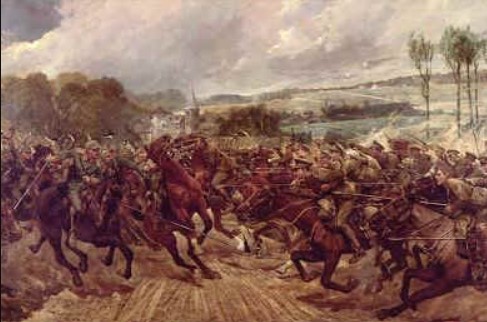
Bertie served for part of the war with the Lancers but later left the regiment, presumably due to wounds or health concerns.
After leaving the lancers, he found work with the Church of England institutes that served military camps in Dorset. These institutes provided reading rooms, canteens, and welfare facilities for troops in places such as Bovington, Wyke Regis, Bincombe, and Upton near Osmington.[7]
Marriage
On 9 July 1917, Bertie married Lucy Burt at Wyke Regis parish church. Bertie was 34, and Lucy was 30. At the time, Bertie was the institute manager at Wyke Regis Camp, while Lucy resided in the St John’s parish of Weymouth. The witnesses were John Charles Sykes and Ann Maria Sykes, identified in the 1921 census as a soldier and his wife.[8]
Lucy had been born on 28 June 1887 at Puncknowle, the daughter of Thomas Burt, a farm labourer from Pendomer.[9] By 1911, she was employed as a cook at St Mary’s Vicarage, Dorchester, and likely continued in similar domestic service in Weymouth.
By 16 November 1918, Bertie was at the Church Institute in Bovington, when he made his will.[10] He was still there when he placed the second advertisement for the evening dress on 30 January 1920.[11]
Hardington
By June 1921, Bertie and Lucy were living in Barry Lane, Hardington, without recorded occupations. They probably resided at St Bernard’s Cottage, owned by Ellen Fudge. As neither Bertie nor Lucy had personal ties to Hardington, it is possible that Lucy’s father recommended it as a good place for them to spend their final time together.
Death
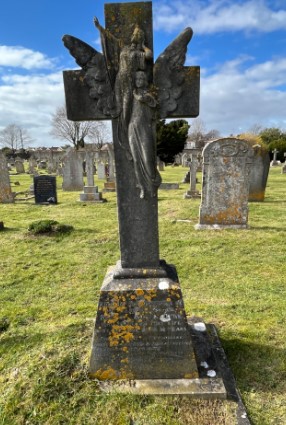
Bertie’s time at the cottage was brief; he died there on June 21, 1921, at the age of 37, with his beloved Lucy by his side. According to the death certificate, the cause of death, as certified by Dr Frank Collar of West Coker, was pulmonary tuberculosis. In his will, he bequeathed his entire estate, valued at £368-7s-9d, to Lucy.[12]
Lucy’s later life
Lucy may have remained at Hardington until 1924, when Ellen Fudge advertised the cottage as available to let.[13]
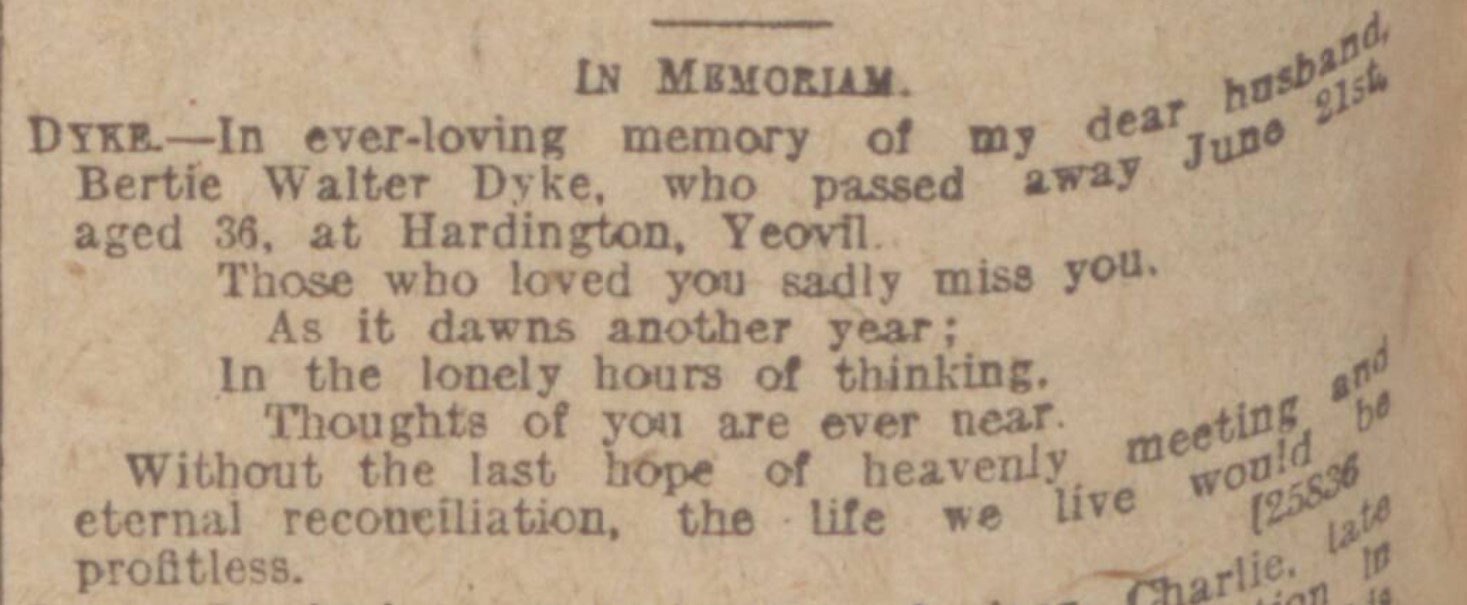
One year after Bertie’s death, Lucy placed an “In Memoriam” notice in the Western Gazette, quoting four lines of verse to express her deep longing for him and adding that life would be “profitless” without the hope of reuniting in Heaven.[14]
However, as time passed, her grief lessened. She moved to Dorset, where she met Reginald Alfred Samways, whom she married in 1925. Reginald had been a farm labourer in his youth, but after the war, he found employment as a dustman with Dorchester Corporation. Their marriage lasted forty-three years until Lucy passed away in 1968 at the age of 81. Reginald died six years later.
References
[1] Western Gazette, 6 June 1919, p.7.
[2] Western Gazette, 30 January 1920, p.7.
[3] Civil registration birth index: birth registered Shepton Mallet Q3 1883, mother’s maiden name Hare.
[4] Sarah Hare left an estate of four leasehold houses, money, furniture and personal effects valued at £470, which she bequeathed to Bertie’s sister, Beatrice, for life. Upon Beatrice’s death, the four houses were to be sold, and the proceeds divided equally among Bertie and his siblings: George Frederick Hare Dyke, Edith Marion Dyke, Florence Dyke, and Rosabell Dyke. Beatrice was still alive in June 1921, so Bertie never inherited his share, but Lucy should have inherited it, assuming she outlived Beatrice (the will of Sarah Hare, dated 25 March 1907, proved at Wells on 24 March 1915).
[5] 1891 census.
[6] Civil registration death index; national probate register (her admon was not granted until 1919).
[7] Southern Times and Dorset County Herald, 3 July 1915, p.8.
[8] Wyke Regis marriage register. The marriage register incorrectly recorded Lucy’s age as 29.
[9] Wyke Regis marriage register; civil registration birth index; 1939 Register.
[10] The will of Bertie Walter Dyke, dated 16 November 1916, proved at Taunton on 29 July 1921.
[11] Western Gazette, 30 January 1920, p.7.
[12] The will of Bertie Walter Dyke, dated 16 November 1916, proved at Taunton on 29 July 1921.
[13] Western Gazette, 21 November 1924, p.6.
[14] Western Gazette, 23 June 1922, p.12.