Introduction
Cyril Henry Rendell spent most of his working life delivering bread to customers around Yeovil, a routine occupation that required long hours and daily travel from his home at Hardington Mandeville and later West Coker. His life was cut short during the Second World War when he became one of Yeovil’s civilian casualties, killed while carrying out his bread round during a German air raid.
Early life
Cyril was born on 4 January 1904 at Hardington Mandeville, the seventh of eleven children born to James Rendell and his wife, Louisa (née Newberry).[1] The family lived at Hardington Moor, where James worked as a newsagent before becoming a smallholder.
On 1 June 1908, he was admitted to the village school.[2] At the age of thirteen, he suffered the loss of his brother George William, who was killed in action in Flanders in November 1917.[3]
A significant change occurred in October 1920 when James Rendell purchased several lots in the Hardington estate sale.[4] The family moved to North Lane, where he established himself as a smallholder while continuing to support his large household. Although he died on 6 February 1922, at the age of fifty-five, from valvular disease, his family continued to live in the same place.[5]
By June 1921, at the age of seventeen, Cyril was employed by H. R. Pulman, a baker in Hendford, Yeovil. Like many rural workers of that period, he appears to have travelled to work by bicycle. On the evening of 18 January 1921, he and Ernest Sandiford were prosecuted for riding through West Coker without lights, a minor offence that reflected the practical realities of travelling country roads at night.[6]
Baking and bread delivery involved exceptionally long days. By the mid-1930s, Cyril had become a roundsman, delivering bread directly to customers in the Yeovil area. The demands of the job are illustrated by an incident in January 1935 when he did not finish his round until about 8.45 p.m. Returning to his employer’s premises, he discovered a man who had suffered fatal injuries after falling from a loft or ladder, and he later testified at the inquest.[7]
Marriage and family
In 1930, Cyril married Ellen Annie Gear of West Coker. Ellen was born on 22 October 1904 at Parkstone, where her father worked as a gardener. Although both her parents survived throughout her childhood, census records suggest that she spent much of her early life in the household of her maternal grandmother, Grace Dodge, and Grace’s husband, Walter Frederick Dodge. By the age of sixteen, she was employed as a twine bailer at the twine factory in West Coker.
Cyril and Ellen had three children: George Henry, born 1934, Geoffrey, born 1937 and a third, whose identity has not yet been established.
By September 1939, the family were living at 6 Uplands Terrace, along with Walter Frederick Dodge, following the death of Grace Dodge the previous year.
Death
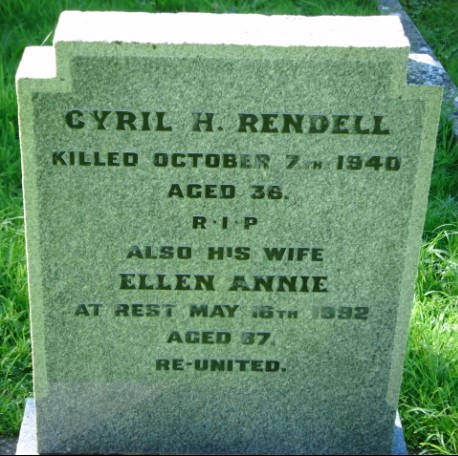
The Second World War brought tragedy to the family. On the afternoon of 7 October, German aircraft attacked Yeovil, dropping over thirty high-explosive bombs and eighteen incendiary bombs, killing sixteen people and injuring another twenty-nine. One stick of bombs fell in the area south of Preston Road, where Cyril was making his delivering.[8] His body was later found in Summerleaze Park.[9] He was only thirty-six years old, leaving Ellen a widow with three young children.
Ellen’s later life
For many years after Cyril’s death, Ellen marked the anniversary of his death by placing an In Memoriam notice in the local newspaper.[10] Around 1951, however, she remarried. Her second husband was Alfred Ernest Card, a widower ten years her senior, who had previously lived in Salisbury and Cardiff before becoming a machinist at Westland Aircraft in Yeovil. Alfred died in October 1959 at the age of 65, leaving an estate valued at £481 1s.[11] Ellen survived him by 33 years, dying on 16 May 1992 at the age of 87.[12] She was buried alongside Cyril at West Coker.
Conclusion
Cyril Rendell’s life was typical of many working men from Hardington Mandeville who found employment in nearby Yeovil rather than working on the land. His routine of early starts, long hours, and daily deliveries was abruptly ended by the random destructiveness of aerial warfare.
References
[1] Hardington School admissions register; 1939 Register.
[2] Hardington School admissions register.
[3] ADM 159/146/1993.
[4] Copy of estate sale catalogue in the author’s possession.
[5] The death certificate of James Rendell.
[6] Western Chronicle, 4 March 1921, p.11.
[7] Langport & Somerton Herald, 2 February 1935, p.3.
[8] https://www.yeovilhistory.info/bombing.htm
[9] Death certificate of Cyril Henry Rendell.
[10] Western Gazette, 3 October 1941, p.8; 9 October 1942, p. 8; 8 October 1943, p.8; 6 October 1944, p.8; 12 October 1945, p.8; 8 October 1948, p.6.
[11] National probate calendar.
[12] Monumental inscription at West Coker.