Introduction
Francis George Marsh spent his working life as an agricultural labourer in Hardington. Although his occupation changed little over time, his life illustrates the importance of family networks in sustaining working-class households through bereavement, illness, and economic insecurity.
Childhood
Francis George Marsh was born at Hardington in late 1852 or early 1853 as the illegitimate son of Elizabeth Marsh. He was usually known as George. Elizabeth also had an older son, William, born out of wedlock. Elizabeth and her two sons lived with her parents, William and Hester Marsh, near North Lane. In 1861, Elizabeth and her married sister, Mary White, both worked at home as canvas weavers.
William and Hester both died in 1865, and the 1871 census recorded Elizabeth and George living in North Lane. Elizabeth worked as a washerwoman while George was a labourer. At that time, William was employed as a farm servant at Bridge Close Farm, Hardington. In March 1876, Elizabeth married Thomas Park at Hardington and settled at Hardington Moor, where she died in 1887.
First marriage
On 26 September 1874, George married Ellen Chapman at Hardington. She was the daughter of Robert and Charlotte Chapman, who lived at Hardington Moor. George and Ellen had three children: Charles (born 1875), Albert Henry (born 1877), and Bessie (born 1879). Albert died at the age of two, and Bessie died in infancy. Ellen died on 1 November 1879 at the age of 23 from tuberculosis.[1] After her death, George remained in Hardington and brought up their surviving son, Charles, alone for the next five and a half years. The 1881 census recorded them living in the High Street.
Second marriage
In July 1885, George married Elizabeth Marsh. Although she has not been securely identified in earlier records, she was probably the domestic servant of that name working on a farm at East Chinnock in 1881. Together, they had two children: Jane (circa 1886) and Walter (1892).
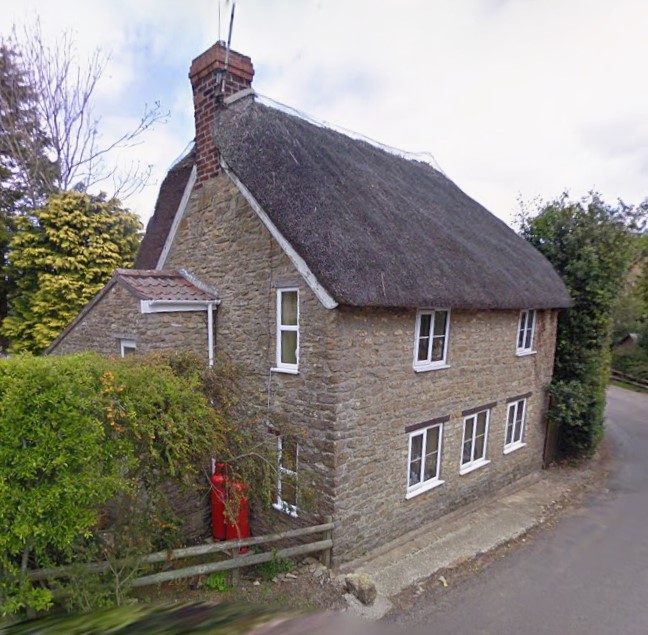
Around 1891, the family moved to Eastfield, a divided former farmhouse.[2] By that time, Charles had become a labourer like his father.
In about 1892, they moved to a four-room cottage at Hardington Moor, which they occupied on a monthly tenancy.[3] By April 1911, Walter was working as a hemp weaver in a web and twine factory.
Walter served in the First World War and suffered from shell shock, from which he never fully recovered. After returning home, his mother initially cared for him, but by 1939, he was a patient at Cotford Mental Hospital, where he died in 1966.
Death
Francis died in 1920 at the age of 67.[4] Later that year, his representatives purchased the cottage in the estate sale as sitting tenants, securing the family’s residence for the first time.[5] Elizabeth may have died in the Wincanton district in late 1937 or early 1938 at the age of 81.
Conclusion
George’s life was characterised by a continuous reliance on family networks: as an illegitimate child supported by his grandparents, as a widower raising a young son, and later as the father of a son permanently affected by the war. The stability of his household relied as much on family ties as it did on wages.
References
[1] Death certificate of Ellen Marsh
[2] Guardian valuations.
[3] Voters’ list; 1920 estate sale catalogue.
[4] The Civil Registration Index recorded his age as 65
[5] 1920 estate sale catalogue.