Introduction
The Foot family of Middlemarsh were a well-established farming family whose position developed over the nineteenth and early twentieth centuries within a relatively confined regional network centred on Dorset and Somerset. Their history illustrates how a farming family could consolidate its position through inheritance and marriage, while remaining vulnerable to economic reversals. Although most of the sons remained within this regional farming world, the experiences of several daughters indicate a greater degree of mobility.
William Foot (c.1803-1866)
William Foot was born at Minterne Magna around 1803, the son of John and Mary Foot. On 18 December 1831, he married Sarah Bennett at Mappowder. Sarah’s father, Cave Bennett, occupied Thurnwood Farm, Mappowder, from about 1815 until his death in 1867. After marrying Sarah, William worked as a farm bailiff at Nottington near Broadway in Dorset. During this time, Sarah gave birth to three children: Rebecca Elizabeth, Philip Matthew Bennett and Herbert William.
Following the death of his father in 1843, William returned to Minterne Magna. In 1851, he farmed 145 acres and in 1861, 150 acres.
Sarah died on 28 September 1857 at the age of 53 due to tuberculosis.[1] After her death, William did not remarry and continued to run the farm. In December 1860, his daughter, Rebecca, married Charles Mayo Burch, a farmer, and they lived initially at Hilfield and later at Hermitage.[2] In February 1862, his son, Philip, married Charles’s sister, Eliza Ann, and moved to Winkfield. Their departures left William at the farm with his son, Herbert.
William remained active and engaged in community affairs. In November 1862, he won second prize for his butter at Sturminster Agricultural Show, and in March 1865, he was appointed as one of Minterne Magna’s two overseers.[3] Unfortunately, he suffered from heart disease, which affected his spirits. By July 1865, Philip had returned to Minterne Magna, probably to help run his father’s farm. The crisis came a year later, when, on 14 May 1866, William sat down in his cowstall with a loaded gun and shot himself in the head. The inquest held at the White Horse Inn the next day reached the conclusion that he killed himself while “labouring under a fit of insanity.”[4] He was buried alongside his wife at Mappowder.
William left an estate valued at “under £6,000.” He bequeathed £2,400, his best horse, saddle and bridle to Herbert; £400 and the income from £600 to Rebecca; and the remainder to Philip.
References
[1] The death certificate of Sarah Foot.
[2] Dorset County Chronicle, 3 January 1861, p.20.
[3] Bridport News, 6 December 1862, p.3; 1 April 1865, p.5.
[4] Taunton Courier and Western Advertiser, 23 May 1866, p.3.
Philip Matthew Bennett Foot (c.1834-1910)
Philip Matthew Bennett Foot was born around 1834, while his father was working as a farm bailiff at Nottington in the parish of Broadwey. Later census returns record his place of birth as Mappowder. He and his sister, Rebecca Elizabeth, were baptised together at Broadway on 18 May 1834. The family moved to Minterne Magna around 1846.
Philip initially worked on his father’s farm alongside his younger brother, Herbert. On 27 February 1862, Philip married Eliza Ann Burch at Hilfield. She was the daughter of Sydenham Burch, who farmed 200 acres at Hilfield in 1851. Two years earlier, Sydenham’s son, Charles, had married Philip’s sister Rebecca. When Sydenham died in 1872, he left an estate valued at under £3,000, which he divided among his ten children and widow.[i]
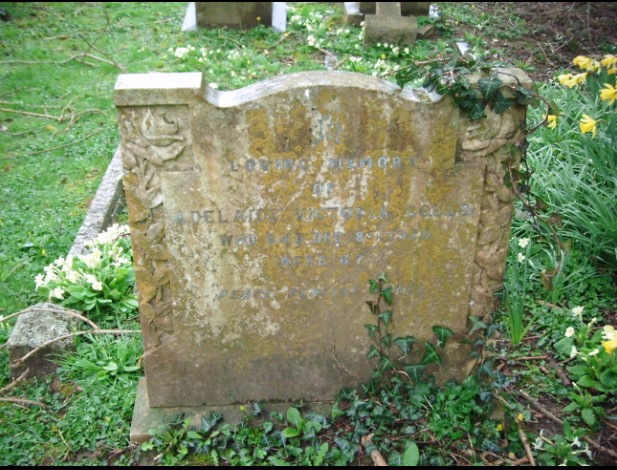
After their marriage, Philip and Eliza moved to Winkfield near Bracknell, where their daughter, Adelaide Victoria, was born on 10 May 1862.[ii] However, their stay in Winkfield was brief, as they had moved to Hilfield by May 1863 and returned to Minterne Magna by July 1865.[iii]
Following the tragic death of William in 1866, Philip inherited the residue of his estate, which likely amounted to about £2,600. Philip took over the family farm while his brother Herbert took on the tenancy of a large farm at Glanvilles Wootton.
By 1871, Philip employed a farmer’s daughter as a governess to help care for their six children. Four more children followed. Unfortunately, two of their daughters died young: Sarah Alexandra May in 1878, at the age of fourteen, from inflammation of the lungs, and Kate in 1894 at the age of 24 after suffering with tuberculosis for four years.[iv]
In December 1880, Herbert William Foot became insolvent and sought an arrangement with his creditors.[v] Despite being a substantial tenant farmer, paying £700 a year in rent and owning £2,000 worth of stock, his assets amounted to less than £10 when sized by creditors.[vi] They sued his brother Philip, his sister Rebecca and uncle Barwell Bennett for raising a fraudulent bill of sale, leading to a legal battle that lasted throughout 1881.[vii] Herbert never recovered financially. By 1911, he worked as a labourer on a farm at Hinton St Mary, and when he died at Woolland in 1928, his estate was valued at only £202 19s 5d.
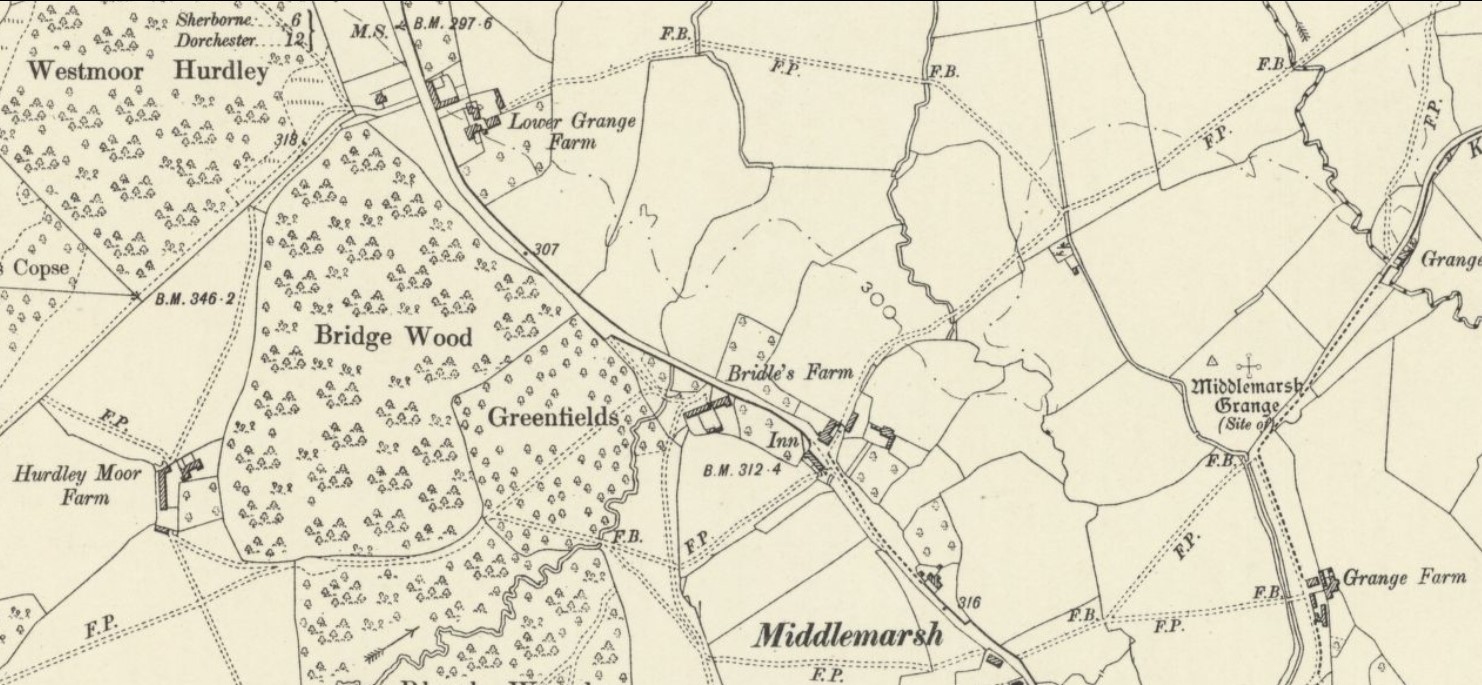
By 1881, Philip occupied 190 acres and employed three men on his farm, which was part of the Middlemarsh Estate. The farm had two names: when the estate was sold in 1912, it was listed “Lower Grange or Manor Farm, Middlemarsh,” a holding of 132 acres.[viii] An account of a footpath dispute in 1935 referred to it as “Manor Farm, Middlemarsh, commonly called locally Lower Grange Farm,” providing furtherThe clarification.[ix]
Philip held various parish offices, including serving on the Highway Board and acting as overseer and churchwarden. Local newspapers provide glimpses of his life at Middlemarsh. In February 1869, he discovered a seventy-year-old road mender named Joseph Davey dead in one of his fields. The inquest concluded that he died from exposure due to inadequate clothing and poor nourishment.[x] In August 1870, Philip had an outbreak of foot-and-mouth disease on his farm.[xi] In October 1892, he attended the first annual dinner of the “Self Help” Lodge of the Independent Order of Oddfellows, formed the previous May.[xii] In January 1899, a family of vagrants was found sleeping in his cowshed, with four children, aged 5, 4, 20 months, and 8 months, having no covering other than their scant clothing.[xiii]
Philip was strict about money. In June 1877, he sued his mother-in-law, Mary Burch, for £1 12s 4d owed for cider and ale, claiming he could not afford to lose the money. However, the judge persuaded him to drop the case.[xiv] In January 1882, a vagrant who stole a penny’s worth of soap from him was charged at Cerne Abbas Petty Sessions but was let off with a caution, as his time in confinement since his arrest was considered sufficient punishment.[xv]
By 1891, all nine of Philip’s children lived at home except for the two eldest daughters, Adelaide and Lily, who were employed in workhouses in or near London. Adelaide was an assistant matron at Chelmsford from 1890 to 1895, serving as the girls’ caretaker and industrial trainer.[xvi] In 1893, she applied for the position of matron at Okehampton workhouse, reaching the final three candidates.[xvii] Lily was listed as an assistant matron at Chelsea in 1891, but little else is known about her career. By 1901, both daughters had returned home, yet their brief careers away still displayed notable independence. Lily never married, while Adelaide married around 1913 but lived apart from her husband by 1921.
During the 1890s, more of Philip’s children left home. In 1895, his eldest son, Nelson, married Sarah Gould, the daughter of Charles and Elizabeth Ann Gould of Round Chimneys Farm, Wootton Glanville, and took on the tenancy of Middlemarsh Farm.[xviii] Three years later, his youngest daughter, Rebecca Jane, married Frederick William Chitterne Wallis of Newbury. Another son, Herbert, moved to Wells to work as a cheese maker, later returning home to run Manor Farm for a short time after his father’s death. From 1914 to 1921, he was the tenant of Manor Farm, Yetminster, before moving to Whitsbury, Hampshire, where he died in 1924.[xix]
Two other sons married into the Gould family of Round Chimneys Farm. Percival married Emily Jane Gould in 1902, and Stanley married Grace Mabel Gould in 1907.
After his marriage, Percival took on the tenancy of Harbin’s Farm, Glanvilles Wootton, where he remained until 1908.[xx] He then worked as a dairyman at Hinton St Mary before becoming the tenant of Manor Farm, Middlemarsh, in 1912.[xxi] In 1950, he purchased the freehold of the 130-acre farm for £11,300.[xxii] When he died in 1958, his estate was valued at £16,864 16s 10d.
The youngest son, Lionel, married Mary Austin at Titchmarsh, Northamptonshire, in 1910. After farming at Orchill Green, Glanvilles Wootton, he served in the army during World War 1 and later became the tenant of Dogbury Farm, Minterne Magna.
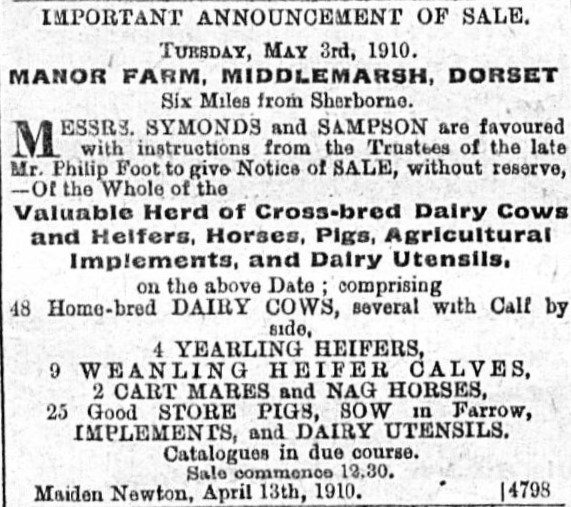
Philip died at Manor Farm on 25 March 1910 at the age of 77, leaving an estate valued at £4,855 16s 9d. After bequeathing legacies of £300 each to his daughters Lily and Adelaide, and gifting various personal belongings, he divided his estate among his eight surviving children. Among his treasured possessions were a piano, a music stool, a piece of plate presented by members of the Middlemarsh Cricket Club, and a silver teapot presented to him as a prize for the best hound puppy. He deducted sums already advanced from the shares of four of his children: £200 each from Nelson and Rebecca, and £150 each from Percival and Stanley. His sale on 3 May 1910 included 48 home-bred dairy cows, 4 heifers, 9 calves, 2 cart horses, 25 store pigs, implements and dairy utensils.[xxiii]
After Philip’s death, Eliza remained at Manor Farm for a time before moving to West Coker Road, Yeovil, where she died in 1917 at the age of 78.
References
[i] The will of Sydenham Burch, dated 4 October 1869, and codicils, proved at Blandford on 20 February 1872.
[ii] Birth certificate of Adelaide Victoria Foot.
[iii] Hilfield baptism register.
[iv] Western Gazette, 22 March 1878, p.5; death certificate of Kate Foot.
[v] Poole Telegram, 17 December 1880, p.12.
[vi] Dorset County Chronicle, 24 February 1881, p.4.
[vii] Dorset County Express and Agricultural Gazette, 20 December 1881, p.2.
[viii] Western Gazette, 12 April 1912, p.1.
[ix] Western Gazette, 7 June 1935, p.4.
[x] Dorset County Express and Agricultural Gazette, 23 February 1869, p.4.
[xi] Southern Times and Dorset County Herald, 27 August 1870, p.2.
[xii] Western Chronicle, 21 October 1892, p.7.
[xiii] Bridport News, 12 May 1899, p.7.
[xiv] Southern Times and Dorset County Herald, 23 June 1877, p.6.
[xv] Dorset County Chronicle, 12 January 1892, p.8.
[xvi] Chelmsford Chronicle, 12 February 1890, p.6; 29 May 1891, p.6; 29 March 1895, p.6.
[xvii] Exeter and Plymouth Gazette, 28 August 1893, p.2.
[xviii] Weymouth Telegram, 26 March 1895, p.1.
[xix] Western Gazette, 29 February 1924, p.4.
[xx] Western Gazette, 6 February 1903, p.12; 13 December 1907, p.1.
[xxi] Western Gazette, 7 June 1935, p.4.
[xxii] Western Gazette, 20 January 1950, p.5.
[xxiii] Dorset County Chronicle, 14 April 1910, p.2.
Stanley Bennett Foot (c.1877-1950)
Stanley Bennett Foot was born at Middlemarsh on 15 July 1877, the fourth son of Philip Matthew Bennett Foot and his wife, Eliza. His father was the occupier of Manor Farm, Middlemarsh, which covered 190 acres in 1881. His mother was the daughter of Sydenham Burch of Hilfield Farm.
After leaving school, Stanley joined his father on the family farm, working there until his marriage in 1907 to Mabel Grace Gould, the youngest daughter of Charles and Elizabeth Gould of Round Chimney Farm, Wootton Glanville.
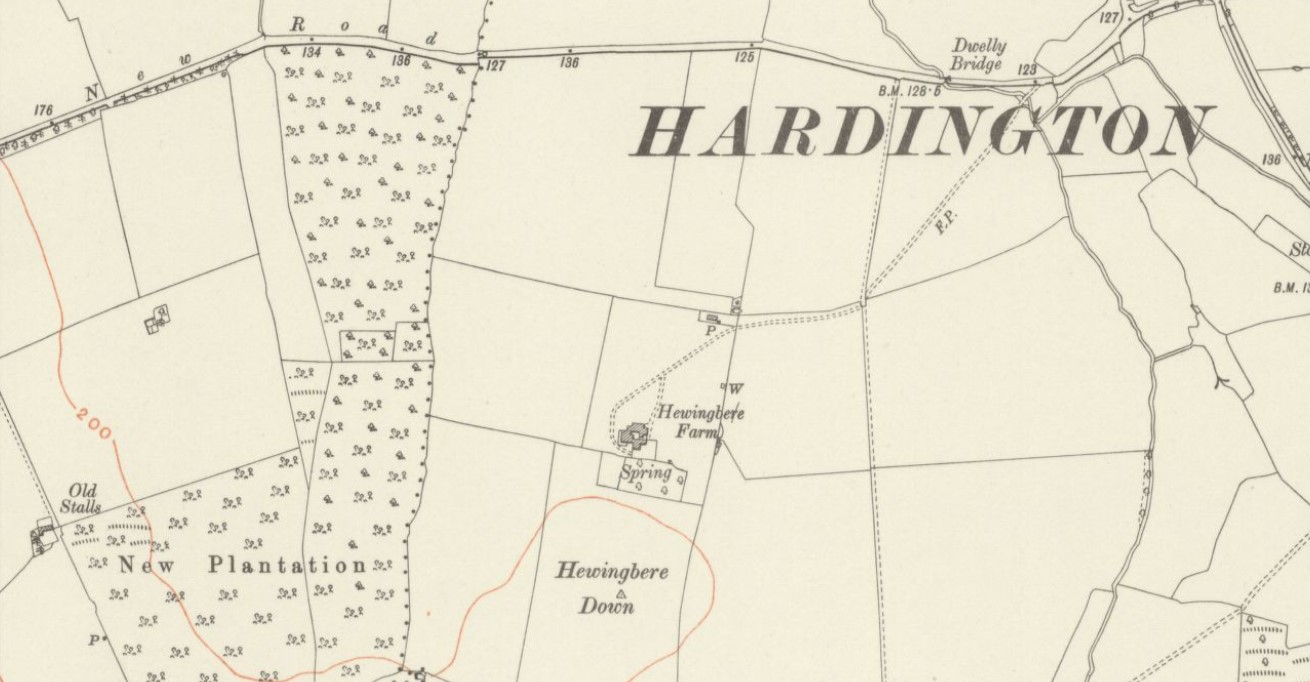
Shortly after their marriage, they moved to Hewingbere Farm, Hardington, a 174-acre farm owned by the Portman estate. The couple had four children: Douglas Hewing (1908), Ronald George (1910), Doreen Adelaide (1912), and Blanche Marjorie (1918).
The 1911 census shows Stanley and Mabel living in the six-room farmhouse with their two sons, Douglas and Ronald. The farm also housed two servants: a 28-year-old domestic servant from Fisherton, Wiltshire, and a 22-year-old farm assistant from Hinton Bluett.
In 1910, Stanley inherited a share in his father’s estate, minus £150 that had previously been advanced to him. In 1913, Mabel inherited a share in her father’s estate, which amounted to £856 11s. He divided this among his nine children, except for a plot of land, a clock, a bureau, and some life policies.[i]
In 1912, Stanley and Mabel attended two local events organised to promote the Liberal Party. In January of that year, they attended a children’s tea held in the granary at Manor Farm, where Mabel presided at the tea tables, played graphophone selections with Stanley, and helped distribute sweets and oranges.[ii] The following month, they attended a Liberal Party dinner in the West Coker schoolroom.[iii]
In the estate sale of October 1920, the farm was offered for sale as lot 37: a dairy farm of 163 acres 3 roods, with a stone-built and tiled farmhouse, farm buildings, a newly-built cottage, twelve fields and one coppice. Stanley purchased the farm as the sitting tenant.
On 5 May 1921, Stanley sued Samuel John Samways, his former employee, for possession of Hewingbere Cottage, with the intention of assigning it to a new employee. Samways had lived at the cottage with his family since around 1910. The court ordered Samuel to leave the cottage within fourteen days and to pay 14s. 6d. in mesne profits (back rent).[iv] However, his departure was delayed, as he was still residing there when the 1921 census was taken on 19 June.
By 1921, only Stanley’s family and extended family lived at the farm. Stanley’s sister, Lily, was a visitor, while Mabel’s nephew, Baden Charles George Green, assisted on the farm.
In August 1926 and again in August 1930, Stanley advertised wheat liners for sale.[v] During the early years of the Second World War (December 1940, January 1940, March 1941), when farm workers were in short supply, he advertised for a farm worker, offering a cottage close to the farm.[vi] He advertised one more in April 1950, just a month before he died.[vii]
In June 1933, Stanley and his brothers, Nelson and Percival, appeared as witnesses in a right-of-way dispute at the Dorset Assizes. They all recalled using the footpath between Middlemarsh and Glanvilles Wootton in their youth.[viii]
During the 1930s, Stanley regularly entered livestock in the annual Christmas Fat Stock Show held at Yeovil market, winning prizes for calves in 1933, 1935 and 1937.[ix]
From the mid-1930s, his children began to marry and leave home. Ronald married Mary Henrietta Case at Branksome in 1935 and later became a licensee and farmer at Bridport. Blanche married James Henry Arthur Bond, a bus conductor, in 1943, and shortly after, Doreen married Ronald Bartlett Bragg, an army sergeant.
The last of his children to marry was Douglas, who married Phyllis Mary Whistler, a farmer’s daughter, in Hampshire in 1944. Phyllis was the niece of Walter Whistler, the second husband of Stanley’s sister, Rebecca Jane.
Stanley made his will in August 1943, naming Mabel, John Sutton Snell (an auctioneer of Yeovil) and Robert Ernest Durston Bartlett (a seed and corn merchant of Haselbury) as his executors. However, Bartlett died in 1945 and was not replaced.
Stanley died on 25 May 1950 at the age of 72, leaving an estate valued at £19,734 0s 11d, the largest of all his siblings. Mabel remained at the farm until her death on 13 April 1973 at the age of 92.
References
[i] The will of Charles Gould, dated 2 March 1912, proved at Blandford on 11 June 1913.
[ii] Western Chronicle 12 January 1912 p. 6; 19 January 1912 p.6.
[iii] Western Chronicle 23 February 1912 p. 5.
[iv] Western Chronicle, 13 May 1921, p.6.
[v] Western Gazette, 13 August 1926, p.9; 1 August 1930, p.8.
[vi] Western Gazette, 27 December 1940, p.2; 10 January 1941, p.4; 21 March 1941, p.4.
[vii] Western Gazette, 21 April 1950, p.6.
[viii] Western Gazette, 7 June 1935, p.4.
[ix] Western Gazette, 8 December 1933, p.2; 6 December 1935, p.16; 17 December 1937, p.16.
Douglas Foot (1908-1987)
Douglas was born at Hewingbere on 24 October 1908. At the age of eleven, he entered a milking competition at East Coker organised by the Yeovil Agricultural Society, finishing third in the category for farmers’ children under 16.[1]
Two years later, he was prosecuted for attempting to sell five plover eggs at Yeovil market, unaware that it was against the Wild Birds Protection Act. His father represented him in court as he was still at school in Dorset. After hearing the evidence, the magistrates dismissed the case upon payment of 4 shillings in costs.[2]
Douglas assisted his father on the farm and took over the running of it after his death.
In 1944, he married Phyllis Mary Whistler, a relative by marriage, in Hampshire, and they had one daughter.
Douglas died on 19 November 1987 at the age of 79, leaving an estate valued at £423,477. Following his death, the farm was sold, and Phyllis moved to Hampshire, where she died on 11 November 1999 at the age of 89.
References
[1] Western Chronicle, 28 May 1920, p.9.
[2] Western Chronicle, 5 May 1922, p.10.
Conclusion
This study of the Foot family across four generations shows how their social and economic position evolved within a relatively confined regional context, shaped by inheritance, marriage, and the opportunities available within a network of neighbouring farming families. In the first generation, William established the family as secure tenant farmers and left substantial provision for his sons, Philip and Herbert. In the second, the experiences of these two sons diverged markedly, with Philip consolidating his position while Herbert faced bankruptcy. In the third generation, the large number of offspring led to a wide range of outcomes. While all five sons entered farming, their fortunes varied considerably: Nelson, Percival and Stanley each left estates worth more than £10,000, whereas Herbert’s estate totalled £2,769 and Lionel’s amounted to only £168. Among the daughters, only Rebecca followed the conventional path of early marriage, while Adelaide and Lily pursued careers in the workhouse system, suggesting a degree of independence uncommon among women in farming households of that era. Overall, the family’s history is a complex tapestry of individual narratives shaped by circumstances, personal agency, and family support, in which relative successes and failures are intertwined.
Appendix: the value of estates for probate purposes:
Generation 1
William Foot (c.1803-1866)-under £6,000
Generation 2
Rebecca Elizabeth Burch (née Foot) (c.1833-1917)-No will or admon
Philip Matthew Foot (c.1834-1910)-£4,855 16s 9d
Herbert William Foot (1840-1928)-£202 19s 5d
Generation 3
Adelaide Victoria Foot (1862-1929)-£1,921 10s 9d.
Sarah Alexandra Mary Foot (1863-1878)-Died a minor
Lily Annie Foot (1865-1950)-£1,620 2s
Nelson William Foot (1868-1952)-£10, 606 2s 11d
Kate Foot (1869-1894)-No will or admon
Herbert Philip Foot (1871-1924)-£2,769 12s 6d
Rebecca Jane Whistler (née Foot) (1872-1950)-£2,982 4s 9d.
Percival John Foot (1874-1958) -£16,867 16s 10d
Stanley Bennett Foot (1877-1950)-£19,734 0s 11d
Lionel Everard Foot (c.1882-1929)-£168 16s 4d
Generation 4
Douglas Hewing Foot (1908-1987)-£423,477