Introduction
George Chaffey Hallett was a smallholder at Broad Hill, Hardington, during the early twentieth century. He began farming after working in his father’s building business and marrying relatively late in life. This study examines his background and farming career and considers what his and his wife’s wills reveal about their financial position and the degree of independence within their marriage.
Childhood
George was born on 13 April 1872 at East Chinnock, the eldest of three sons born to George and Sarah Jane Hallett.[1] His father was a stone mason, while his mother was the daughter of a small-scale farmer.
In the 1880s, his father, George Senior, became a builder and employer, despite early challenges. He was born out of wedlock and lost his mother when he was around six, afterwards being raised by his grandmother and her second husband, Henry Rendell, who also worked as a stonemason and taught George Senior the trade.
By the age of 18, George Junior was a carpenter’s apprentice, probably working in his father’s business. He has not been found in the 1901 census, suggesting he may have moved away to find work before later returning.
Marriage
In 1908, George married Beatrice Elizabeth Matravers Voizey, the daughter of Herbert Joseph Voizey and his wife, Mary. Herbert was a butcher and shopkeeper at Hardington. At the time of their marriage, George was 36, and Beatrice was 35.
The couple settled in Hardington, where, by 1909, George occupied 4 acres 4 roods 15 perches in Swin’s Lane, owned by the Rev. Clife and 8 acres 1 rood 34 perches in Barry Lane, owned by Thomas Genge.[2] He and Beatrice probably lived at Struckmead Farm, as the 1911 census listed them living in an eight-room house in Barry Lane.
In the 1910s, George, his father, and his brother, Walter, all became farmers, the latter at Dawe’s Farm, East Chinnock. In 1929, Walter’s daughter, Muriel Gladys Hallett, married William Joseph Allan White, a farmer and later the licensee of the Royal Oak Inn at Hardington.
Broad Hill smallholding
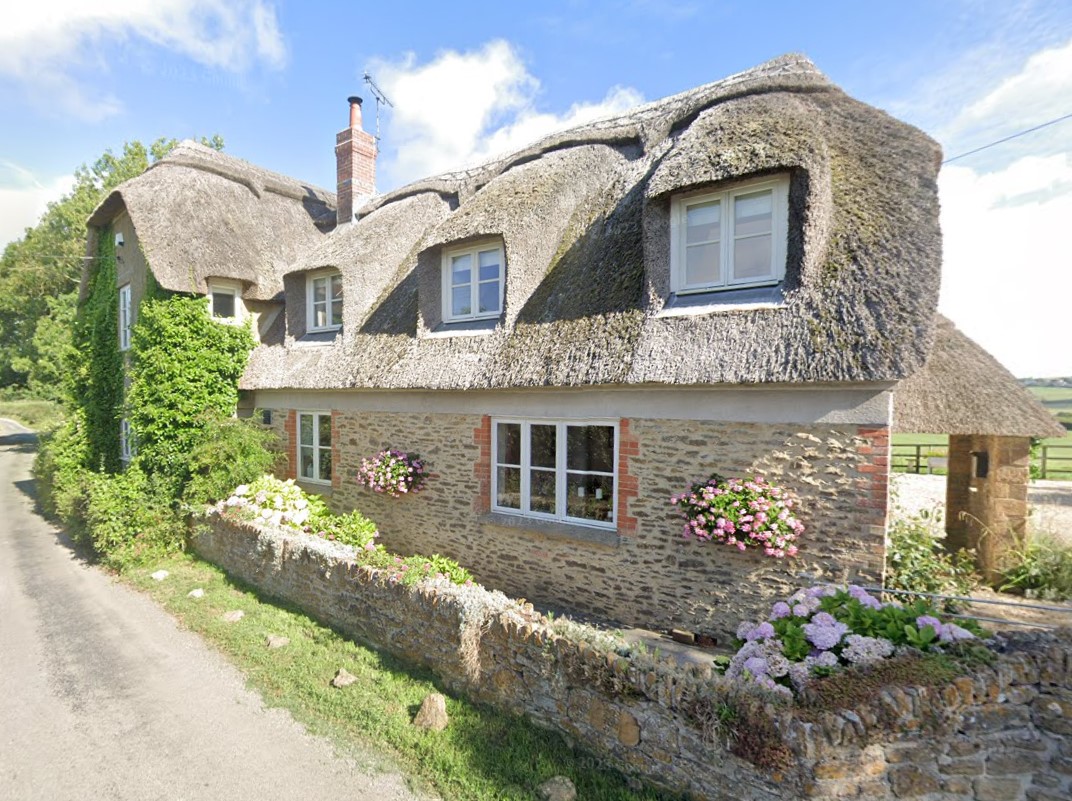
By 1912, George and Beatrice had moved to Broad Hill Cottage, where George made a living as a smallholder.[3] The parish rate book for 31 December 1923 recorded him as the occupier of 27 acres 2 roods and 25 perches owned by Viscount Portman. George probably purchased the farm in the Portman Estate sale of 1924 as the sitting tenant.
Although George was able to purchase his smallholding, he may not have had sufficient funds for working capital, especially given the challenging economic conditions of the 1920s. His situation likely improved with the establishment of the Milk Marketing Board in 1933. After the outbreak of World War II in 1939, local War Agricultural Committees dictated his farming practices.
In 1933, George may have received one-third of his father’s estate after his father died intestate and a widower, assuming it was divided equally between the surviving sons. The total value of the estate was £405 6s 10d.[4]
On 22 May 1942, George sold his smallholding in two lots by auction. The sale notice described the property as “a superior built dwellinghouse, productive garden, and a range of well-built farm buildings, together with nearly 22 acres of pasture and orchard land; also an enclosure of 7 acres of pasture land, with excellent road frontage.” It stated that George was retiring due to ill health, although this may have referred to Beatrice’s health rather than George’s.[5]
Later years
Beatrice died at Broadstone Cottage, the home of her sister Blanche, on 20 January 1943 at the age of 70, leaving an estate valued at £1,490 1s. Two days before she died, she made a will meticulously dividing her estate between her husband, siblings, nephews, and nieces. George received no capital from her estate, only an income for life after legacies of £280 had been paid to her surviving siblings from her Post Office Savings account.[6]
George died at Dawes Farm, East Chinnock, the home of his brother Walter, on 6 October 1951 at the age of 79, leaving an estate valued at £964 11s. In his will dated 18 July 1949, he bequeathed everything he owned to Walter.[7]
Conclusion
George and Beatrice farmed at Broad Hill for about thirty years, much of that time under challenging economic conditions. Despite these difficulties, they accumulated a modest but significant level of capital, leaving estates which, taken together, amounted to £2,454 12s.
Significantly, Beatrice left George an income for life without any capital, indicating a degree of financial separation within their marriage and a careful distinction between support for a spouse and the preservation of capital within her family.
References
[1] Civil Registration Birth Index; 1939 Register. A daughter born in 1877 died in infancy.
[2] Guardian Valuations.
[3] Voters’ Lists.
[4] National Probate Calendar.
[5] Western Gazette, 15 May 1942, p.1.
[6] The will of Beatrice Elizabeth Matravers Voizey, dated 18 January 1943, proved at Bristol on 31 May 1943.
[7] The will of George Chaffey Hallett, dated 18 July 1949, proved at Winchester on 6 December 1951.