Introduction
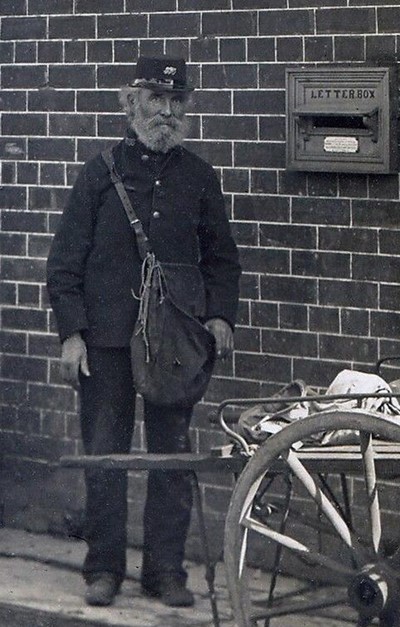
George Rendell’s working life included periods as a weaver, a soldier, and a postman. His work as a postman involved long hours of walking in all weathers but provided a regular income, which he ultimately used to purchase a house at Hardington, probably benefiting from the sale and breakup of the Portman estate.
Early life
George was born on 26 June 1866 at Haselbury Plucknett, the eldest child of Henry and Mercy Rendell.[1] Both his parents were web weavers, and the family lived in the hamlet of Puddletown.
After a brief period as a groom around 1880, during which time the family lived at 21 North Street, Henry became a foreman at a web factory in East Coker. After leaving school, George followed the family trade and worked as a linen weaver before enlisting in the Rifle Brigade in 1887, probably serving for about seven years.[2]
Marriage
In 1895, George married Emma Jane Rendell, the youngest child of Jeremiah and Anne Rendell of Hardington.[3] Before her marriage, Emma worked as a domestic servant at Hardington and later at Sherborne.
George and Emma initially lived at West Coker, where George worked as a weaver. They had two children there: Margaret Mercy, born on 25 September 1896, and Albert Percy, who was born in 1897 and died in 1898.[4]
Rural postman
On 15 July 1900, George joined the Post Office as a rural postman attached to the East Coker sub-office.[5] This prompted a move to 5 Buntham Cottages, a five-room property at North Coker. Their third child, Bernard Leslie George, was born at East Coker on 4 March 1901.[6]
Hardington
At some point between 1911 and 1921, the family moved to Sunnydene, Hardington. The move may have followed the Portman estate sale of October 1920, as Sunnydene—although not specifically named—was probably lot 59, described as a stone-built, thatched cottage forming the western end of a block of three, with an area of 28 perches.[7]
The parish rate book for 31 December 1923 records George Rendell as the owner-occupier of a cottage and garden in the “Street” measuring 24 perches. Although the areas do not exactly correspond, the evidence suggests that George moved to Hardington after purchasing a property there.
The 1921 census recorded him as a postman working the route “East Coker to Yeovil.” At that time, Bernard was employed as an oil engine fitter at Petters Limited, while Margaret worked as a servant at Alton House in Alton, Hampshire.
On 24 February 1926, George died of a cerebral haemorrhage at the age of 59, leaving an estate valued at £186 12s.[8] After his death, Emma went to live with Margaret and her husband at Alton. Emma died in the Alton area in 1949 at the age of 83.[9]
Conclusion
The Post Office, much like the railways, offered a form of employment characterised by regularity, discipline, and modest security. For George, it provided a steady income over many years and, ultimately, the means to acquire a cottage of his own. Although his life was largely uneventful, it illustrates a modest yet significant form of economic stability becoming available to rural working families in the early twentieth century.
References
[1] Civil registration birth index; Royal Mail Pension and Gratuity Records, 1834-1970.
[2] Royal Hospital Chelsea Pensioner Soldier Service Records, 1760-1920.
[3] Civil registration marriage index.
[4] Civil registration birth index; civil registration death index; 1939 Register.
[5] Royal Mail Pension and Gratuity Records, 1834-1970.
[6] Civil registration birth index; 1939 Register.
[7] Portman Estate sale catalogue, October 1920.
[8] Royal Mail Pension and Gratuity Records, 1834-1970; National Probate Calendar.
[9] Civil registration death index