Introduction
George William Marsh spent most of his life within a few miles of his birthplace. Although a medical condition cut short his military service during the First World War, he established a long career with Petters and later with Westland Aircraft, married, and raised a family. By the end of his life, he had spent nearly eighty years in the neighbouring parishes of Hardington Mandeville and East Chinnock.
Early life
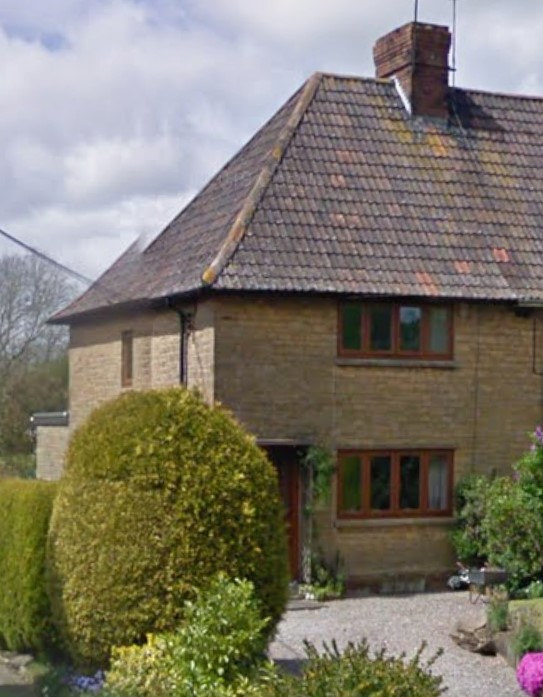
George William Marsh was born at Hardington Mandeville on 1 May 1893, the sixth of eleven children born to Edward Marsh and his wife Elizabeth (née Hallett).[1] His father came from a long-established Hardington family, while his mother was a native of Middle Chinnock. His father was a farm labourer all his life, while his mother was a machine shirt maker at the time of her marriage. The family lived near the upper end of the High Street in a cottage later numbered 342. This cottage and the one next door were later bought by Jesse Axe in the estate sale of 1920.
George’s childhood was marked by a series of family bereavements. In February 1905, his sister Frances Maud died at Crewkerne Hospital from tubercular meningitis at the age of sixteen.[2] Six years later, the family suffered a more profound loss when their mother died suddenly on 25 April 1911.
On that fateful day, Elizabeth travelled to Yeovil with one of her sons and a daughter in a horse-drawn trap driven by Mrs Watts, the wife of the Hardington blacksmith. After seeing her son off at the railway station, Elizabeth and her daughter entered the Butcher’s Arms for refreshments. Shortly afterwards, the landlord heard a scream and found Elizabeth collapsing to the floor. A doctor was called, but she died before he arrived. A post-mortem examination attributed her death to heart failure caused by longstanding heart disease.[3]
At the time of her death, six children remained at home: George, 17, and Ernest, 15, who were both working as farm labourers, and four younger children aged 7 to 13. Later the same year, George’s father married Emma Eastment, a single woman from Hardington Marsh who had three children of her own. Given Edward’s parental responsibilities, the remarriage probably reflected practical necessity as much as companionship. Emma became stepmother to the Marsh children, although she herself died from stomach cancer in 1917.[4]
First World War
On 18 February 1916, George enlisted in the Somerset Light Infantry. He was twenty-two years old and stood five feet eight inches tall. After a brief period in the Army Reserve, he was posted for service on 31 March 1916. On 13 May, he was transferred to the 9th Battalion of the Duke of Cornwall’s Light Infantry.
His military career was short-lived. A Medical Board examined him in September 1916 and found that he was suffering from exophthalmic goitre, now known as Graves’ disease, a disorder of the thyroid gland. The board recorded that the condition had existed in a minor form since childhood but had become more pronounced after he joined the army. The doctors believed it was associated with residence in what they described as a “goitre district”. As a result, George was discharged on 17 September 1916 as no longer physically fit for war service. He does not appear to have served overseas.[5]
Marriage and family life
Following his discharge, George returned to civilian life in Hardington. By 1921, he had left his father’s household and was boarding with Thomas Woodland and his wife, Harriet. He had also secured employment as a fitter with Petters Ltd at the Westland Foundry in Yeovil, beginning an association with the firm that would last for many years.
On 24 September 1921, he married Evelyn Alice Fry at St Mary’s Church, West Chinnock.[6] Evelyn was the daughter of a farm labourer and had spent part of her working life in domestic service at Martock. The couple initially lived at Hardington, where they were residing when their eldest child, Phyllis Irene, was baptised at West Chinnock in March 1922.[7]
Four further children followed: Mervyn George in 1924, William Ralph in 1926, Myra Betty Joan in 1928, and Barbara Kathleen in 1934.
At some point during the 1920s or 1930s, George and Evelyn moved to the neighbouring parish of East Chinnock. By 1939, they were living at 8 Fordhay Terrace. George was then employed as an aircraft storekeeper at Westland Aircraft, reflecting the transformation of the former engineering works into one of Britain’s principal aircraft manufacturers.
Later years
George remained at East Chinnock for the rest of his life. He died in 1972 at the age of seventy-nine. Evelyn survived him by four years, passing away in 1976, at the age of seventy-seven.
Conclusion
Their lives spanned a period of considerable change, from the agricultural world of late-Victorian Hardington to the aviation age represented by Westland Aircraft. Despite the interruption caused by ill health during the First World War, George built a stable working and family life close to the communities in which he was raised.
References
[1] Civil registration birth index; 1939 Register.
[2] Western Chronicle, 17 February 1905, p.8; death certificate of Frances Maud Marsh.
[3] Western Gazette 28 April 1911 p. 4.
[4] Death certificate of Emma Marsh.
[5] British Army World War I Pension Records 1914-1920.
[6] Western Gazette, 4 October 1946, p.8 (silver wedding).
[7] West Chinnock baptism register.