A Somerset funeral
In September 1936, George Willy Matraves and his wife, Dulcina, travelled from Horsham to Haselbury to attend the funeral of his uncle, John Willy. Both men had done well in their chosen careers. John had become the tenant of Manor Farm, Haselbury, and George had served for 25 years with the Royal Field Artillery, pursuing an exemplary career as a farrier. While family loyalty may have influenced George’s decision to attend the funeral with his siblings, Flossie and Ernie, he may also have felt a deep sense of gratitude towards his uncle. Not only had he overseen George’s training as a blacksmith, but he had also served as a role model, possibly inspiring George to enlist in the army as a young man.
Early life
George was born on 10 January 1875 at Hardington, the second son of Thomas Matraves and his wife, Mary (nee Willy).[1] Mary died from tuberculosis on 8 June 1888, when George was only 13 years old, and his father remarried the following year.[2]
After leaving school, George chose not to work with his brothers, John and James, in their father’s blacksmith forge at Hardington. Instead, he became an apprentice blacksmith under his uncle, John Willy, at South Petherton. Although John Willy later specialised in building and farming, at that time he also undertook various other work, including ironmongery, wheel-making and general smith work.[3]
John Willy was energetic, competitive, and community-spirited. He served as a councillor, a Poor Law Guardian and a Captain of the South Petherton Volunteer Fire Brigade. He was also a member of the Rifle Volunteers and a crack shot. Between 1870 and 1905, he participated in numerous shooting competitions, both locally and nationally, winning the Daily Graphic prize in 1904, which was presented to him by H.R.H. the Princess of Wales.[4]
Under John’s influence, George probably became attracted to the military as a career. After completing his apprenticeship, he returned home to Hardington for a short time, playing cricket for Hardington on 11 May 1895, and then he travelled to Taunton to enlist on 21 November 1895.[5] The next day, he went to Exeter to join the Royal Artillery as a farrier. He was given the service number 12182 and assigned to the 18th Field Battery.[6]
Military career
George threw himself into his new career. After completing technical training, he was appointed a Shoeing Smith on 11 September 1896. Alongside this, he pursued voluntary Army education to support his career advancement, gaining a 3rd Class certificate on 5 Nov 1896. That same month, he extended his length of service to 12 years.
In April 1898, he completed a Veterinary Course at Aldershot and later a Carriage Smiths Course at Woolwich. On 18 March 1899, he was promoted to the rank of Sergeant Farrier, and on 24 Mar 1899, he transferred to 8th Field Battery, Royal Artillery, which subsequently became part of the Royal Field Artillery following the army reorganisation that year.
In January 1900, his brigade was sent to South Africa to serve in the Second Boer War. He distinguished himself by his gallant conduct and was mentioned in despatches, his name appearing in Lord Roberts’s despatch of 10 September 1901.[7] On 18 February 1902, he was promoted to Farrier Staff Sergeant.
After the war ended on 31 May 1902, George remained in South Africa for nearly three more years. On 10 Jan 1905, he was transferred to 20th Battery, Royal Field Artillery, which was soon shipped directly to India. It is difficult to identify the precise date as his overseas service was accounted for continuously rather than by physical movements. However, he was officially taken off South African strength on 21 January 1905 and taken onto the Indian establishment immediately afterwards, with the intervening sea passage counted as overseas service.
Shortly after arriving in India, he was promoted to Farrier Quartermaster Sergeant on 31 March 1905. While in India, he continued his education, earning a 2nd Class certificate on 24 Feb 1907 and a 1st Class certificate on 27 March 1913. While stationed in Dinapore, he re-engaged for 21 years of service on 19 April 1907.
By this time, he had probably met and begun courting Dulcina Elfreda Dewey, though the details of their early relationship are unclear. Dulcina had come to India as a child with her parents, although her father had died by this point. The couple married at Dinapore on 7 August 1907.[8]
George and Dulcina had three children: Dulcie Florence, born at Dinapore on 17 July 1908; Ellen Mary, born at Lucknow on 25 September 1910; and Jack, born at Lucknow on 4 April 1913.[9]
The 20th Battery RFA was part of the IX Brigade RFA, which was attached to the 7th (Meerut) Division of the Indian Army. When war was declared in 1914, this division was mobilised for service in Europe as part of the Indian Expeditionary Force ‘A’.
The battery was deployed directly to France, landing at Marseilles around October. As married soldiers were not permitted to take their families into a theatre of war, Dulcina and their children probably returned to Britain at that time or shortly after. Although the precise route and timing of their repatriation cannot be established, it is likely that they were back in England by the autumn of 1914. During the war, they may have lived with Dulcina’s mother, although the specific location is unclear.
George’s service in France nominally ended on 20 November 1915, after which his battery was sent to Mesopotamia. In August 1917, he was awarded the Meritorious Service Medal.[10]
In September 1917, George was invalided to India, suffering from palpitations and faintness. After less than three months, he was shipped home, arriving in England on 30 January 1918. The following month, he was granted official permission to extend his service beyond 21 years, and on 22 June 1918, he was promoted to Warrant Officer Second Class. On 13 January 1920, he was discharged from the army.
Life in Horsham
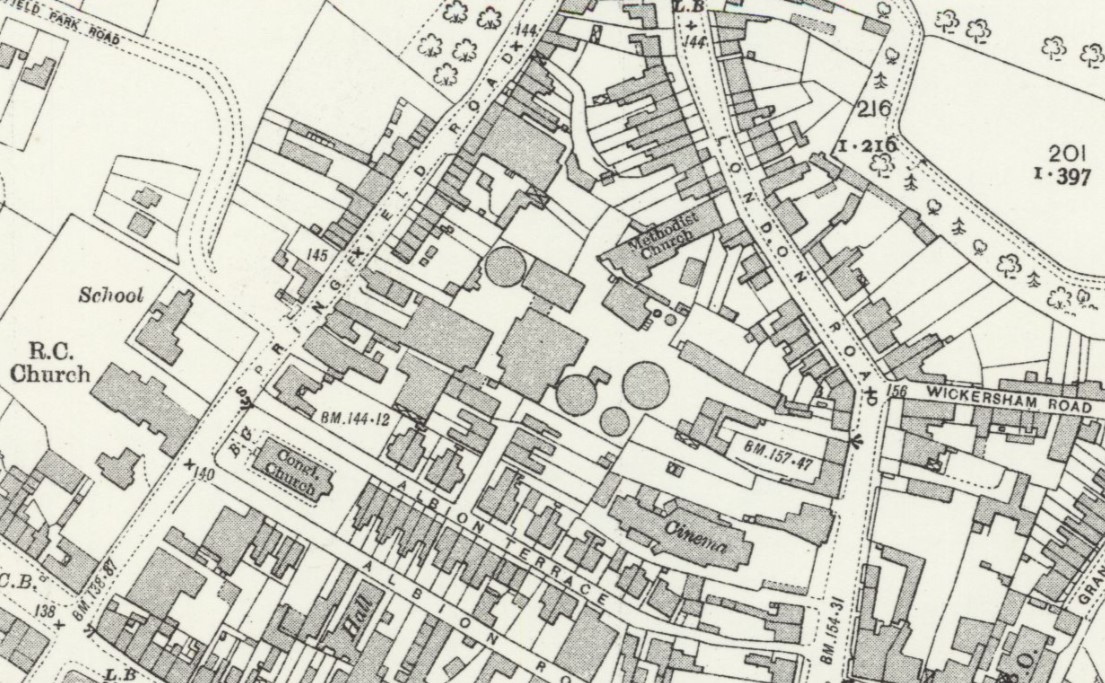
Even before his discharge, George and his family settled at 36 Albion Terrace, Horsham. In January 1919, he placed an advertisement in the Western Gazette seeking a position as a stud groom in good stables or any other suitable work.[11] By June 1921, he worked as a blacksmith at the Forge, Rudgwick, helping Mrs Annie Luff whose husband had died the previous year. By September 1939, he had taken on the less strenuous role of a Water Gas Operator.
Their three children were all accomplished. Dulcie, who never married, became a headteacher at Horsham. Ellen married George Kenneth Cudby, also a headteacher, in 1938. Jack, after attending Collyer’s School in Horsham, earned a BSc in engineering from Brighton Technical College, and then joined the Harland Engineering Company of Alloa, Scotland, on a three-year apprenticeship. While in his third year, he was present in a test tank when another apprentice misconnected a generator. The generator ran too fast and exploded, some of the flying metal hitting Jack, who was only a few feet away. He was taken to the Clackmannan County Hospital, where he died the next day. His parents and sisters travelled to Scotland for the funeral.[12]
George died at home in his sleep on 29 March 1955, at the age of 80.[13] After his death, Dulcina and Dulcie moved to 1 Springfield Park Road, Horsham. Dulcina died on 19 March 1973, aged 83, leaving an estate valued at £5,528. She left a legacy of £150 to her daughter, Ellen, and the remainder to Dulcie.[14]
References
[1] Civil Registration Birth Index; 1939 Register.
[2] Death certificate of Mary Matraves.
[3] Kelly’s Directory of Somerset, 1889, p.306.
[4] Taunton Courier and Western Advertiser, 19 September 1939, p.13.
[5] Taunton Courier and Western Advertiser, 15 May 1895, p.7.
[6] British Army World War I Pension Records 1914-1920. Unless otherwise stated, details of George’s military service, postings, promotions, and overseas movements are derived from this source.
[7] London Gazette, 10 September 1901, p. 5984.
[8] British Army World War I Pension Records 1914-1920.
[9] British Army World War I Pension Records 1914-1920.
[10] London Gazette, 14 August 1914, p.8432.
[11] Western Gazette, 24 January 1919, p.7.
[12] West Sussex County Times, 19 November 1937, p.5; 24 December 1937, p.7.
[13] West Sussex County Times, 1 April 1955, p.14.
[14] The will of Dulcina Elfrida Matraves, dated 8 July 1943, proved in London on 25 July 1973.