Introduction
Hugh Granville-Martin led a complex life, which included long-term relationships with at least three women, two of whom bore a child with him. In his youth, he was a fast and reckless driver who caused several accidents. During the Second World War, he served in India with the army and after the war, he served with the RAF as a Flight Lieutenant for about ten years. After his father’s death, he began a new career in the pub trade, running two pubs and starting a pub locum business.
Early life
Hugh was born on 1 July 1912 in Finchley, probably in a nine-room house at 17 The Grove.[1] His father, Arthur Granville Martin, ran a business as a lace curtain agent, while his mother, Florence Daisy (née Faircloth), was the daughter of a railway clerk. Hugh had a sister, Phyllis Margaret, born in 1906, who was raised by their maternal grandparents.
By 1915, the family had moved to Surbiton, living briefly at Exelynne, South Bank and then at 2 Oakhill Road. His father also had an office at 4 Paternoster Square in the City of London.[2]
Hugh has not been found on the 1921 census, possibly because he was at school. When he was fourteen, his mother died on 5 August 1926 at the age of forty-three.[3] The following year, his father married Olga Swaffer, who was twenty years younger. After briefly living at 2 Garrick Villas, Hampton Court Road, they moved to Arolmede, Ashley Road, Walton-on-Thames.[4]
Hugh began driving at sixteen and soon developed a habit of driving fast and recklessly, which led to several accidents and court appearances. On the evening of 4 April 1930, Hugh and a young woman were returning from a dinner and dance in his car. As he drove along the King’s Road at about 11 o’clock at night, his car hit a female pedestrian who was crossing the road, fracturing her left arm. The case was heard at West London Police Court the following July. A stockbroker who witnessed the accident estimated that Hugh was travelling at about 45 miles per hour when it occurred.
He stated that the car stopped some yards ahead, and a woman got out on the off side, went round the front of the car and got in on the near side. When he reached the car, he saw a man in the driving seat pulling on his trousers. However, a quarter of an hour passed before either occupant got out. The magistrate said he would rule out the question of the trousers and concluded that Hugh had not kept his eyes on the road and fined him £3 with five guineas in costs.[5] Although it is impossible to know for certain, one explanation may be that the woman was driving and that after the accident she got out and moved around to the passenger seat, while Hugh edged across to the driver’s seat, a movement an observer might interpret as pulling on his trousers. They could then have sat in the car for a while, trying to get their story straight.
The following year, Hugh was involved in another accident. At about 1.50 a.m. on 14 April, while driving along Hersham Road towards Walton-upon-Thames, he overtook a lorry and swerved to avoid an oncoming cyclist. His car mounted the pavement, careened along the footpath and collided with a shop and a gatepost. The whole episode was observed by a policeman who was walking along the footpath. In court, the policeman estimated that Hugh was travelling between 50 and 56 miles per hour, although Hugh put his speed at no more than 35 miles per hour. Hugh was convicted of dangerous driving and fined £15, plus five guineas in costs.[6]
Hugh may also have been responsible for another reckless driving incident in October 1931. Another motorist saw a car driven dangerously on the Kingston bypass and took the registration number. The police investigated and discovered that Hugh’s father owned the car. Initially, he refused to provide the driver’s details but, when the case came to court, the magistrates accepted his testimony that neither he nor any member of his household had driven the car that night.[7]
By 1931, Hugh was working as a commercial traveller.[8] In about 1933, he left home to live in a bedsit at 78 Cambridge Terrace, near Sussex Gardens. His work took him far from London, as in October 1933, he was fined £1 for causing an obstruction with his car in Halifax. He gave his address as 78 Cambridge Terrace, Leyton.[9]
His reckless driving continued. In the early hours of January 1934, his car hit a lamppost at the junction of Grosvenor Place and Grosvenor Crescent, and he was taken to St George’s Hospital with facial cuts and concussion.[10]
By 1935, he lived at 24 Polygon Mews with a Patricia Martin, although it is unclear who this was, as no record of a marriage to a Patricia has been found.[11]
The 1939 Register recorded Hugh living at Barn Cottage, Monxton, Hampshire, with a divorcee named Nona Saffell. She ran a guest house, and he assisted her. His marital status was recorded as married, but it is unclear when he married.
India
Around 1941, Hugh was posted to India, where he quickly attained the rank of Company Quartermaster-Sergeant. On 11 October 1942, he received an emergency commission as a Second Lieutenant.[12] While in India, he appears to have lived with and possibly married Hermione Douglas Mallins, the daughter of an army officer. On 8 May 1947, Hermione gave birth to a daughter, Caroline Peter.[13] She and Hugh appear to have separated around then, and he began living with Philippa Hearle Humphries.
Philippa was the only child of Major-General Austin Timeaus Miller, C.B., M.C., of the Sherwood Foresters and was the granddaughter of Colonel Sir Edward Hearle Cole.[14] In April 1944, while serving with the Wrens, she married Commander Patrick Humphries of the Royal Navy Fleet Air Arm.[15] Patrick was twelve years older than Philippa, and had been married before, with his first marriage ending in divorce. On 13 November 1945, Philippa departed from Liverpool on the SS Drottningholm, travelling first class to Bombay, possibly to visit her parents in Srinagar.[16] While in India, she met Hugh.
Life in England with Philippa
In November 1948, Philippa returned to England, travelling on the M.V. Circassia, which departed from Karachi and arrived in Liverpool on 1 November 1948. Hugh’s name is on the passenger list but has a pencil line through it.[17] However, other evidence indicates he returned to England at this time.
In November 1948, he was arrested in London for drink driving and had to appear in court. The police alleged that at about 2.45 a.m., while driving along St George’s Street, Westminster, his car stalled, and after getting out, he collapsed. A police inspector stated that Hugh had bought his car second-hand the day before for his wife, who, because of infantile paralysis, was unable to use public transport. Hugh stated that he had just returned to London after being away for seven years. He had met some friends and drunk more than he should have. He pleaded guilty to driving while under the influence of drink. He was fined £10, ordered to pay £5 in costs, and disqualified from driving for a year. At that time, his address was Queen’s Gate, South Kensington. The newspaper report described him as an “ex-major on demobilisation leave”.[18]
In November 1949, Hugh was appointed a Flight Lieutenant in the RAF Equipment Branch on a five-year short-service commission.[19] In March 1952, this was converted to a permanent commission.[20]
Hugh’s joining the RAF coincided with his adoption of the hyphenated Granville-Martin as a surname.[21] He used this form for the rest of his life.
By March 1950, Hugh and Philippa were living at “Rosemary,” Wodehouse Road, Old Hunstanton, Norfolk. They employed Miss Joan Odlin as a companion and children’s nurse. One day Joan discovered that her wallet and £5 were missing from her bag. She told Philippa, and they searched for them together. When their search yielded no results, Joan reported the matter to the police. Later, she found the empty wallet in Philippa’s leather golfing jacket. At Hunstanton Magistrates’ Court, Philippa pleaded guilty to stealing the items but claimed she could not remember doing so. Her solicitor said that she had contracted infantile paralysis (polio) in India in 1946, and that, in addition, she had given birth to a child in December 1949, eight weeks before committing the offence. Childbirth, he said, played tricks with the human mind, “especially with a person already abnormal from a dreadful complaint.” Hugh told the court that since contracting paralysis, his wife had been unstable and often did not know what she had been saying or doing. The magistrates rejected this as an excuse but took into account Philippa’s previous character and fined her £20.[22] The civil registration birth indexes show that Hugh and Philippa did indeed have a daughter in 1949.
Hugh and Philippa’s relationship ended soon after this incident, and in 1952 Philippa married Kenneth Clifford Brickwood, a former Captain in the Royal Marines, with whom she had two daughters.
Marjorie Baily
On 13 April 1956, Hugh married Marjorie Baily at the Register Office of Westminster South. Hugh was forty-three, and Marjorie was forty-six, although she recorded her age as forty-five. Both lived at 4 Mill Street, Westminster, and were previously divorced. [23]
Marjorie had lived in London for at least nine years and had one adult son, who acted as a witness to her marriage to Hugh. It is unclear when her divorce was finalised, but she appears to have lived apart from her first husband since 1953 or 1954.[24]
Marjorie came from a military background. She was born Marjorie Church on 22 June 1909 in Bermuda, where her father, Walter Church, served as a quartermaster with the 2nd Battalion of the Duke of Cornwall’s Light Infantry.[25] Marjorie was the youngest of six children.[26] Her mother, Violet Fanny (nee Gardner), was the daughter of a cook.[27]
Walter Church had a long and distinguished military career, rising from the ranks to become an honorary major. He served for about nine years in the ranks and over two years as a warrant officer. He took part in the Nile Expedition and subsequently served in the Sudan campaign under Lord Kitchener, fighting at Atbara and Omdurman in 1898. He was mentioned in despatches and awarded the Distinguished Conduct Medal (DCM) for his bravery. In 1899, he received a commission as quartermaster in the Lincolnshire Regiment. Ten years later, he transferred to a similar appointment with the Duke of Cornwall’s Light Infantry (DCLI). In 1910, Walter was posted to Bloemfontein in South Africa, accompanied by his family. He attained the honorary rank of major in March 1914 and was attached to his regiment’s depot at Bodmin around that time.[28]
By the age of ten, Marjorie had lost both her parents and an elder brother. Her mother, Violet, died in March 1915 at the age of forty-one, and was buried in the Fort Pitt Military Cemetery near Rochester.[29] Her father, Walter, died at the Military Hospital, Devonport, in June 1920 at the age of fifty-two, leaving a modest estate of £167 4s 3d.[30] Marjorie’s brother, Walter Harry, was killed in action in France in July 1916, while serving as a Second Lieutenant with the Duke of Cornwall’s Light Infantry.[31]
By June 1921, Marjorie and her sister Eva were attending St Katherine’s School, Mortimer House, Clifton.[32] At twenty, she married Jack Alexander Highett Baily, whose father, Cyril, was a member of the firm of Messrs A. Baily and Co., which manufactured athletic goods in Glastonbury.[33] Jack had attended a boys’ preparatory school in Clifton and, after his marriage, became the general manager of a motor business there.[34] Jack and Marjorie had one child, Patrick Alexander Highett Baily, born in late 1929 or early 1930.[35]
In 1938, the family lived at 1 Berkeley Mansions, Berkeley Avenue, Clifton.[36] That year, Jack went bankrupt, and the public examination revealed a deficiency of £824, which Jack attributed to medical bills and personal extravagance.[37] Following his bankruptcy, Jack moved to London, where he worked as an aircraft technician.[38] He and his family later lived at 5a Hay’s Mews, W1 and ½ Vicarage Gate, W8.[39] By 1954, he and Marjorie had separated, and she was living at 31 Lexham Gardens, W8.[40]
In July 1957, Hugh gave evidence in the prosecution of a company whose burglar alarm rang all night. The newspaper report referred to him as an Air Force Officer of Mill Street, Mayfair, who worked at the Air Ministry.[41]
In late 1957 or early 1958, Hugh’s father died at the age of seventy-eight.[42] The probate calendar contains no reference to a will, and any property he owned probably passed to is wife, Olga.
Chieveley
Soon after his father’s death, Hugh left the RAF and entered the pub trade. In 1958, he purchased the Red Lion, Chieveley, Berkshire, a free-house about five miles north of Newbury. The pub had previously been offered for sale by auction on 1 May 1958, but failed to attract a buyer.[43]
Hardington Moor and East Coker
Hugh and Marjorie’s stay at the Red Lion was brief, and in August 1960, they moved to Holly Tree Cottage, Hardington Moor.[44]
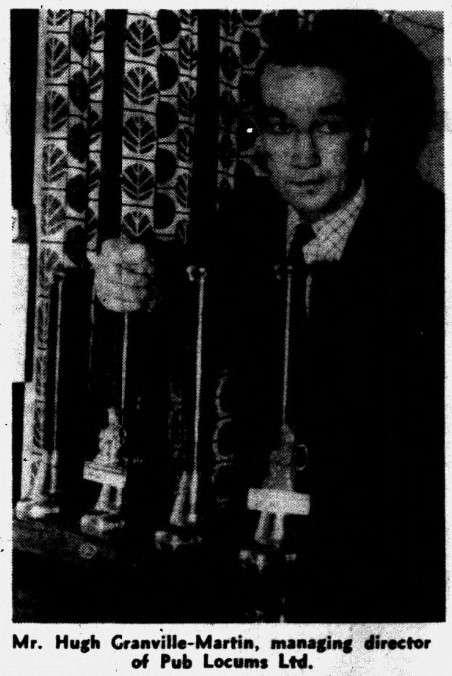
The following year, Hugh formed a company called Pub Locums Ltd to provide relief to licensees who went on holiday, fell ill, or otherwise required cover. The idea grew out of their difficulty in taking holidays while at the Red Lion. The company’s initial charges started at £15 a week and increased with the size of the establishment.[45]
In January 1963, Hugh took over the licence of the Half Moon Hotel, Yeovil, which Brutton Mitchell Toms owned, after Yeovil Town Council’s planning committee turned down Berni Inns of Bristol’s proposal to extend the hotel and install a restaurant.[46] He stayed there until 1965, when he gave up the tenancy to focus on his locum business, which he ran from home.
In January 1965, Hugh told a reporter that demand for his company’s services had been “amazing.” He had twenty-seven couples and ten single managers on his books who collectively carried out over three hundred reliefs over the summer.[47]
On 1 July 1969, Hugh’s fifty-seventh birthday, his daughter, Caroline Peter (known as Peta), was killed in a car accident on the M1 motorway at Woodall near Sheffield. She was travelling to London with a fellow student from Leeds University, Hilary Cole, who was driving a car hired from Hertz Rent-a-Car. The car struck the central reservation and went out of control. It was later discovered that one tyre had a slow puncture caused by a nail. At the inquest, the coroner concluded that the puncture, together with nine hundredweight of luggage, had probably caused Hilary to lose control of the car. A verdict of accidental death was recorded. Peta was twenty-two and lived at 18 Edgecombe Road, Redland, Bristol, which was her mother’s home.[48]
That same month, Marjorie’s sister, Ethel Monica Ford, died in hospital in Bristol. Her death announcement referred to her as “loved sister of Tim Hamilton and Smudge Granville-Martin,” revealing the family nicknames of Marjorie and her sister Eva Hamilton.[49] Although these nicknames may have started in their school days, Marjorie continued to use hers in everyday life.[50]
Hugh and Marjorie lived at Hardington Moor for twenty-five years. They were an outward-going, sociable couple, well known in the village’s two pubs. Marjorie wore thick make-up and drank heavily.
On 3 November 1985, Marjorie died near Reading, probably at or near the home of her son, at the age of seventy-six. She left an estate valued “not exceeding £40,000.”[51]
Following her death, Hugh moved to “New Chapter,” Holywell, East Coker, where he continued to run his locum business.[52] He died on 9 May 1990, at the age of seventy-seven, leaving an estate valued at £154,198.[53]
Conclusion
Hugh Granville-Martin’s life was marked by a striking contrast between his turbulent personal affairs and his successful military and business careers. Despite facing repeated difficulties in his private life, he rose from Company Quartermaster-Sergeant to an Army commission, subsequently became an RAF officer, and established a successful business providing temporary management for public houses.
References
[1] Civil Registration Birth Index; 1939 Register; 1911 census.
[2] London electoral rolls.
[3] Find a Grave® Index, 1300s-Current.
[4] London electoral rolls.
[5] Fulham Chronicle, 11 July 1930, p.2.
[6] Surrey Advertiser, 2 May 1931, p.10.
[7] Surrey Advertiser, 17 October 1931, p.12.
[8] Surrey Advertiser, 2 May 1931, p.10.
[9] Halifax Evening Courier, 20 October 1933, p.7.
[10] Westminster and Pimlico News, 26 January 1934, p.5.
[11] London electoral rolls.
[12] London Gazette, 30 April, p.1960.
[13] Civil registration death index-Rother Valley, Q3,1969.
[14] Civil & Military Gazette (Lahore), 6 May 1944, p.2.
[15] Sevenoaks Chronicle and Kentish Advertiser, 21 April 1944, p.6; Civil & Military Gazette (Lahore), 6 May 1944, p.2.
[16] Outward Passenger Lists, 1890-1960; Civil & Military Gazette (Lahore), 1 June 1947, p.2.
[17] Incoming Passenger Lists, 1878-1960.
[18] Chelsea News and General Advertiser, 26 November 1948, p.5.
[19] London Gazette, 30 Dec 1949, p.6169.
[20] London Gazette, 9 Dec 1952, p. 6482.
[21] London Gazette, 30 Dec 1949, p.6169.
[22] Lynn Advertiser, 17 March 1950, p.5.
[23] Copy of marriage certificate.
[24] London voters’ lists.
[25] Civil registration death index, Reading and Wokingham, November 1985.
[26] RG14, ED Mauritius and South Africa, piece 34976.
[27] Hawley marriage register; entry for 22 January 1894; RG 11, Easthampstead, ED 2, piece 1320, folio 54, p.31; RG 12, Frimley, ED 10, piece 565, folio 19, p.31.
[28] Cornish Guardian, 25 June 1920, p.3.
[29] Find a Grave® Index, 1300s-Current.
[30] Cornish Guardian, 25 June 1920, p.3; National Probate Calendar.
[31] Find a Grave® Index for Burials at Sea and other Select Burial Locations, 1300s-Current.
[32] RG15, Clifton, ED10, sch Ee, p.2.
[33] Civil registration marriage index; Central Somerset Gazette, 26 September 1924, p.4.
[34] RG15, Clifton, ED8, sch Ii, p.3; Western Daily Press, 7 May 1938, p.11.
[35] Civil registration birth index.
[36] Kelly’s Directory of Bristol and Suburbs, 1938, p.527.
[37] Western Daily Press, 7 May 1938, p.11.
[38] 1939 Register.
[39] London voters’ lists.
[40] London voters’ lists.
[41] Westminster and Pimlico News, 12 July 1957, p.1.
[42] Civil registration death index.
[43] Reading Standard, 11 April 1958, p.19; Reading Standard, 9 May 1958, p.24.
[44] Taunton Courier and Western Advertiser, 4 February 1961, p.9.
[45] Taunton Courier and Western Advertiser, 4 February 1961, p.9.
[46] Western Daily Press, 22 January 1963, p.3.
[47] Bristol Evening Post, 6 January 1965, p.4.
[48] Civil Registration Death Index; National Probate Calendar; Western Daily Press, 15 August 1969, p.7; Bristol Evening Post, 15 August 1969, p.3.
[49] Western Daily Press, 23 July 1969, p.10.
[50] Information provided by Margaret Danes.
[51] National Probate Calendar.
[52] Western Gazette, 14 March 1986, p.40.
[53] National Probate Calendar.