Introduction
James Edwin Vickery’s farming career spanned both world wars. During the First World War, he repeatedly appeared before military tribunals as the authorities attempted to override his agricultural exemption and conscript him for service. After farming in partnership with his older brother at Hinton St George, he later became the tenant of Bridge Close Farm at Hardington, where he remained until the early 1950s. Although his working life was dedicated to agriculture, he married a woman from a non-farming background.
Childhood
James was born on 27 October 1884 at Otterford, Somerset, the sixth of seven children of Henry and Caroline Vickery.[1] His father farmed 93 acres at Rull Farm.[2]
Both parents came from established farming families. Henry’s father, Joseph Vickery, had farmed 175 acres at Clifthayne Farm in Yarcombe after earlier running the Eagle Tavern at Buckland St Mary.[3] When Joseph died in 1895, his estate was valued at £602 8s 2d.[4] Caroline’s father, Edward Losmore, farmed 175 acres at Whitestaunton in 1871 and left an estate valued at under £1,500 when he died in 1878.[5]
After marrying in 1874, Henry moved between several farms in Somerset and Dorset, as was typical for farming families in the region at that time.[6] He worked for several years as a dairyman at Burrowbridge before taking on Rull Farm.[7] In the late 1880s, he moved to Elmore Farm, Thorncombe, where he began developing a flock of high-quality sheep.[8] By 1914, this flock had grown to 200 Down breeding ewes, indicating a well-established sheep enterprise that probably influenced James’s later interest in sheep breeding.[9]
First World War
By the time the First World War broke out, several family members were already established in farming. Two of Henry’s sons had farms of their own, another was living in the United States, and his daughter was farming with her husband.[10]
In 1914, Henry retired from farming. His flock was dispersed at a sale on 11 November 1914, followed by the sale of cattle, horses, lambs and farm implements in February 1915.[11] He and Caroline then moved to Hinton St George.[12]
Around this time, James entered into a partnership with his older brother John at Park Farm, Hinton St George. However, after the introduction of conscription, their position became increasingly uncertain. In May 1916, James, then thirty-one, appeared before a military tribunal and received conditional exemption from service. The tribunal heard that the brothers were farming 331 acres and that it would be impossible for John to manage the holding alone, since they had 50 cows to milk and a flock of 300 sheep to tend.[13] This scale of operation placed them among the larger tenant farmers in the district.
The authorities continued to press the issue. By June 1917, James had been passed medically fit for general service, while John was classified as B2. The military representative sought a review of James’s exemption, but the agricultural representative opposed the application, leading to an adjournment.[14] In September 1917, the case was referred to the War Agricultural Executive Committee, and in May 1918, a further attempt to revoke the brothers’ exemptions failed.[15] These proceedings illustrate the tension during the war between the demand for soldiers and the need to maintain food production.
Post-war
After the war, James continued to farm on a substantial scale and, like his father, showed a particular interest in sheep breeding. In November 1924, he joined the Dorset Horn Sheep Breeders’ Association, and in May 1930, he was elected to its council.[16] In August 1929, he advertised for a shepherd to manage a Dorset Horn breeding flock.[17]
James also achieved success in other branches of farming. At the Yeovil Agricultural Show in 1923, his cheese was highly commended, and in 1929 and 1931, he won prizes for flax.[18]
He took an active part in local affairs. In June 1924, he assisted with seating arrangements for the Muchelney Abbey Pageant.[19] In September 1928, he was elected a guardian for Chillington.[20] Additionally, he belonged to the Crewkerne branch of the National Farmers’ Union and retired as its chairman in December 1937.[21] He was also a member of the Crewkerne “Parrett and Axe” Lodge of Freemasons.[22]
In late 1924 or early 1925, James’s mother died at the age of 77.[23] Shortly after, James married Bertha Kate Tazewell in the Williton registration district.[24] Bertha was born on 17 November 1896 at Street, where her father James worked as a railway carman before entering the licensed trade.[25] After running two pubs, he acquired an off-licence at 5 West End Street in 1907 and ran it for more than 40 years. [26]
Bertha joined James at Hinton St George, where they had two sons: William James in 1925 and Sidney John in late 1926 or early 1927.[27] By 1929, James was the tenant of Hill Farm, a mixed farm of 241 acres.[28] In July 1932, the farm was advertised as available to let from 25 March 1933.[29]
Hardington
Around 1934, the family moved to Bridge Close Farm, Hardington, succeeding Julius Fricker. James’s two sons, William and Sidney, attended the village school.[30]
At Bridge Close, James focused primarily on dairy farming. In April 1935, he advertised for a cowman and his wife, the latter being expected to assist with milking when required. The position included a house and garden close to the farm.[31]
By November 1938, his father had moved in with him at Bridge Close Farm. He died there on 17 June 1940 at the age of ninety, leaving an estate valued at £5,200 18s 7d. James inherited £100 and, as a tenant in common with three siblings, received an equal share in the residue of the estate, probably amounting to £1,200 in total.[32]
During the Second World War, labour shortages became acute. In 1940, James advertised for a boy to work on the farm, and, in 1941, for a man used to horses and milking.[33] After the war, he advertised for a man for general farm work in 1945 and 1946.[34] When advertising for men, he offered a tied cottage and garden.
In 1947, William married Barbara Mary Sutton of Crewkerne, and they moved into one of the farm’s tied cottages.[35] In July 1949, Bertha’s father died, and James and Bertha attended his funeral.[36] A few months later, Bertha herself died at Hardington on 16 November 1949 from a cerebral haemorrhage at the age of fifty-two.[37]
Final years
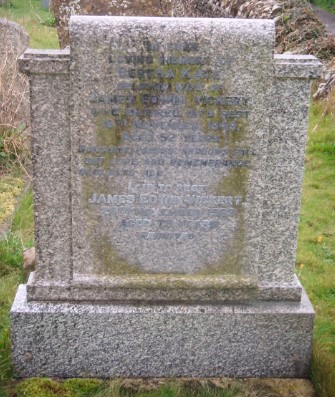
After Bertha’s death, James left Hardington and later lived at 128 Benedict Street, Glastonbury, which became his final home. He died on 26 November 1963 at the age of 79, leaving an estate valued at £6,401 5s 7d.[38] He was buried alongside Bertha at Hardington.[39]
Conclusion
James Edwin Vickery dedicated his life to agriculture and, by 1930, had established himself as the tenant of a large mixed farm. His repeated appearances before wartime tribunals highlight the pressures farmers faced when military recruitment demands conflicted with the need to sustain food production. In his forties, he became actively involved in agricultural organisations and local affairs, suggesting he was a respected figure within the farming community. His career as a tenant farmer exemplifies the continuity of farming practices from the First World War through the 1950s.
References
[1] Civil Registration Birth Index; Otterford baptism register; 1939 register; RG12, Thorncombe, ED10, piece 1667, folio 113, p.3. The youngest child, Annie, died at the age of one.
[2] RG11, Otterford, ED4, piece 2364, folio 36, p.9.
[3] RG9, Buckland St Mary, ED4, piece 1635, folio 46, p.6; RG10, Yarcombe, ED5, piece 2404, folio 7, p.6.
[4] National probate calendar.
[5] RG10, Whitestaunton, ED7, piece 2404, folio 100, p.7; National Probate Calendar.
[6] Whitestaunton marriage register.
[7] Burrowbridge baptism register.
[8] RG12, Thorncombe, ED10, piece 1667, folio 113, p.3.
[9] Western Gazette, 6 November 1915, p.1.
[10] RG14, Beaminster, ED3, piece 12458; RG15, Edington, ED7, schedule 38;1930 United States Federal Census for Newton, Sussex, New Jersey, USA; RG14, Mosterton, ED1, piece 12456.
[11] Western Gazette, 6 November 1915, p.1; Bridport News, 22 January 1915, p.4.
[12] RG15, Hinton St George, ED7, schedule 98.
[13] Taunton Courier and Western Advertiser, 31 May 1916, p.2.
[14] Western Chronicle, 29 June 1917, p.5.
[15] Taunton Courier and Western Advertiser, 22 May 1918, p.5.
[16] Western Gazette, 7 November 1924, p.7; Western Gazette, 16 May 1930, p.3.
[17] Taunton Courier and Western Advertiser, 28 August 1929. p.6.
[18] Langport & Somerton Herald,15 September 1923, p.5; Western Daily Press, 13 September 1929, p.9; Western Morning News, 11 September 1931, p.8.
[19] Langport & Somerton Herald, 7 June 1924, p.9.
[20] Taunton Courier and Western Advertiser, 8 September 1926, p.7.
[21] Exeter and Plymouth Gazette, 17 December 1937, p.6.
[22] Express and Echo, 18 February 1939, p.9.
[23] Civil Registration Death Index.
[24] Civil Registration Marriage Index.
[25] Street baptism register.
[26] Central Somerset Gazette, 27 January 1900, p.7; Central Somerset Gazette, 29 March 1907, p.7; 8 July 1949. p.5.
[27] Civil Registration Birth Index.
[28] Taunton Courier and Western Advertiser, 28 August 1929. p.6.
[29] Western Gazette, 15 July 1932, p.8.
[30] Hardington school admissions register.
[31] Western Gazette, 26 April 1935, p.8.
[32] The will of Henry Vickery, dated 4 November 1938, proved at Llandudno on 30 October 1940.
[33] Western Gazette, 26 January 1940, p.6; 24 October 1941, p.4; 31 October 1941, p.4.
[34] Western Gazette, 30 November 1945, p.5; 11 January 1946, p.1.
[35] Civil Registration Marriage Index; death certificate of Bertha Kate Vickery.
[36] Central Somerset Gazette, 15 July 1949, p.5.
[37] Death certificate of Bertha Kate Vickery.
[38] Civil Registration Death Index; National Probate Calendar.
[39] Gravestone at Hardington.