Introduction
James Walter Raymond became a small farmer at Hardington Mandeville, acquiring Townsend Farm in the Portman estate sale of 1920 and remaining there until his death in 1964. The loss of his only son at the age of seven left him without an immediate male heir, but his youngest daughter had a son who would eventually inherit the farm.
Early life and family background
James was born on 23 December 1879 in Yeovil, the fifth of ten children born to Henry Stacey Raymond and his wife, Elizabeth (née Slade).[1] His father had moved from Queen Camel as a young man and worked in the gloving industry as a leather dresser. His mother came from Over Compton and had been a domestic servant at Reckleford before her marriage.
At the time of James’s birth, the family probably lived in Park Street. In the early 1880s, they moved to Mill Lane, and in 1889, to Hillside, Sherborne Road. On 4 November 1889, James transferred from Huish School to Reckleford School.[2]
Marsh Hill Farm
In 1900, Marsh Hill Farm, Yeovil Marsh, was advertised to let from 25 March 1901. It comprised a farmhouse, farm buildings and 41 acres of land.[3] This became the family’s next home.
The 1901 census suggests that the farm was a family enterprise, since James was listed as a dairyman farmer, while his brothers, Frank and Fred, were listed as farm servants. All three were described as workers who worked at home. Their father, Henry, was still employed as a leather dresser at that time, although he was later called a farmer.
The family business suffered a severe setback when Henry died on 27 September 1903 from cancer of the stomach at the age of 52. James registered his father’s death.[4] Following Henry’s death, James appears to have become the principal figure in the management of the farm.
On 2 April 1906, he married Amy Lilian Bugg at Stalbridge. Amy was born at Stalbridge on 17 October 1880, the daughter of John Thomas Bugg, a painter and glazier. By 1901, she was working at Hendford Lodge, Yeovil, as a cook. After their marriage, she joined James at Marsh Hill Farm, where they had two children: John Stacey, born in 1907 and Daisy Lilian May, born in 1910.
By 1911, James’s family occupied five rooms in the farmhouse, while the other four housed his mother and two brothers, Fred and Cuthbert. Fred was a milk salesman, while Cuthbert was a fitter. Frank had emigrated to Canada earlier that year.[5]
James’s mother died at 54 St Michael’s Road, the home of her daughter, Elizabeth, on 26 February 1912 at the age of 62. Her estate was valued at £216 13s 1d, and she appointed her sons, Fred and Bert, as her executors. Her will was not proved until 15 February 1919.
Elizabeth owned a house at 58 St Michael’s Road, which she bequeathed to all seven of her surviving children. She divided her furniture among Fred, Bert, Cuthbert and Frank, and left her personal belongings to Elizabeth, except for two small gifts to grandchildren. Her will explicitly directed that James should continue repaying a £66 loan in instalments, suggesting that his position at Marsh Hill Farm may have depended partly on family capital rather than solely on independent resources.[6]
Lower Vagg Farm
In 1914, James and his family moved to Lower Vagg Farm, taking over from Mr W. J. Elliott, who held his dispersal sale on 11 March 1914.[7] The following year, the family suffered a tragic loss when John died at the age of seven due to capillary bronchitis.[8]
In February 1920, the farm’s auction was advertised for the following month. The farm was described as 29 acres of excellent dairy land, but no other details were provided. It is likely that James was the tenant and that the sale of the land necessitated his departure.[9]
Townsend Farm
In October 1920, James purchased Townsend Farm in the Portman estate sale. The sale catalogue listed the farm as lot 33, describing it as an attractive, compact smallholding with a farmhouse, buildings, and 50 acres 2 roods 31 perches of land. Eddy Turner’s personal copy has the price paid handwritten as £2,500. Robert William Bartlett had previously occupied the farmhouse and much of the land. The catalogue referred to the farm as “Towns End Farm”, but later Ordnance Survey maps use the term “Townsend.” Prospect Farm, located about 100 metres away, was also sold in the same sale.
The 1921 census recorded James and his family at Prospect Farm but listed Townsend Farm as his place of work, suggesting he had not yet taken up residence there. This may indicate that the farmhouse at Townsend required improvement before it could be occupied.
Although eleven years had passed since Daisy’s birth, Amy gave birth to Winifred Amy on 18 May 1921, followed by Ruby on 18 November 1924. In 1933, Daisy married Ernest Arthur Edwards, and the couple established their home at New House Farm, Denham, where they had three children. Ten years later, Winifred married William Eddy Turner and moved to Manor Farm, Hardington, where they had four children.
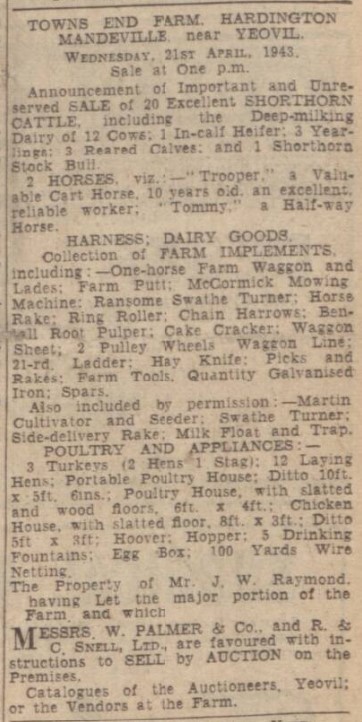
Winifred’s marriage coincided with James’s withdrawal from farming. On 21 April 1943, he sold his livestock and equipment by auction because he had let most of the farm. Included in the sale were 20 Shorthorn cattle, two cart horses, farm implements, poultry, and appliances.[10] This marked the effective end of his active farming career.
James’s wife, Amy, died intestate on 21 February 1945 at the age of 64, leaving an estate valued at £450 4s, which James administered. After Amy’s death, James lived at the farm solely with his youngest daughter, Ruby, for five years. Around 1950, Ruby married William Thomas Curtis of Whetham Farm, Burstock, who was a cousin of William Eddy Turner. Bill Curtis took over the running of the farm and continued to live there until his death in 2002. He and Ruby had one child, Kenneth George, born in 1957. Through this line, the farm effectively passed to the next generation.
James died on 5 June 1964 at the age of 84, leaving an estate valued at £10,028 1s 0d.[11] His executors were William Eddy Turner and Aubrey Ernest White, a neighbouring farmer.
Conclusion
James Walter Raymond’s life reflects a gradual progression from a family-run dairy enterprise to independent ownership within the Hardington farming community. His early career was shaped as much by family support as by his own efforts. Although the loss of his only son changed the line of succession, the farm remained within the wider family through his youngest daughter and her son. His experience illustrates the potential for enduring capital growth in small-scale farming in the early twentieth century.
References
[1] Yeovil Holy Trinity baptism register; 1939 Register.
[2] Reckleford School Admission Register.
[3] Western Gazette, 19 October 1900, p.5.
[4] Death certificate of Henry Stacey Raymond; Western Chronicle, 2 October 1903, p.8.
[5] Canada, Incoming Passenger Lists, 1865-1935.
[6] The will of Elizabeth Raymond, dated 23 February 1912, proved in London on 15 February 1919.
[7] Western Gazette, 6 March 1914, p.1.
[8] Death certificate of John Stacey Raymond.
[9] Western Gazette, 13 February 1920, p.1.
[10] Western Gazette 16 April 1943 p. 1.
[11] The will of James Walter Raymond, dated 13 April 1964, proved at Winchester on 21 October 1964. The Civil Registration Death Index mistakenly recorded James’s age as 83.