Introduction
Joseph Hussey spent most of his adult life as a railway platelayer at Hardington Marsh. His early years were marked by poverty and family instability. Before his birth, his mother and some of his older siblings spent time in the Beaminster Union Workhouse. After a short period of regular army service and nearly a year on active service during the First World War, he settled into more than two decades of steady work maintaining the railway. In the late 1930s, he shared his home with a widowed half-sister. His life ended abruptly in 1942 following a workplace accident in Yeovil.
Childhood and family background
Joseph was born on 2 July 1886 at Beaminster, as the fourth of five illegitimate children born to Mary Hussey (née Bowditch).[1] He was baptised at Beaminster on 8 July of the same year.[2]
Mary was born around 1853 and grew up in Broadwindsor.[3] After her mother died when she was seven, she and her siblings were raised by their father.[4] By April 1871, he was working as a foreman in a flax mill, while Mary and her sister Martha lived away from home, working at Greenham Flax Mill.[5]
During this time, Mary appeared before the magistrates for striking a man with an umbrella after he complained about the behaviour of the factory girls.[6] A year later, she had an illegitimate daughter, Sarah Ellen, who died at three months while in the care of a day nurse.[7] She went on to have another daughter, Susan Maria, in 1874, followed by Florence in 1877.[8]
In 1878, Mary married Walter Hussey, a farm labourer, but the marriage was short-lived, as he died only five months later at the age of 35.[9] Together, they had a son, Walter, who was born in the Beaminster Union Workhouse in late 1879.[10] Mary remained in the workhouse for some time, as the 1881 census recorded her there with Susan, Florence and Walter.[11] By 1891, Mary and Susan had left, but Florence and Walter were still inmates.[12]
After leaving the workhouse, Mary had two sons, Joseph in 1886 and William in 1889.[13] By April 1891, the family was living in Hogshill Street, Beaminster, where Mary supported the household by working as a laundress.
In 1895, Mary married again, this time to Abner William Dunsby, a gardener who had a history of mental illness.[14] They had a daughter, Hilda Ellen, and around 1904, the family moved to Misterton.[15]
After leaving school, Joseph worked as a farm servant at Whetley in the parish of Broadwindsor.[16]
Army service
On 22 September 1902, Joseph enlisted in the army at Dorchester.[17] His service papers state that he was eighteen years and two months old, implying a birth year of 1884, but the civil registration and baptism records show that he was born in 1886. Like many young recruits, he appears to have overstated his age in order to meet the minimum age for enlistment. His enlistment was processed at the Dorset Regiment depot, but he chose to serve in the cavalry and was posted to the 18th Hussars, a cavalry regiment of the line. His service papers described him as five feet four and a half inches tall, weighing 123 pounds, with brown hair, blue eyes and a fresh complexion, and noted that his physical development was good. His civilian trade was recorded as a butcher.
During his three years with the colours, he was stationed initially at Aldershot and later at York, where the regiment was quartered. His service record shows several brief hospital admissions for minor ailments during this period. On 22 September 1905, he was transferred to the Army Reserve after completing the active portion of his enlistment.
When he enlisted, he named two people as his next of kin: his mother, Mary Dunsby of White Hart Street, Beaminster, and his elder brother, Walter Hussey, “address not known.”
Marriage and move to Hardington
After leaving the army, Joseph returned to civilian life and joined his mother at Misterton. On 8 October 1910, he married Elizabeth Annie Pike at Misterton. The couple initially lived in a five-room house in the village, where their first child, Cecil Edward, was born in September 1911. At that time, Joseph worked as a mason’s labourer. [18]
Elizabeth’s father worked as a railway platelayer, and this connection probably helped Joseph obtain employment on the railway. Around this time, he became a platelayer and moved with his family to Hardington Marsh, where the railway company maintained cottages for its workers. The line passing through the marsh was part of the London and South Western Railway main line linking Exeter with London Waterloo, and it provided employment for a small number of men responsible for maintaining the permanent way. His brother or half-brother, William, worked nearby as a farm labourer at White Vine Farm in 1911.[19]
First World War
Joseph was mobilised as a reservist on 5 August 1914 at the outbreak of the First World War and reported to the depot of the 18th Hussars in Scarborough. On 9 October, he embarked for France, joining the British Expeditionary Force during the early stages of the war.[20]
Although Joseph had been trained as a cavalry trooper, the nature of war had changed dramatically by 1914. Instead of the mobile mounted warfare for which cavalry regiments had traditionally prepared, much of the fighting on the Western Front took place in trenches, and cavalry units often fought dismounted alongside the infantry. In April 1915, Joseph was wounded and spent several weeks in hospital, including treatment at the British base hospital at Boulogne, before returning to duty.
While he was serving overseas, his second son, Joseph Sidney George, was born in December 1914. Joseph remained in France until September 1915, when he was discharged from the army on the completion of his twelve-year period of engagement.
His war service was recognised in the village; in February 1915, a local newspaper printed a Roll of Honour for the men from the village serving in the army and navy, which included Joseph’s name.[21]
Later life at Hardington Marsh
After his discharge, Joseph returned to Hardington and resumed his work as a railway platelayer. A daughter, Ethel Florence, was born in September 1921.[22]
For many years, the family lived in the railway cottage at Hardington Marsh. The Hardington rate book for 31 December 1923, recorded Joseph occupying one acre and two roods of land and a cottage owned by the railway company. Another platelayer, Walter Sprague, lived next door.[23]
The work of a platelayer involved maintaining the track and ensuring the safe running of trains along the line. Although physically demanding, this job generally provided steadier employment than agricultural labour, and men in such posts often remained in railway service for long periods.
By September 1939, Joseph and Elizabeth were still living at Hardington Marsh with their two younger children. Also in the household was Joseph’s half-sister, Florence Hurren, who had been widowed in 1934.[24]
During the early years of the Second World War, Joseph left the railway and found employment as a butcher’s assistant. The family moved to 2 Hunts Houses at Holywell in the parish of East Coker.[25]
Death
In March 1942, Joseph was knocked down by a motor lorry on the premises of the Yeovil firm Aplin and Barrett. The accident caused fractures to his ribs and sternum, one of which pierced the pleura and led to pneumothorax. He was taken to Yeovil Hospital, where he died on 23 March 1942 at the age of fifty-five. An inquest held three days later returned a verdict of misadventure.[26]
In the years that followed, his wife and children placed several In Memoriam notices in the local newspaper, stating that he was sadly missed.[27]
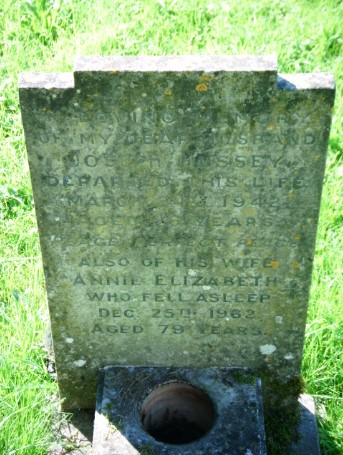
Elizabeth survived him by twenty years and died on 25 December 1962 at the age of seventy-nine.[28]
Conclusion
Joseph Hussey’s life illustrates the experience of many rural working men of his generation. Born into a family marked by poverty and instability, he spent a short period in the regular army before settling into long-term employment maintaining the railway line that ran through Hardington Marsh. Apart from his military service, his life was largely lived within a small area on the Dorset–Somerset border, where he raised his family and worked for more than two decades as a platelayer. After many years of service on the railway, it was a motor lorry accident that brought his life to an abrupt end.
References
[1] Civil registration birth index; RG12, Beaminster, ED4, piece 1662, folio 37, p3; 1939 Register.
[2] Beaminster baptism register.
[3] Civil registration birth index; RG19, Broadwindsor, ED7, piece 1364, folio 94, p.7.
[4] Civil Registration Death Index.
[5] RG10, Broadwindsor, ED7, piece 2025, folio 20, p.7; RG10, Crewkerne, ED8, piece 2408, folio 47, p.24. Martha died in 1874 at the age of 25.
[6] Western Gazette, 22 December 1871, p.7.
[7] Western Gazette, 14 February 1873, p.7;
[8] Civil registration birth index; Broadwindsor baptism register. Florence’s birth was registered under the name “Flora.”
[9] Broadwindsor Marriage Register; Broadwindsor burial register.
[10] Civil registration birth index; RG11, Stoke Abbott, ED10, piece 2120, folio 123, p.25.
[11] RG11, Stoke Abbott, ED10, piece 2120, folio 123, p.25.
[12] RG12, Beaminster, ED4, piece 1662, folio 37, p.3.RG12, Stoke Abbott, ED10, piece 1661, folio 105, p.17.
[13] Civil registration birth index; Beaminster baptism register.
[14] Beaminster marriage register; Lunacy Patients Admission Registers, 1846-1921
[15] Civil registration birth index; Beaminster voters’ lists.
[16] RG13, Broadwindsor, ED5, piece 2010, folio 46, p.10.
[17] British Army World War I Pension Records 1914-1920.
[18] RG14, Misterton, ED10, piece 14377; British Army World War I Pension Records 1914-1920; Civil Registration Birth Index.
[19] RG14, Hardington Mandeville, ED4, piece 14381. When William Hussey married at Misterton in 1909, he recorded his father as Abner Dunsby.
[20] British Army World War I Pension Records 1914-1920.
[21] Western Chronicle, 5 February 1915, p.6.
[22] Civil Registration Birth Index; 1939 Register; Civil Registration Death Index.
[23] Hardington Mandeville rate book.
[24] 1939 Register; Civil Registration Death Index.
[25] Death certificate of Joseph Hussey.
[26] Death certificate of Joseph Hussey.
[27] Western Gazette, 24 March 1944, p.8; 21 March 1947, p.8; 25 March 1949, p.8. These notices and his memorial inscription recorded his date of death as 24 March 1942, but his death certificate states it as 23 March 1942.
[28] Memorial inscription at West Coker.