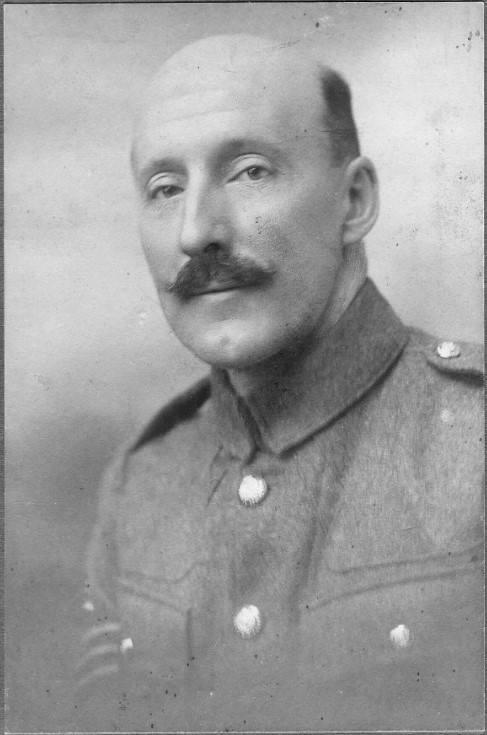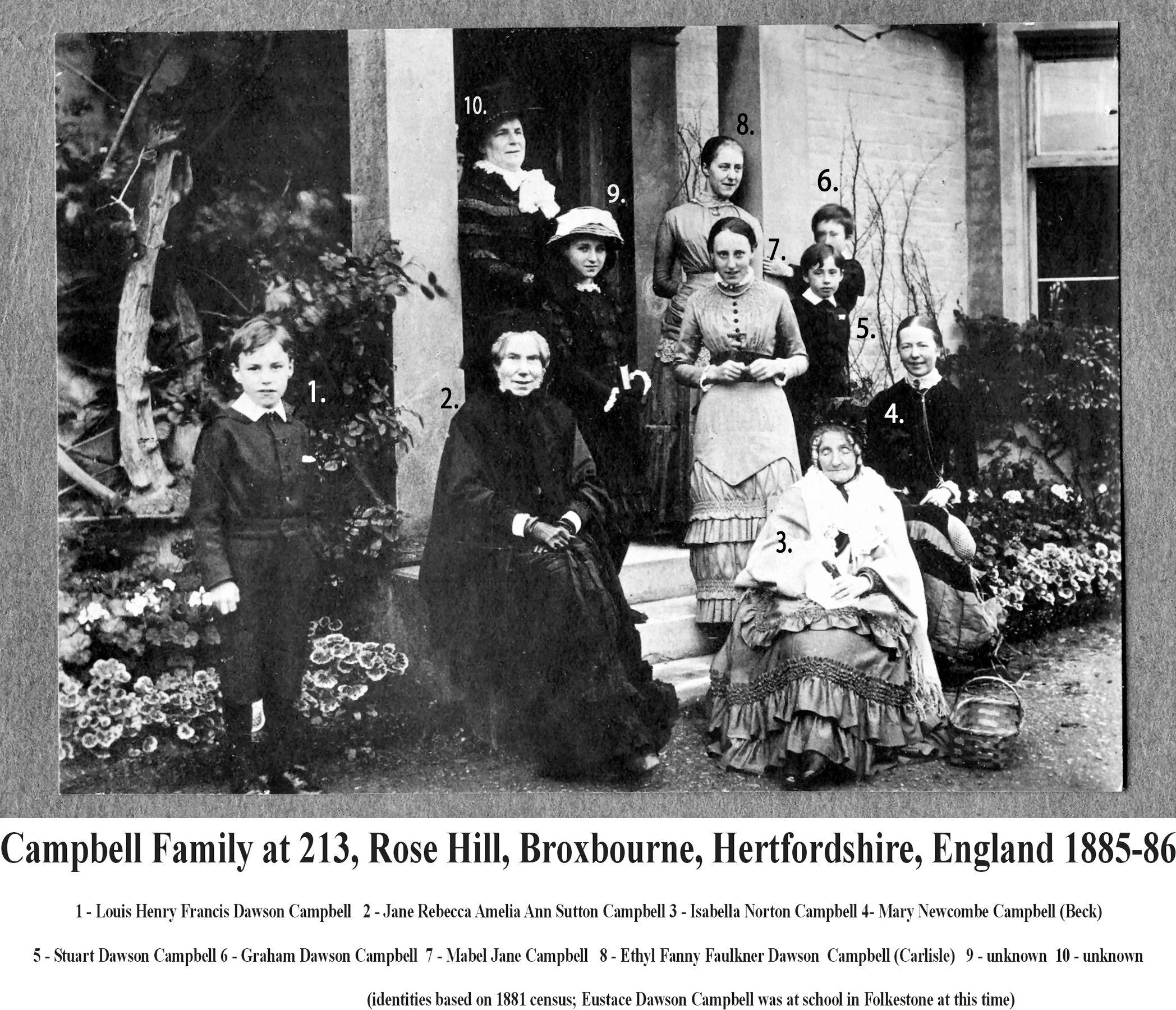
Introduction
On Saturday, 15 September 1934, twenty-eight-year-old Arthur Francis Dawson Campbell, a sapper with the Royal Engineers based in Gibraltar, set out to cycle to England. He planned to pedal through Spain and France and take the cross-channel ferry from Cherbourg to Weymouth, a journey he estimated would take fifteen days.[1] His destination was Cary’s, Hardington Mandeville, the home of his father, Louis Henry Francis Dawson Campbell, and his stepmother, Ellen Ruth Campbell. His father had purchased the former farmhouse a few years earlier, upon retiring from managing tea plantations in Ceylon. This study will examine his father’s life.
Childhood
Louis was born on 7 October 1871 at 21 Mount Preston, Leeds, the fifth of seven children born to Rev. Dawson Campbell and his wife, Fanny Dyson Campbell.[2] His father, Dawson, was born in Blackheath, Kent, the son of a City of London wine merchant.[3] While training for the law in Folkestone, he married Fanny, the daughter of Francis McNamara Faulker, the port Vice-Consul and customs house agent, in 1864.[4] This marriage gave him a renewed sense of direction, leading him to attend Corpus Christi College, Cambridge, from 1866 to 1869 before entering the Anglican ministry.[5] His first appointment was as the curate of St George in Leeds.[6]
After three years in Leeds, Dawson returned to the South of England, serving as curate of Hoddesdon in Hertfordshire from 1872 to 1875, and later as the perpetual curate of Ware.[7] He enjoyed a successful career as an amiable, hardworking and conscientious Evangelical clergyman.[8]
In the late 1870s, tragedy struck the family. Fanny died in June 1878 at the age of 36, followed by Dawson, who died in December 1879 at the age of 37.[9] Both deaths were caused by tuberculosis, a disease that had also killed Dawson’s father at the same age.[10] Dawson was held in such high esteem by his parishioners that they organised a memorial fund to pay for the university education of any of his sons who wished to enter the ministry (none of them did), and a marble tablet in the chancel of Ware church.[11]
After Dawson’s death, his seven children moved in with their paternal grandmother, Jane Rebecca Amelia Ann Campbell, who lived at Rose Hill, Broxbourne, Hertfordshire. The 1881 census recorded a household comprising six grandchildren (one at school in Hastings), two other relatives, a visiting female missionary, and six servants.[12] Jane, the grandmother, was remarkably wealthy, having inherited her husband’s estate and probably a third of her father’s estate. When she died in 1899, her estate had a net value of £11,170 5s 6d, of which Louis inherited about £1,000.[13] He probably inherited little from his father, Dawson, who died intestate, leaving a personal estate valued at “under £500.”[14]
Like his brothers, Eustace, Graham and Stuart, Louis probably attended a minor boarding school, after which he went abroad. According to a letter he wrote in October 1931, he spent ten years in the Transvaal and thirty-two years in Ceylon, although these periods were probably not continuous.[15] As he left Ceylon for the last time in 1927, this information implies that he began working overseas in his mid-teens.[16]
By the 1890s, tea planting in Ceylon had become an established career for young British men seeking opportunities beyond the increasingly competitive professions at home. The island’s central highlands were dominated by estates managed by expatriate Britons, who formed a distinct colonial society. Advancement required resilience and long service rather than university training, and successful managers could achieve a degree of financial security, though rarely great wealth.
First marriage
In about 1901, Louis married Nellie Elizabeth Lloyd, the daughter of a former Major in the Royal Artillery.[17] They had three children: an unnamed son born in 1902, who died in infancy; Arthur Francis Dawson, born in about 1906; and Beatrice Mabel Jane, born in 1908. The last two were born in Ceylon.[18] On 7 June 1915, Nellie died in Johannesburg at the age of forty.[19] Louis returned to England with Arthur, who was 9, and Beatrice, who was 7, arriving in Plymouth on 14 April 1916.[20] After enrolling them in private schools, he departed from Liverpool for Ceylon on 11 July 1916.[21]
Second marriage
In 1921, Louis began courting, from a distance, Ellen Ruth Micklem, whom he probably first knew as a girl when she lived at Yew House, in Broxbourne.[22] Her father, Thomas Micklem, was a solicitor who, upon his death in 1901, left an estate valued at £101,960 13s 3d, which he probably bequeathed to his wife, Ellen, and their four daughters.[23] By 1921, Ellen and two of her daughters were dead, while a third died in 1922. As none of her sisters married, Ellen probably inherited most of her father’s estate.
Louis travelled to England in 1921 and spent time at Bexhill-on-Sea, where Beatrice was a pupil at St John’s School, and at Northacre, Godalming, the home of his married sister, Ethel Carlisle.[24] In November 1921, he returned to Colombo, and Ruth followed him in January 1922.[25] The couple married at Christ Church, Colombo, on 8 March 1922.[26]
Two years later, Louis and Ellen travelled from Colombo to London, arriving on 3 July 1924, and using Ethel’s address as their proposed destination.[27] The purpose of the trip appears to have been to collect Arthur, as they returned to Colombo with him on 26 September 1924.[28]
Three years later, Louis retired at the age of 55. He and Ellen travelled from Colombo to London, arriving on 24 May 1927.[29] They initially settled in Woodbury, Devon, where their address in January 1931 was Southcroft, and in October 1931 it was Greenside.[30] While living at Woodbury, Louis wrote a letter to a newspaper relating how, at a local meeting, he had protested at a politician’s claim that no distinction should be made between the colonies and “foreign countries” for the purposes of trade.[31] He also gave a lecture to the Women’s Institute on tea and rubber on 10 February 1933.[32]
Arthur may have lived with them in Woodbury for part of this period, as he arrived in Hull from Ceylon on 16 June 1929.[33] Beatrice trained as a nurse at St John’s Hospital, Lewisham, from 1930 to 1933, and in May 1934, qualified as a midwife.[34]
Hardington
Between 1933 and 1935, Louis and Ellen moved to Cary’s, Hardington. In November 1935, Louis began measuring rainfall for the Mid-Wessex Rainfall Association, continuing until September 1950.[35] His meticulous recording of rainfall over fifteen years suggests a sustained interest in measurement and agricultural cycles, habits perhaps formed during his decades on tropical estates.
Newspapers provide a few glimpses into their time in the village. Louis wrote a letter to the editor of the Western Gazette about the dangerous crossroads at Podimore and the difficulty of buying a train fare to Cheshire.[36] He also advertised for books by Allan Fea, a popular historian of the day whose work is steeped in nostalgia for England’s past.[37] Louis and Ellen were friends with the Vassall family, the children of the former rector. They attended the funeral of John Godfrey Vassall at Martock on 7 April 1938, and Ellen asked a friend to represent her at the funeral of Amy Vassall on 3 May 1950.[38] It is unclear whether they knew the Vassall family before moving to Hardington
.In April 1937, Beatrice announced her engagement to Rev. John Stott Gamon, a former Royal Navy commander who had recently taken Anglican orders.[39] They married later that year, probably at Hardington.[40]
During the war, Ellen organised the collection of oddments of wool to make bunk covers for minesweepers.[41] From 1945 to 1947, when they were quite elderly, she placed advertisements in the local newspaper seeking a helper to cook their meals.[42]
Louis died on 8 July 1952 at the age of 80, leaving an estate valued at £2,375 6s 2d. He bequeathed his furniture, cars and other effects to Ellen and instructed his trustees to convert the remainder into money and invest it, paying Ellen the income for life, with the capital to Beatrice upon Ellen’s death. The trustees could postpone the sale as long as they wished.[43] The comparatively modest size of his estate suggests that the greater portion of their assets came from Ellen’s inheritance rather than from his plantation career.
Ellen’s later life
After Louis’s death, Ellen moved to Farnham in Hampshire, where she lived at 6 High Park Road. She died on 15 February 1964 at the age of 88, leaving an estate valued at £19,889 5s 8d. She bequeathed her property, 6 High Park Road, to the Rector and churchwardens of St Andrew’s Church, Farnham.[44]
Arthur’s death
As for Arthur Campbell, the enthusiastic cyclist who began this narrative, he sadly died at Gibraltar in May 1935, just eight months after his epic bike ride. The cause is unknown. The following year, Louis and Ellen travelled to Gibraltar, probably to visit his grave.
References
[1] Western Morning News, 20 September 1934, p.7.
[2] Yorkshire Post and Leeds Intelligencer, 10 October 1871, p.8.
[3] West Kent Guardian, 26 February 1842, p.8; Bell’s New Weekly Messenger, 9 April 1843, p.3.
[4] RG9, piece 551, folio 156, p.3; Law Examination Records, 1836-1949; Folkestone Chronicle, 9 July 1864, p.8; Dover Express, 3 April 1868, p.4; HO107, piece 1633, folio 74, p.14.
[5] Cambridge University Alumni, 1261-1900.
[6] Crockford’s Clerical Directory, 1874, p.144.
[7] Leeds Mercury, 30 November 1872, p.3; Evening Mail, 12 November 1875, p.8.
[8] Leeds Mercury. 30 November 1872, p.3; Hertford Mercury and Reformer, 11 January 1873, p.2; Hertford Mercury and Reformer, 23 October 1875, p.5; Irish Ecclesiastical Gazette, 3 January 1880, p.17.
[9] Cambridge Independent Press, 29 June 1878, p.8; Hertford Mercury and Reformer, 13 December 1879, p.3.
[10] Herts Guardian, 13 December 1879, p.5.
[11] Hertford Mercury and Reformer, 21 February 1880, p.2.
[12] RG11, piece 1399, folio 45, p.6.
[13] The will of Jane Rebecca Amelia Ann Campbell, dated 6 December 1888, with three codicils, proved in London, on 3 May 1899. Louis inherited one-sixth of a trust fund of £2,000 and one-eighth of the residuary trust fund.
[14] National Probate Calendar.
[15] Exeter and Plymouth Gazette, 19 October 1931, p.2.
[16] Incoming Passenger Lists, 1878-1960.
[17] RG11, piece 980, folio 102, p.1; RG13, piece 658, folio 40, p.19. Place and date of marriage unknown. Nellie may have left England on the Avondale Castle on 19 May 1900.
[18] Gamon family tree on Ancestry, accessed 5 February 2026.
[19] National Probate Calendar.
[20] Incoming passenger lists, 1878-1960.
[21] Outward passenger lists, 1890-1960.
[22] RG11, piece 1399, folio 45, p.6; RG12, piece 1092, folio 41, p.8.
[23] National Probate Calendar.
[24] Incoming passenger lists, 1878-1960; RG15, Bexhill, enumeration district 3, schedule 258.
[25] Outward passenger lists, 1890-1960.
[26] Andrews Newspaper Index Cards, 1790-1976.
[27] Incoming passenger lists, 1878-1960.
[28] Outward passenger lists, 1890-1960.
[29] Incoming passenger lists, 1878-1960.
[30] Outward passenger lists, 1890-1960; Exeter and Plymouth Gazette, 19 October 1931, p.2.
[31] Exeter and Plymouth Gazette, 19 October 1931, p.2.
[32] Exeter and Plymouth Gazette, 17 February 1933, p.3.
[33] Incoming passenger lists, 1878-1960.
[34] Register of Nurses for 1937, p.372; The Midwives Roll, 1935, p.219.
[35] Taunton Courier and Western Advertiser, 20 November 1935, p.3; Western Gazette, 15 September 1950, p.9.
[36] Western Gazette,11 October 1946, p.7; 25 August 1950, p.5.
[37] Western Gazette,5 August 1949, p.5.
[38] Western Gazette,15 April 1938. p.16; 5 May 1950, p.4.
[39] Chester Chronicle, 24 April 1937. P.16.
[40] Marriage registered in Chard district, Q3, 1937.
[41] Western Gazette, 22 January 1943, p.4.
[42] Hull Daily Mail, 24 February 1945, p.2; Western Morning News, 21 November 1946, p.4; Western Morning News,6 June 1947, p.4.
[43] The will of Louis Henry Francis Dawson Campbell, dated 26 December 1947, proved in London on 20 August 1952.
[44] The will of Ellen Ruth Campbell, dated 27 February 1963, proved in London on 15 May 1964.