Introduction
The life story of Mary Monica Jones is rich and varied. She was the daughter of a West Midlands doctor and, after losing her mother in childhood, spent periods living with her devout Roman Catholic grandparents and later on a Welsh farm, where she met her future husband. After farming together in Wales, the couple bought a smallholding in West Sussex before retiring to Hardington Marsh.
Childhood
Mary Monica Jones was born on 2 October 1885 at Longton, a suburb of Stoke-on-Trent, as the second of three daughters born to Edwin White Jones and his wife, Catherine Agnes.[1] Her sisters were Mary Frances Ethelreda and Winifred Margaret. The presence of two daughters named Mary reflects Catholic devotional practice; accordingly, the elder was known as Ethel and the younger as Monica. A fourth child, Bernard Wynne, died in infancy.[2]
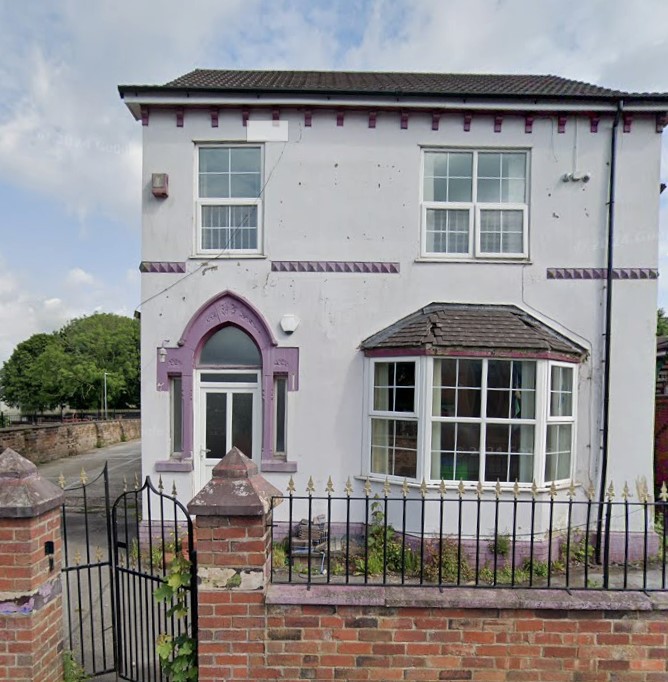
Monica was born into a medical family. Her father, Edwin, was a general practitioner who had studied at the University of Glasgow. After graduating in 1880, he joined the practice of William Joseph Dawes at Denbigh House, Trentham Road, Trentham.[3] In 1882, he was admitted into partnership and in 1883, he married Dawes’s daughter, Catherine Agnes.[4] They established their home in Chaplin Street, not far from the surgery.
A distinctive feature of the Dawes family was their devout Roman Catholicism. William Dawes had played a leading role in building St Gregory’s Church in the 1860s, and two of his sons and two of his daughters joined the Benedictine Order.[5]
Edwin’s family background differed markedly from Catherine’s. He was born and grew up at Trefonen Hall, a farmhouse near Oswestry.[6] After his father’s early death, his mother ran the farm until her own death in 1897.[7]
When Monica was four, her mother died of pulmonary tuberculosis at the age of 29.[8] Following her death, Edwin remained unmarried for nine years, managing his household with the assistance of a housekeeper, a housemaid, and a groom.[9]
In 1899, when Monica was thirteen, Edwin married Constance Clara Louise Adderley, the daughter of John Adderley, a local china manufacturer.[10] The following year, Constance gave birth to a daughter: Catherine Edith Mary.[11]
By 1901, Monica was living with her maternal grandparents in the fifteen-room Denbigh House, with no one else there except four servants.[12] However, she probably saw her father almost every day and her sisters fairly regularly
In September 1902, her grandfather died while staying at Blackpool for his health. Accustomed to taking nepenthe, an opium extract, to relieve his pain, he informed his wife that he had taken more than his usual dose and subsequently died, although his death was attributed to misadventure rather than suicide.[13] In his will, he left “To each of the children of my late daughter Catherine Agnes Jones who shall attain the age of twenty-one years the sum of one hundred and fifty pounds.”[14] Monica was twenty-one in 1906.
Following his death, his widow, Frances, continued living at Denbigh House, and Monica lived with her until at least 1911.[15] It seems unlikely that they were particularly close, as Frances left nothing to Monica in her will.[16]
In October 1905, when Monica was twenty, her father died at home of heart failure after a normal day’s work in his practice.[17] His funeral was held at the Roman Catholic Church at Cresswell, followed by cremation in Manchester. Included in the procession to the railway station was the horse and trap used on his professional rounds.[18]
Edwin left an estate with a gross value of £5,331 7s 10d, and a net value of his personal estate of £2,785 12s 9d. He left his daughters—Ethel, Monica, and Winifred—£750 each, and all his household effects equally. He also left his medical books, instruments, and £50 to a nephew. The remainder of his estate was placed in trust, with instructions for the income be paid to his widow for life and the capital divided equally among his daughters thereafter.[19]
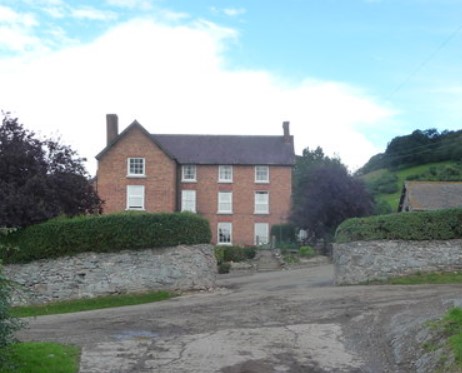
After Edwin’s death, his family broke up. Constance and their daughter moved in with her parents at Forsbrook, while Ethel found a home in Wales with her father’s family, moving to Mathyrafal Farm near Welshpool, the home of Jane Jones, the widow of her father’s older brother.[20] In 1911, Ethel married a doctor and moved to Wandsworth.[21] Meanwhile, in 1910, Winifred married a potter’s manager.[22]
Wales and marriage
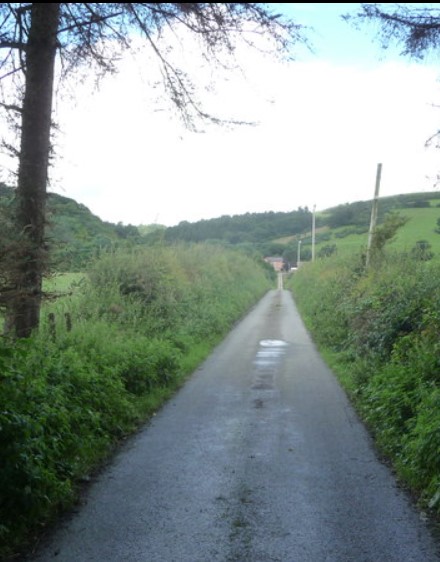
After Ethel left Mathyrafal Farm, Monica probably took her place. While living there, she met Griffith Jones, a farmer at Green Hall, Llanfyllin, Montgomery.
Griffith came from a respectable farming family. He was born at Tan Y Ffridd near Pontrobert, where his father farmed 120 acres in 1881.[23] He attended Bangor University, which had a pioneering agricultural department. In 1902, his family moved to Green Hall, where he entered into a partnership with his father, and a few years later, they bought the freehold from the Earl of Powis.[24] When his father died in 1917, he left an estate valued at £2,106 10s 2d gross, all of which he bequeathed to Griffith, except for £50.[25]
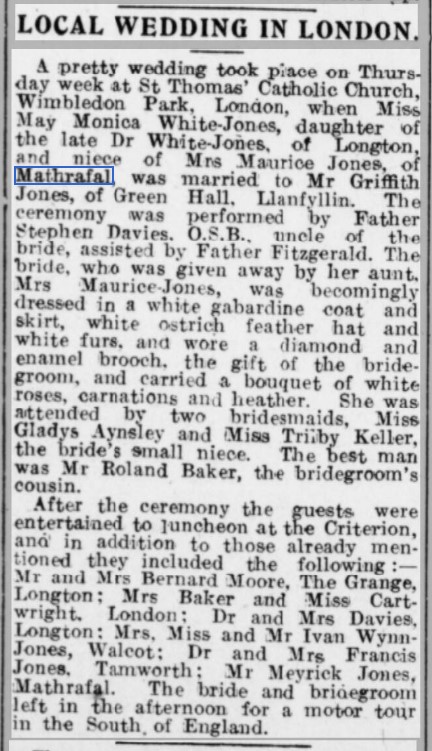
On 7 October 1920, Monica and Griffith were married at a Roman Catholic church in London. The ceremony was performed by Father Stephen Dawes, O.S.B., who was Monica’s uncle. Monica’s aunt, Jane Jones of Mathrafal, gave her away. After hosting a reception at the Criterion, Griffith and Monica departed for a motor tour of the South of England.[26]
The couple initially lived at Green Hall, Llanfyllin. The 1921 census recorded them living there with Monica’s sister, Ethel, as a visitor, as well as a young female domestic servant. At that time, Griffith was 43, while Monica was 35.[27] Although they may have hoped to have children, they remained childless.
Loxwood
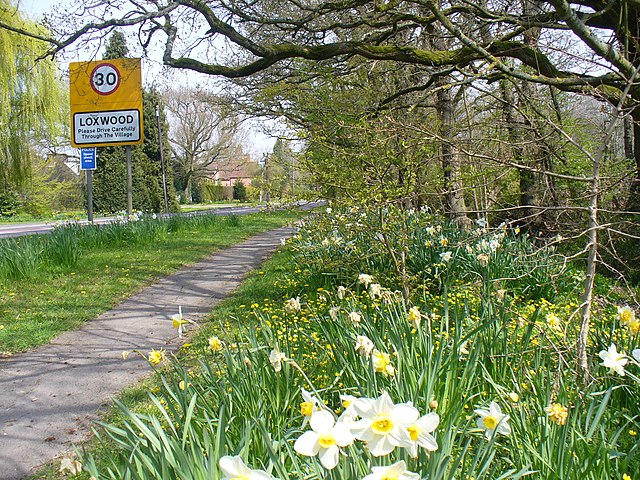
By September 1939, Griffith and Monica were living at Black Hall Cottage, Alfold Road, Loxwood, where they ran a poultry farm.[28] In 1931, the property was advertised for sale as a three-bedroom detached bungalow with two acres of land, so they may have bought it then.[29]
Their move to Loxwood was probably driven by the severe agricultural depression in Wales and may have been facilitated by government assistance. The Loxwood area offered good infrastructure and access to stable markets. By downsizing to a smallholding, they could run it themselves without the need for hired help.
Hardington
During the war or soon after, they moved to Hardington, where they lived at the Cottage, Hardington Marsh, by June 1948. Monica died there on Christmas Day 1949 at the age of 64, leaving an estate of £1,199 18s, which she bequeathed to Griffith.[30]
Griffith survived his wife by ten years, dying on 26 November 1959 at the age of 82.[31] He had several friends at Hardington whom he remembered in his will, most of them members of the farming community. These were Alice Maud Rawlins of Hardington Marsh, the mother of Albert and Wilfred; Mrs Lilian Whetham of Bryants Farm, Pendomer; Aubrey White and his sisters, Winifred and Gladys of Grove Farm; Marion Oxenbury of White Vine Farm, and Ernest Sandiford of Hardington. He also left £50 to the vicar and churchwardens of Pendomer Church for use in memory of his wife. He left the remainder of his estate equally to Winfred, three of her children, and Ethel.[32]
Griffith and Monica are both buried at Pendomer.[33]
Conclusion
Monica’s story shows her emerging from the early constraints of a West Midlands medical family and, in her late twenties, moving to Wales, where she developed an identity shaped by her father’s Welsh heritage. Harsh economic realities later forced her and her husband to leave Wales, but they continued to live in small rural communities, first in West Sussex and then at Hardington.
References
[1] Civil registration Birth Index; 1939 Register,
[2] Civil registration Birth Index; Civil registration Death Index.
[3] Staffordshire Sentinel, 12 October 1905, p.4; The Medical Register, 1883, p.485.
[4] Newcastle Guardian and Silverdale, Chesterton and Audley Chronicle, 25 November 1882, p.5; 28 April 1883, p.5.
[5] Staffordshire Sentinel, 19 April 1929, p.8; 12 June 1918, p.3.
[6] Staffordshire Sentinel, 12 October 1905, p.4; Trefonen baptism register; RG9, piece 1877, folio 92, p.10; RG11, piece 2781, folio 18, p.30.
[7] National Probate Calendar.
[8] The death certificate of Catherine Agnes Jones.
[9] RG12, piece 2145, folio 40 p.11.
[10] Civil Registration Marriage Index; Staffordshire Sentinel, 15 June 1918, p.3.
[11] Civil Registration Birth Index.
[12] RG13, piece 2618, folio 127, p.4.
[13] Preston Herald, 27 September 1902, p.12.
[14] The will of William Joseph Dawes, dated 5 September 1900, proved in London on 31 January 1903.
[15] RG14, piece 16600.
[16] The will of Frances Dawes, dated 15 February 1918, proved in London on 8 February 1919.
[17] Staffordshire Sentinel, 12 October 1905, p.4;
[18] Staffordshire Sentinel,16 October 1905, p.3.
[19] The will of Edwin White Jones, dated 20 June 1905; 4 December 1905.
[20] RG14, piece 16695; RG14, piece 33854.
[21] Civil Registration Marriage Index; RG15, enumeration district 24, schedule 71.
[22] RG14, piece 16694.
[23] RG11, piece 5496, folio 37, p.5.
[24] Montgomery County Times and Shropshire and Mid-Wales Advertiser, 10 November 1917, p. 5.
[25] The will of Griffith Jones, dated 16 December 1916, proved in London on 16 March 1918.
[26] Montgomery County Times and Shropshire and Mid-Wales Advertiser, 16 October 1920, p.6. The report names the venue as “St Thomas’ Catholic Church, Wimbledon Park,” although no such church existed. It is likely that the journalist confused either Sacred Heart Church, Wimbledon, which then served Wimbledon Park, or St Thomas à Becket Church, West Hill, Wandsworth, both plausible locations given the family’s connections.
[27] RG15, enumeration district 22, schedule 48.
[28] 1939 Register.
[29] West Sussex Gazette, 14 May 1931, p.7.
[30] The will of Mary Monica Jones, dated 11 June 1948, proved in London on 8 March 1950.
[31] The Civil Registration Death Index incorrectly recorded his age as 81. After meeting Monica, he appears to have shaved a year off his age (see 1921 census).
[32] The will of Griffith Jones, dated 11 June 1948, proved in London on 8 March 1950.
[33] Gravestone at Pendomer.