Introduction
Michael Dawe’s life appears to have combined ambition with a degree of financial overreach. After many years of farming, he married an attractive younger woman named Betsy Barnard, who had previously been involved in a bigamous marriage that resulted in the birth of a son. After their marriage, Michael and Betsy adopted an affluent, middle-class lifestyle, which contributed to Michael’s bankruptcy in 1862. He spent his final years in Bedminster, where he passed away in 1876. One of his sons became a clergyman in the Church of England, while another pursued a career as a solicitor.
Early life
Michael was born around 1801 at Benville Park, Corscombe, the youngest of eleven children born to Thomas Dawe and his wife, Grace Clarke (née Bartlett). He was baptised at Melbury Bubb on 14 April 1805 “in the 4th year of his age”.
By 1826, Michael had moved to East Chinnock.[1] During the 1830s and 1840s, he occupied substantial areas of land in the parish. The 1832 voters’ list recorded him as the tenant of Barrow’s Farm, while the 1846 voters’ list recorded him as holding a lease for years of Broad and other land.
In 1825, Michael’s brother, Francis, married Mary Guppy at Halstock. They settled at Chardstock, where Francis initially farmed before jointly running Coaxdon Mills with Thomas Guppy, who may have been his brother-in-law. In November 1830, both men went bankrupt, after which Michael appears to have purchased the mill.[2] While Francis Dawe moved to Guernsey, Thomas Guppy continued in business at the mill until 1844, when he was succeeded by Robert Hallett, who remained there until 1860.[3]
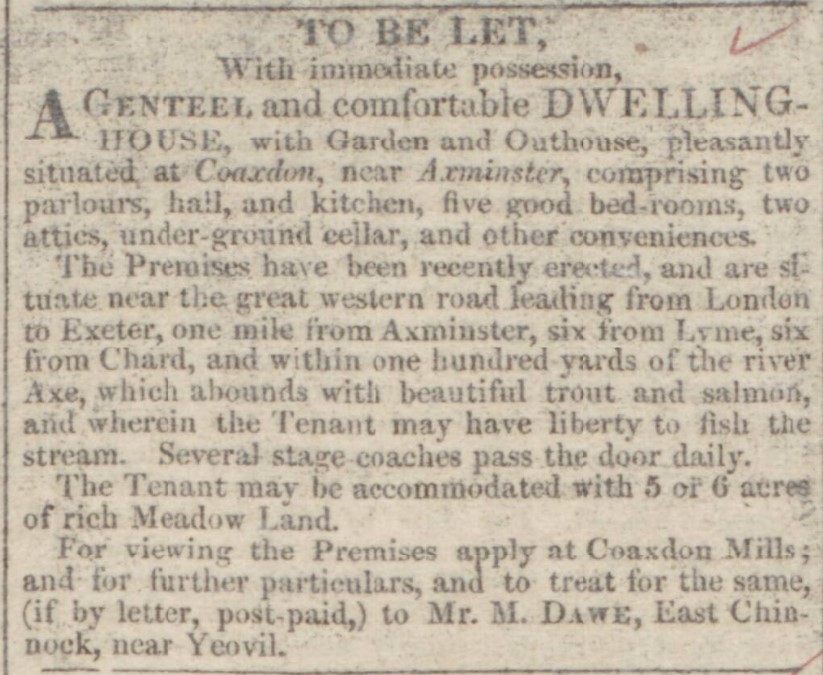
In June 1831, Michael advertised a “recently erected” house to let, describing it as “A genteel and comfortable dwelling-house, with garden and outhouse, pleasantly situated at Coaxdon, near Axminster, comprising two parlours, hall, and kitchen, five good bed-rooms, two attics, under-ground cellar, and other conveniences.” The tenant had permission to fish in the nearby River Axe, which “abounds with beautiful trout and salmon.”[4] By 1841, Francis’s brother, George, was the tenant of that property.
In 1836, Michael’s father died at the age of 79, leaving a substantial estate valued at more than £2,865. He left Michael a legacy of £600 and one-fifth of the residue as a tenant in common.[5]
Michael has not been found in the 1841 census. The Hardington tithe survey of 1843 recorded him as occupying 166 acres owned by Lord Portman, including a dairy house at Hardington Marsh (number 574 on the tithe map), and another 61 acres owned by Lord Ilchester and two others. From 1843 to 1856, he usually chaired the New Year’s Day tenants’ dinner in the parish, which testifies to his status within the local tenantry at that time.[6]
On 21 January 1847, he held an auction sale of dairy stock at Marsh Farm because he was “declining the Dairy Business.” The sale included 45 cows, five two-year-old heifers and two barreners.[7] Despite the sale, the church rate book indicates that he continued to occupy a substantial area of land in the parish until 1857.
Marriage
On 28 October 1846, Michael married Betsy Barnard at Somerton. Her parents, William and Keturah Barnard, had lived in Somerton all their lives, and William was listed in the 1851 census as a house proprietor.
Bigamy
Before marrying Michael, Betsy had been the victim of bigamy. The story began in May 1840 when a male cousin of Betsy’s visited her parents, accompanied by a young gentleman named Charles Butt, who claimed to be a sea captain. After several more visits, Butt told her parents that he wished to marry Betsy, asserting that if he could not have her, he would not marry at all. He boasted of having ample means to support Betsy, including an estate worth £300 a year, a mansion, and a farmhouse. Won over by his good looks and claims to wealth, her parents consented, and Betsy and Butt were married at Somerton Church on 1 December 1840. Betsy soon became pregnant and gave birth to a son on 13 December 1841. However, by then, it had come to light that Butt had a previous wife who was still living.
On January 10, 1842, Butt faced charges of bigamy at the Somerset Quarter Sessions. The prosecution produced evidence of his first marriage to Mary Field at St George’s in the East, Middlesex, on 25 June 1834. Mary’s aunt and uncle testified that she and Butt had visited them after their wedding and conducted themselves as husband and wife. They also stated that Butt and Mary had a daughter named Ellen, who was living in Jersey with Mary.
The defence argued that there was insufficient evidence to prove the first marriage, claiming that the law required the production of the witnesses who had signed the marriage register, and that no adequate explanation had been provided for their absence. However, the Chairman, Francis Popham, dismissed this argument, stating that the absence of the witnesses did not undermine the prosecution’s case. The jury swiftly returned a guilty verdict. Popham berated Butt for betraying Betsy’s trust and for his disgraceful actions, which he attributed to brutal animal passion. He sentenced him to eighteen months of hard labour.[8]
Married life at East Chinnock
Michael and Betsy established their home at East Chinnock, where they had five children. In March 1851, Michael was a farmer of 240 acres, employing five men and five boys.
Manslaughter incident
In August 1851, Michael’s brother, George, of Coaxdon Mills, was sentenced to twelve months’ imprisonment after he accidentally knocked over and killed a man while riding home from Chard market in a drunken state.[9] This incident may have provoked hostility towards the family, as the victim had a wife and ten children, and George denied responsibility despite the evidence of witnesses.
Move to Coaxdon
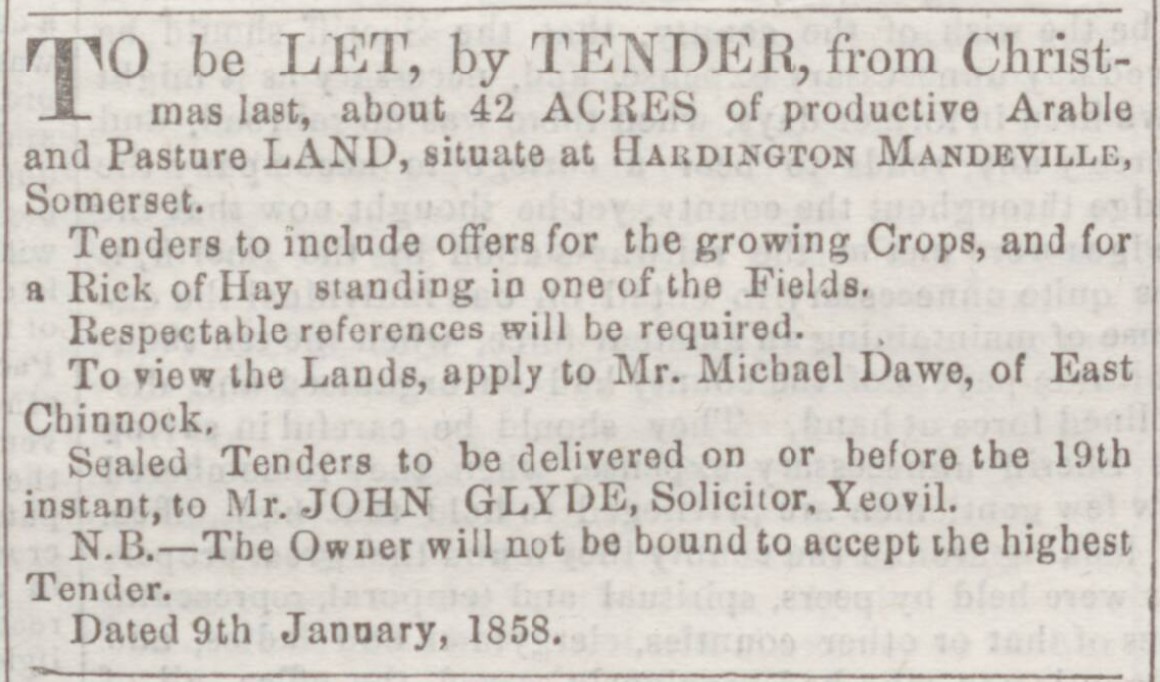
In 1858, Michael began to sell off some of his assets. On 7 January 1858, he advertised 42 acres of land at Hardington to let, including growing crops and a rick of hay.[10] Later that month, he put his property at Coaxdon up for auction, but there is no evidence that it was sold.[11]
In the absence of a buyer, Michael decided to take up residence at Coaxdon. His decision was probably influenced, in part, by the death of George’s wife in March 1858, which left George on his own. Michael acted as the executor of her small estate of under £20.[12] Michael was living at Coaxdon by the third quarter of 1858, when he registered the birth of his sixth child. This child died young, as did his seventh.
Michael expanded the house by adding a wing. He may have partly financed this by selling more assets, as in October 1860, he sold a house and land at East Chinnock in six lots.[13] He also inherited the entire estate of his brother George, who died in November 1860, leaving an estate valued at under £1,000.[14]
The 1861 census recorded a household that comprised Michael, Betsy, their six children, Betsy’s widowed mother, and one female servant. Michael’s widowed brother, Francis, lived next door. Michael was described as a landed proprietor, while Francis was a miller.
Financial crisis
Although Michael was living like a gentleman of leisure, he did not have an income to match, which resulted in mounting debts and friction with local tradesmen. One creditor was Samuel Pearce, a master stonemason who lived nearby. In August 1861, when Samuel’s wife, Ruth, asked Michael’s stepson, William, to remind his father to pay what he owed her husband, he reacted by riding at her with his horse. Shortly after, Samuel and William clashed on the road one evening. Samuel, who was carrying a gun, seized the bridle of William’s horse, and William retaliated by hitting him in the face with a stick. Samuel then complained to William’s mother, who cleaned and treated his bloody face. Subsequently, William was fined £2 10s for assault.[15] This incident, along with another the following year, in which William failed to attend court to face a claim for £4 for shrubs and trees, suggests he may have been haughty and high-handed.[16]
Michael also owed money to Joseph Harbour, a stone mason of Chard. After repeated visits to Michael’s house had extracted a mere £2, he sued Michael for the balance of £30 15s 7d at Axminster County Court in November 1861. The judge referred the matter to a local architect for arbitration. In the same court, another creditor sued him for the £5 arising from a bounced cheque.[17]
The court proceedings were a sign of grave problems. In December 1861, Michael advertised his house and 30 acres of land at Coaxdon to let or for sale.[18] However, he soon lost control of the situation, and on 15 February 1862, the Court of Bankruptcy for the Exeter District declared Michael bankrupt and sent him to the Devon County Prison.[19] His property at Coaxdon was sold by auction on 30 April 1862.[20] On 26 June 1862, the County Court granted an order to discharge him.[21]
While it is difficult to pinpoint the exact causes of Michael’s financial problems, three factors stand out: his withdrawal from farming (which had been the source of his wealth), his asset sales and his high level of spending, including on the house extension and education. The 1861 census noted that his five children were receiving tuition at home, while William Field Barnard was an undergraduate at St Mary Hall, Oxford.[22]
Michael never recovered financially. However, Betsy may have retained some property in her own name, as the 1871 census recorded her as living off the rents of houses. This income may have contributed to the education of their sons, Michael and Richard. Michael attended Balliol College, Oxford, from 1867 to 1871, while Richard was a pupil at Tiverton in 1871.[23]
Michael’s later years
The bankruptcy may have broken up the family. William emigrated to Australia, where he married in 1867.[24] By 1871, Michael was living in the household of his nephew, Francis Dawe, at Hardington Marsh, where he identified himself as a gentleman. Meanwhile, Betsy and her sons, Michael and Thomas, were living in the home of a female cousin, Martha Morrison, at Hillsbridge House, Bedminster.[25] Their daughters, Frances and Helen, were employed in the household of the Chancellor of St David’s Cathedral in Wales, one as a governess and the other as a teacher.
Michael eventually returned to Bedminster. At the age of 75, he suffered an apoplectic seizure and died on 12 January 1876 at Barnard House, New Cut, with his son Thomas by his side. Although his death certificate recorded his name as Michael Watson Dawe, he was known simply as Michael Dawe throughout his life.[26]
Betsy’s widowhood
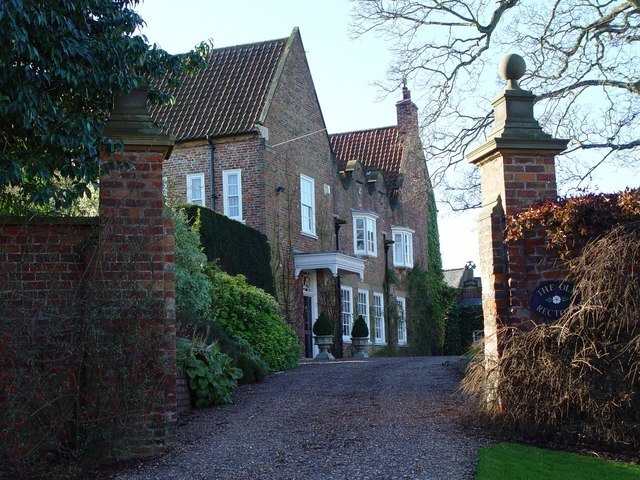
After Michael’s death, Betsy moved in with her eldest daughter, Frances Ann Bodley Hanscombe, at Pirton Hall, Hertfordshire, where she made her long-term home. She died on 29 May 1892, at the age of 77, at the Rectory, Walkington, Yorkshire, the home of her son, Michael.
Michael and Betsy’s children
Their children’s careers suggest that, despite financial setbacks, the family succeeded in securing entry into the professional middle class. Their eldest son went to Balliol College, Oxford, and then entered the church. The next became a tea merchant, while the youngest son became a solicitor. In 1873, their eldest daughter married a wealthy farmer named William Hanscombe, and her home at Pirton Hall, Shillington, Bedfordshire, became the home of her mother and her sister, Helen. Helen remained unmarried and died in 1937.
William Field Barnard, Betsy’s son with Charles Butt, attended St Mary Hall, Oxford, before emigrating to Australia, where he married Ada Blunden on 2 July 1867.[27] He died at Northcote, Melbourne, in 1893.
Conclusion
Michael Dawe’s life illustrates an attempt to move from substantial tenant farming to the social position of a gentleman. This endeavour proved disastrous, leading to bankruptcy and a brief period of imprisonment. Although he never regained his financial standing, his wife appears to have retained access to some independent income, although its extent and origin are unclear.
References
[1] Bath Chronicle and Weekly Gazette, 14 September 1826, p.4.
[2] London Courier and Evening Gazette, 5 November 1830.
[3] Sherborne Mercury, 10 February 1844, p.1; Wiltshire County Mirror, 10 October 1860, p.8.
[4] Sherborne Mercury, 20 June 1831, p.1.
[5] The will of Thomas Dawe, dated 13 November 1834, proved in London on 9 April 1836.
[6] Dorset County Chronicle, 19 January 1843, p.4; Sherborne Mercury, 6 January 1844, p.3; Sherborne Mercury, 4 January 1845, p.3; Sherborne Mercury, 9 January 1847, p.3; Sherborne Mercury, 9 January 1855, p.2; Sherborne Mercury, 8 January 1856, p.3.
[7] Dorset County Chronicle 14 January 1847 p. 1
[8] Taunton Courier and Western Advertiser, 12 January 1842, p.7. The newspapers depicted Charles Butt as a serial bigamist, but no evidence has been found to support this claim. He was born in 1817 at St Helens on the Isle of Wight and married Mary Field when he was about seventeen. By 1851, she was living on Jersey as a fishmonger, which suggests a very different life from that later led by Betsy. Butt subsequently became involved with a third woman, Susan Williams, with whom he had a daughter. In 1855, he was awarded a mate and master certificate after five years’ service in the British Merchant Service in the coasting trades. He probably died in Hackney in 1871.
[9] Dorset County Chronicle, 14 August 1851, p.4.
[10] Sherborne Mercury, 12 January 1858, p.4.
[11] Dorset County Chronicle, 7 January 1858, p.17.
[12] Bridport News, 3 April 1858, p.4.
[13] Sherborne Mercury, 2 October 1860, p.4.
[14] The will of George Dawe, dated 6 April 1858, proved at the Principal Registry on 28 January 1861; Bridport News, 8 December 1860, p.3.
[15] Sherborne Mercury, 1 October 1861, p.3; Pulman’s Weekly News and Advertiser, 1 October 1861, p.5.
[16] Nowlen’s Weekly Chronicle, 7 June 1862, p.4.
[17] Nowlen’s Weekly Chronicle, 7 December 1861, p.4.
[18] Exeter and Plymouth Gazette, 6 December 1861, p.1,
[19] Dorset County Express and Agricultural Gazette, 25 February 1862, p.1
[20] Dorset County Chronicle, 24 April 1862, p.17.
[21] Southern Times and Dorset County Herald, 5 July 1862, p.1.
[22] Foster, Joseph, Alumni Oxonienses: The Members of the University of Oxford, 1715-1886, p.62.
[23] Foster, Joseph, Alumni Oxonienses: The Members of the University of Oxford, 1715-1886, p.353.
[24] Australian and New Zealand, 21 September 1867, p.4.
[25] Although Martha Morrison was the head of the household, she was identified as an imbecile. She died on 14 March 1875, leaving an estate valued at “under £200.”
[26] Death certificate of Michael Watson Dawe.
[27] Australian and New Zealand, 21 September 1867, p.4.