
Introduction
This article explores the life of John Herbert Satchell, including his childhood in Newbury and Dover, his curacies in London, Cambridge, and the diocese of Durham and his time as rector in Bristol and Hardington Mandeville. It examines the circumstances surrounding his entry into the priesthood, the nature of his parochial duties, his financial situation, and his wife’s family background.
Early years in Newbury (1859-1873)
John Herbert Satchell was born at Newbury on 9 August 1859 and was baptised at St Mary’s Church, Speen, on 11 September.[i]
His family was involved in the brewing business. His father, John Thomas Satchell, took over the Newbury Brewery from his father, John Satchell, and ran it in partnership with Francis Flower Somerset from 1852 to 1872.[ii] In 1855, John Satchell married Sarah Wild, the daughter of Thomas Wild, who owned a tanning business at Rickmansworth.[iii]
John Herbert Satchell was probably born at the family home in Donnington Square, a planned development to the north of the town built about twenty years earlier, consisting of architect-designed villas set in ornamental grounds.[iv] When he was about six years old, his family moved to Wash Common on the southern side of the town.[v]
While they were living at Wash Common, their manservant, William Ward, who worked as a groom and gardener, was killed in tragic circumstances on Whit Monday 1870. He was at the Gun public house, celebrating with members of a local benefit society, when a crowd of non-members attempted to force their way inside. After Ward and some men evicted them, one individual punched Ward in the head, killing him instantly. John Thomas Satchell testified at the inquest.[vi]
By this time, John Herbert may have been in London, as in 1871 he and his brother, Clifford, were attending Eldon House School, Tooting— the same school that their father had attended thirty years earlier.[vii] The 1871 census shows that the youngest pupil was nine years old and the oldest was seventeen, providing a rough guide to when John may have started and finished at the school.[viii] An advertisement for the school from 1852 promoted its success in preparing young gentlemen for military service and listed its annual fees as thirty-five guineas.[ix]
Although John Thomas Satchell was one of Newbury’s principal inhabitants, he took little part in civic affairs. Unlike his business partner, Francis Somerset, who was a town councillor and involved in various public organisations, John limited his activities to serving as a churchwarden at St John’s Church from 1867 to 1873 and as a director on the board of Newbury Cemetery Company.[x]
At the end of 1872, the partnership between Satchell and Somerset was dissolved, and the two men went their separate ways.[xi] Somerset went on to implement substantial improvements to the brewery, and when he died in 1894, his estate was valued at £39,691 11s 11d.[xii]
References
[i] Birth certificate of John Herbert Satchell.
[ii] Reading Mercury 10 January 1852, p.2; Newbury Weekly News and General Advertiser, 30 January 1873, p.4.
[iii] Reading Mercury, 30 June 1855, p.5.
[iv] Berkshire Chronicle 26 August 1848, p. 3.
[v] Voters’ Lists for Newbury
[vi] Reading Mercury 11 June 1870, p. 2.
[vii] RG10/1250 folio 83 page 25; HO107/1068/5 folio 41, page 15.
[viii] RG10, Tooting Graveney, ED 17, piece 720, folio 71, p.15.
[ix] British Army Despatch 9 April 1852 p.16
[x] Berkshire Chronicle 22 December 1894 p. 8; Newbury Weekly News and General Advertiser 2 May 1867 p.5; Reading Mercury 13 January 1872 p.6.
[xi] Newbury Weekly News and General Advertiser, 30 January 1873, p.4.
[xii] Berkshire Chronicle 21 February 1874 p.8; National Probate Calendar.

The Dover years (1874-1881)
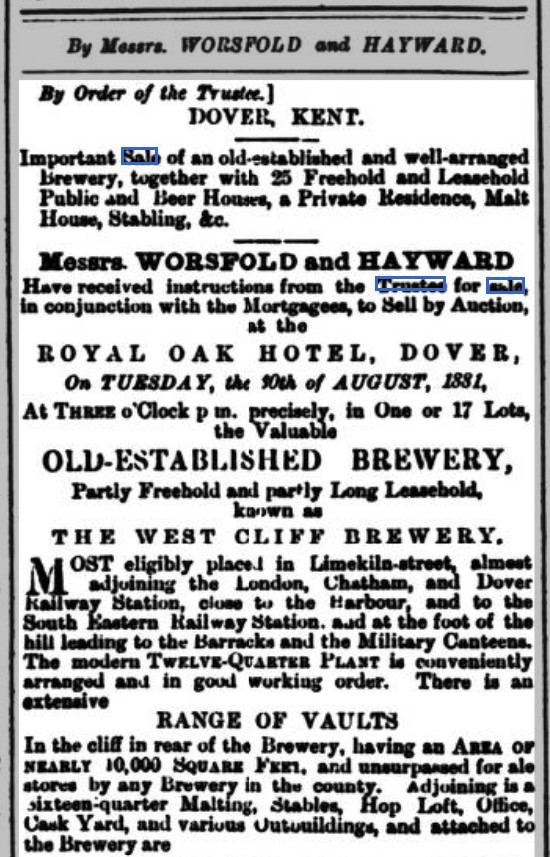
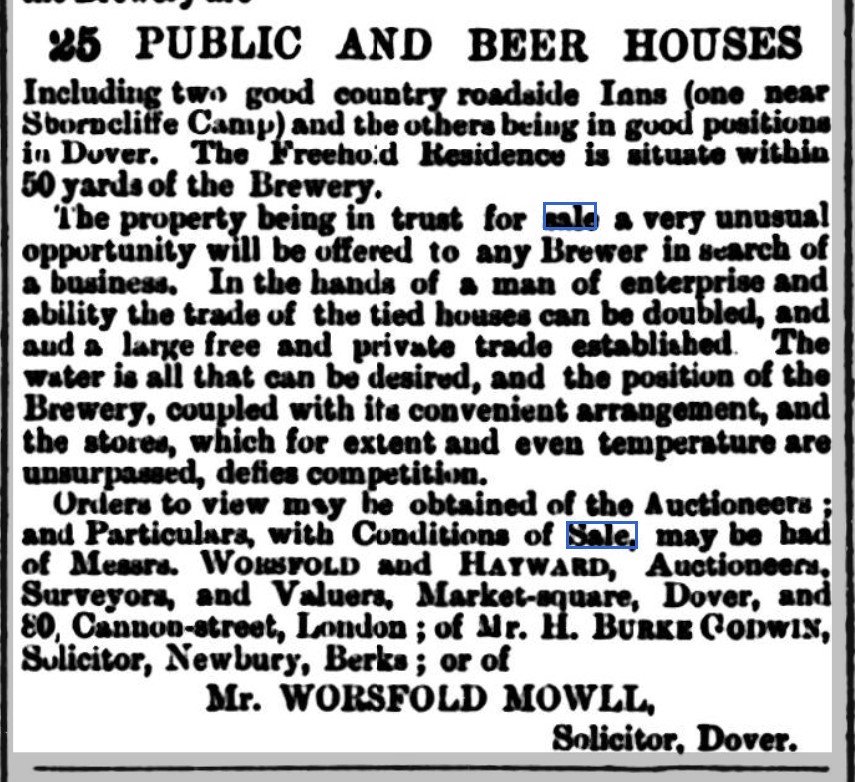
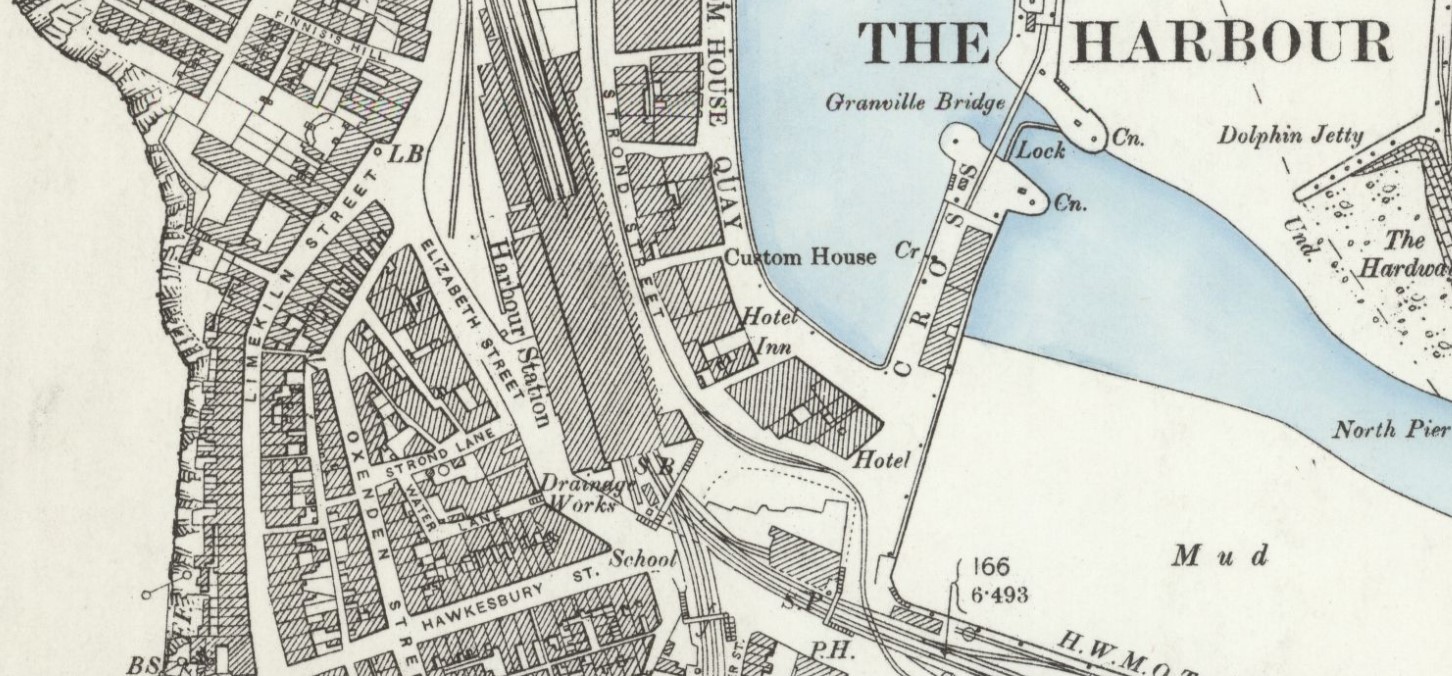
In 1874, John Thomas Satchell embarked on a new business venture by buying the West Cliff Brewery in Limekiln Street, Dover, for £9,100. The property comprised the brewery, malting house, six public houses, and a residence at 10 Limekiln Street. He paid a premium of £200 for the seven hired houses.[i]
After leaving school, John worked in the brewery.[ii] He also joined the 1st Cinque Ports Artillery Volunteers, which became an important part of his life.[iii] He attended drills, dinners and balls, won shooting competitions and rose to the rank of Lieutenant.[iv]
By 1880, John Thomas Satchell was attempting to dispose of the brewery, arranging auctions in October 1880 and again in March 1881.[v] When it was offered for a third time, in August 1881, the sale was conducted by trustees in conjunction with the mortgagees, indicating that control had passed to his creditors and that the disposal was effectively a distress sale.[vi] Although fourteen public houses realised £10,600, the brewery itself found no purchaser and was subsequently closed, with its plant and stock sold off later in the year.[vii]
The brewery’s closure marked a pivotal moment in John’s life, forcing a reassessment of his prospects. In November 1881, he resigned his commission in the Volunteer Corps and began training for a career in the church.[viii]
References
[i] Dover Express 27 March 1874 p. 2.
[ii] RG11, Dover, ED8, piece 1004, folio 30, p.10.
[iii] Dover Chronicle, 8 September 1877, p.6.
[iv] Dover Chronicle, 8 September 1877, p.6; Whitstable Times and Herne Bay Herald, 19 January 1878, p.3; Dover Chronicle, 7 September 1878, p.5; Dover Chronicle, 25 October 1879, p.5.
[v] Dover Express, 1 October 1880, p.4; Morning Advertiser, 3 March 1881, p.8.
[vi] Dover Chronicle, 13 August 1881, p.4.
[vii] Dover Chronicle, 3 September 1881, p.8; Kentish Express, 12 November 1881, p.4.The family’s home, 10 Limekiln Street, also remained unsold.
[viii] Dover Chronicle, 26 November 1881, p. 7.
Early career (1882-1897)
He entered the London College of Divinity in 1882, where the course of study typically lasted about three years.[i] While studying for this course, he learned of his brother Clifford’s death in New Zealand in June 1883 at the age of 22.[ii] Two more of his brothers would also die young, both from tuberculosis: Arthur Wild Satchell in 1888 and Edward Wade Satchell in 1892.[iii] Arthur died in the county lunatic asylum at Chatham, suggesting he had a pre-existing mental illness. Such an illness would have significantly affected the family and may have contributed to another brother, William Stanley Satchell, pursuing a career as a mental nurse.[iv]
In December 1885, John was ordained as a deacon at Oxford and licensed to the curacy of Thame in Oxfordshire, where he served for three years under the Rev Elijah Bagott Corbett, an associate of King’s College London and the vicar of Thame from 1872 until his death in 1892.[v] John was ordained as a priest at Oxford in December 1886.[vi]
In addition to his regular church duties, John actively participated in community and religious activities. He attended the annual meeting of the Society for Promoting Christianity to the Jews, spoke at a meeting of the Church Missionary Society, chaired a meeting on prison reform, and administered Holy Communion in the Workhouse on Christmas morning.[vii] His stay in the parish coincided with the celebrations for Queen Victoria’s Golden Jubilee in 1887 and the opening of a new Town Hall in 1888.[viii]
Despite his father’s occupation, John was a keen supporter of temperance. In May 1887, he attended a meeting at the Town Hall opposing the opening of pubs on Sundays and spoke at another temperance meeting later that year.[ix]
After leaving Thame, Satchell spent the next few years serving as a curate in London parishes: St Mark’s, Victoria Docks, from 1889 to 1890 and St Mary’s, West Kensington, from 1890 to 1892.[x]
He then moved to Cambridge, where he served as the curate-in-charge at the parish of St Andrew the Less from 1892 to 1896.[xi] In October 1893, he enrolled as a theology student at Trinity College and graduated with a third-class degree in 1896.[xii]
While at Cambridge, John met his future wife. Lucy Rose Yescombe, who was living with her great aunt and her husband, a retired army major, in a house in Newmarket Road, close to the church where John was the curate.[xiii] They married at St Mark’s, Coney Heath, St Albans, on 21 September 1898.[xiv] Lucy’s decision to marry may have been influenced by the major’s death in April that year.
Lucy was born on 29 March 1871 at Lyme Regis, the third daughter of Charles and Frances Elizabeth Yescombe.[xv] Both her parents belonged to gentry families. Her father, Charles, was the son of the Rev. Morris Yescombe and the Honourable Mary Jane Crosbie, whose first husband, the Honourable George William Massy, was the son of an Irish baron. Her mother, Frances, was the daughter of Nathaniel Preston, an Irish landowner and magistrate.
Frances had a troubled childhood, losing her mother when she was three and her father when she was ten. After that, she and her younger brother became wards of the Court of Chancery.[xvi] Frances later lived with an uncle in Bath, where she met Charles Yescombe and had a daughter with him in 1867, although they did not marry until the following year.[xvii]
The couple lived together for a time at Lyme Regis, where they had three more daughters: Mary Adelaide Margaret in 1869, Lucy Rose in 1871, and Dunbar Annie Henrietta Sydney, born in 1874, who died in infancy. Charles joined the Freemasons in July 1869 and became a First Lieutenant with the 1st Dorsetshire Artillery Corps in September 1871.[xviii]
In the mid-1870s, Charles and Frances separated “by mutual consent.”[xix] Charles resigned his commission as a First Lieutenant with the 1st Dorsetshire Artillery Corps in August 1875 and left the family home.[xx] By December 1878, he was living at Haverstock Hill, Camden.[xxi] In 1888, he died in a lodging house in Southampton at the age of 38 due to tuberculosis.[xxii] He left a small estate of £150, much of which was, by a codicil, left to a brother and a woman named Anna Louisa Spinks.[xxiii]
Frances stayed at Lyme Regis until at least 1879, supported by an income of £90 a year from a marriage settlement created by her late father and an allowance from her relations.[xxiv] Lucy and her sister, Mary, were sent away to Shalbourne in Berkshire to be tutored by a widow with previous experience running a school.[xxv]
The family circumstances placed Lucy, her sisters and her mother in an ambiguous social position, largely dependent on the generosity of relatives to maintain a genteel lifestyle. Lucy’s sister, Edith Morris Preston, married an Irish barrister and lived to the age of 87; her other sister, Mary Adelaide Margaret Yescombe, never married and died in 1907 after taking chloroform to help her sleep.[xxvi]
References
[i] Crockford’s Clerical Directory, 1898, p.1196.
[ii] New Zealand, Death Index, 1848-1966.
[iii] Death certificate of Arthur Wild Satchell; death certificate of Edward Wade Satchell.
[iv] RG14, St Pancras, ED39, piece 741.
[v] Berkshire Chronicle, 26 December 1885, p.8; Bucks Herald, 7 January 1893, p.5.
[vi] Reading Mercury, 24 December 1886, p.4.
[vii] Oxford Journal, 24 April 1886, p.8; Bucks Herald, 23 April 1887, p.5; Bucks Herald, 21 April p.8; Bucks Herald, 9 June 1888, p.8; Bucks Herald, 15 January p.5; Bucks Herald, 31 December 1887, p.7
[viii] Bucks Herald, 25 June 1887, p.8; Bucks Herald, 7 April 1888, p.8
[ix] Oxford Chronicle and Reading Gazette, 14 May 1887, p.8; Oxford Chronicle and Reading Gazette, 17 December 1887, p.6.
[x] Crockford’s Clerical Directory, 1898, p.1196.
[xi] Crockford’s Clerical Directory, 1898, p.1196.
[xii] Cambridge Independent Press, 6 October 1893, p.5; Morning Post, 24 June 1896, p.3; Crockford’s Clerical Directory, 1898, p.1196.
[xiii] RG12, Cambridge, ED1, piece 1283, folio 16, p.26.
[xiv] Dover Chronicle, 24 September 1898, p.1.
[xv] Western Times, 8 April 1871, p.2.
[xvi] Limerick Chronicle, 14 May 1845, p.3; Dublin Evening Mail, 18 March 1853, p.3; Dublin Evening Post, 10 May 1855, p.3.
[xvii] RG9, Walcot Trinity, ED8, piece 1695, folio 26, p.5.
[xviii] United Grand Lodge of England Freemason Membership Registers, 1751-1921; Hampshire Chronicle, 7 October 1871, p.8
[xix] https://www.bomford.net/IrishBomfords/Chapters/Chapter18/PrestonYescombeDocument.htm
[xx] Volunteer Service Gazette and Military Dispatch, 21 August 1875, p.14.
[xxi] https://www.bomford.net/IrishBomfords/Chapters/Chapter18/PrestonYescombeDocument.htm
[xxii] Death certificate of Charles Yescombe.
[xxiii] Will of Charles Yescombe, dated 4 March 1872, and codicil dated 7 June 1886, proved at the Principal Registry on 5 October 1886.
[xxiv] https://www.bomford.net/IrishBomfords/Chapters/Chapter18/PrestonYescombeDocument.htm
[xxv] RG11, Shalbourne, ED9, piece 1273, folio 108, p.2.
[xxvi] Wiltshire Telegraph, 4 December 1909, p.3; Weekly Irish Times,14 September 1907, p.2.


Middle career (1896-1912)
John’s degree from a prestigious college could have opened the door to a benefice, but this did not happen for another sixteen years. In the meantime, he served in a succession of curacies: St Luke, West Holloway 1896-1898, St Nicholas, Durham 1898-1901, Alston with Garrigill 1901-1905, St Peter’s, Bishop Wearmouth 1905-1909, St Stephen’s, Spitalfields 1909-1911, St James, Hatcham 1911-1912.[i] His two daughters were both born in Durham: Una Margaret on 1 October 1900, and Nathalie Frances on 11 November 1904.[ii] Crockford’s for 1908 listed the family’s address as 3 Holmlands Park, Sunderland.[iii]
John’s lack of promotion after obtaining his degree invites enquiry, particularly regarding his time in the Diocese of Durham. The Bishop of Durham had about 101 parochial livings in his gift and wielded considerable influence over many other appointments. John’s time in the diocese coincided with the tenure of two bishops: Brooke Foss Westcott, a liberal evangelical, and Handley Carr Glyn Moule, a prominent evangelical and a leading figure in the Keswick or “Higher Life” movement. John’s views were broadly aligned with both bishops, and furthermore, it is likely he encountered Moule during his time at Cambridge, where Moule was the Principal of Ridley Hall (1880-1899), a theological college just a short walk from Trinity College. The fact that neither Westcott nor Moule helped John secure a benefice suggests that other factors were at play besides theology. Possible explanations include a lack of ambition, an aversion to responsibility, and a preference for moving around and serving in different parishes. While the available evidence does not support a definitive conclusion, it’s important to note that preferment at that time often bore little relation to an individual’s ability.
In 1904, John’s mother died, followed by his father two years later.[iv] His father left an estate valued at £1,681 6s 2d, which was administered by John and a Dover solicitor. John inherited an oil painting by the seventeenth-century Flemish painter Teniers and shared the remainder of the estate equally with his six surviving siblings.[v]
By the time of John Senior’s death, three of his daughters—Alice, Edith, and Florence— were still living at home, all of whom worked as daily governesses.[vi] By 1911, Alice had moved into a six-room house at 6 Ladbroke Road, Epsom, with her sister, Mary, and Frances Yescombe, the mother of Lucy Satchell.[vii] Edith had moved to London, where she ran a kindergarten; while Florence remained in Dover, where she died in 1910.[viii] A fifth daughter, Mildred Scott Satchell, married Alfred Kearney, a Squadron Sergeant Major in the Yeomanry, in 1897.[ix]
Three of John’s sisters died unmarried in his lifetime, leaving estates from which they benefited. Florence died intestate, leaving an estate valued at £558 13s 9d.[x] Edith died testate in 1919, leaving an estate valued at £415 15s 2d, most of which she divided among her surviving siblings.[xi] Mary died intestate in 1920, leaving an estate valued at £983 8s 2d.[xii] John’s total inheritance from his three sisters probably amounted to about £400.
References
[i] Crockford’s Clerical Directory, 1932, pp.1149-50.
[ii] Civil Registration Birth Index; 1939 Register.
[iii] Crockford’s Clerical Directory, 1908, p.1262.
[iv] Dover Chronicle, 21 May 1904, p.1; Dover Express, 9 November 1906, p.5.
[v] Will of John Thomas Satchell, dated 26 January 1897, proved in London on 15 November 1906.
[vi] RG13, over, ED5, piece 841, folio 113, p.17.
[vii] RG14, Epsom, ED11, piece 2958.
[viii] RG14, St Pancras, ED6, piece 657; Dover Express, 18 February 1910, p.1; Dover Chronicle, 19 February 1910, p.2.
[ix] Civil Registration Marriage Index; RG13, Bolton, ED40, piece 36929, folio 94, p.10.
[x] National Probate Calendar.
[xi] Will of Edith Satchell, dated 20 March 1917, proved in London on 26 June 1919.
[xii] National Probate Calendar.
Bristol (1912-1927)
In 1912, Satchell finally obtained his own living when he was appointed rector of St Werburgh’s, Bristol, by the Lord Chancellor.[i] He also served as chaplain to Hook’s Hill Orphanage.[ii] He was rector during the First World War and, after the war, organised the erection of a memorial in the church, the opening of which was attended by 1,300 people.[iii]
His compassion for the poor is evident in his support for a petition calling on the Poor Law Guardian not to summon the unemployed for non-payment of poor law rates.[iv] His commitment to evangelising is evident in his support for a series of “Back to the Bible” talks held in 1925.[v]
In December 1924, he and his wife launched a campaign to raise £5,000 for a new Parish Hall, recognising that the “task is exceedingly difficult for a poor parish with no wealthy church people living in it.”[vi]
By May 1919, Lucy’s mother was living at the rectory, remaining there until her death in 1923, although she is not recorded on the 1921 census.[vii] She left an estate valued at £1,262 8s 5d, all of which she bequeathed to Lucy, except for her household items and personal effects, which she left to her other daughter, Edith.[viii]
Another resident at the rectory was Edith Julia Taylor, a friend of Lucy.[ix] Born in Brixton in 1875, she was the daughter of Charles Bartlett Taylor, a portrait painter and photographer. In 1911, she kept a boarding house at 8 Richmond Avenue, Montpelier, Bristol.[x] Lucy left her a generous bequest in her will.
On 3 July 1921, John conducted a farewell service as he was about to go on a year’s exchange to Smyrna.[xi] This may have been a gift to his wife, who was then fifty, or for health reasons. Either way, it prefigured the exchange of livings with the Rev Beddoe in 1927.
References
[i] Dover Chronicle, 31 August 1912, p.7.
[ii] Crockford’s Clerical Directory, 1932, pp.1149-50.
[iii] South Gloucestershire Gazette, 18 December 1920 p12.
[iv] Western Daily Press, 1 March 1921. p.9.
[v] Western Daily Press, 14 November 1925, p.6.
[vi] Western Daily Press, 11 December 1924, p.5
[vii] Will of Frances Elizabeth Yescombe, dated 17 May 1919, proved in London on 3 July 1923.
[viii] Will of Frances Elizabeth Yescombe, dated 17 May 1919, proved in London on 3 July 1923.
[ix] RG15, Bristol, ED8, schedule 132.
[x] RG14, Bristol, ED2, piece 15060.
[xi] Western Daily Press, 6 July 1921, p. 8.
Hardington Mandeville (1927-1933)
In September 1926, it was announced that the Rev. John Morgan Beddoe would exchange livings with the Rev. John Herbert Satchell of St Werburgh’s, Bristol.[i] Beddoe may have wished to move closer to his mother’s home at Gelligaer following his father’s death in May 1926.[ii]
John was instituted at Hardington in 1927.[iii] The exchange involved the valuation of live and dead farming stock at Hardington, which was carried out by the auctioneer and valuer, Sidney Herbert Crees.[iv] John did not wish to retain the use of the walled kitchen garden at the rectory, and in September 1927, he advertised it to let. The garden extended to ¾ acre and had 81 fruit trees, a vinery with four good vines, a plum house and a good water supply.[v] In May 1932, he advertised cow stalls, stables, a garage, outhouses and about one acre of kitchen garden at the Rectory, available to let as a whole or in parts.[vi]
John also chose not to engage in farming. On Monday, 5 December 1927, he sold his livestock and farm implements by auction. The sale included a herd of 17 Shorthorn cattle, a black cart horse, two wagons, a milk float, a set of chain harrows, a mowing machine, a tedding machine, a horse rake, an iron pig trough, two portable poultry houses, a rick of hay and one ton of mangolds.[vii]
On 28 June 1929, Lucy died at the rectory at the age of 58 due to kidney failure.[viii] She left an estate valued at £1,406 5s 2d, of which about a third was probably taken up in providing an annuity of £20 for Edith Julia Taylor. Lucy gave her husband first choice of any household items, effects, and jewellery he wished to keep, followed by Edith, and then other relatives and friends, with no one person allowed more than £5 in value. The remainder was divided between her two daughters.[ix]
Local newspapers provide glimpses of John’s parochial duties. In November 1928, he was among the clergy present at the induction of the Rev. Henry Haywood to the living at Barwick.[x] In May 1931, September 1932 and April 1933, he advertised for an organist.[xi] On Saturday, 1 August 1931, a fete was held in the Rectory grounds.[xii] On Monday, 28 March 1932, he officiated at the wedding of Percival George Abbott and Muriel White.[xiii] Another fete was held in the rectory grounds on Saturday, 18 June 1932, raising money for the Church Bells Fund, followed by an evening pageant depicting the flight of Prince Charles to France. [xiv] In May 1932, a faculty was applied for to add a new bell and to rehang the five existing bells.[xv]
On Monday, 17 July 1933, John died unexpectedly at St Luke’s Nursing Home for the Clergy in London following an operation, at the age of 74. His funeral was held at Hardington three days later.[xvi] He left an estate valued at £2,593 7s 7d, which he divided among his two daughters and his two surviving sisters, Alice and Mildred. He gifted his household effects and half of the remainder to his two daughters equally. One quarter of the remainder was allocated to provide an annuity for Alice for life, with the other quarter designated for Mildred’s annuity for life. After their deaths, the capital was to pass to his daughters.[xvii] On 7 September 1933, his surplus furniture and effects were sold by auction.[xviii]
References
[i] Clifton and Redland Free Press, 23 September 1926, p. 3.
[ii] Western Mail, 27 August 1926, p. 6.
[iii] Crockford’s Clerical Directory, 1932, pp.1149-50.
[iv] Somerset Heritage Centre, D/P/hard.m/23/3.
[v] Western Gazette, 23 September 1927, p. 9.
[vi] Western Gazette, 20 May 1932, p. 9.
[vii] Western Gazette, 25 November 1927, p. 1.
[viii] Western Gazette, 5 July 1929 p. 16; death certificate of Lucy Rose Satchell.
[ix] The will of Lucy Rose Satchell, dated 21 December 1914, proved in London on 24 July 1929.
[x] Exeter and Plymouth Gazette 15 November 1928, p. 2.
[xi] Western Gazette 1 May 1931, p. 8; 15 May 1931, p. 8; Western Gazette, 30 September 1932, p. 8; Western Gazette, 7 April 1933, p. 8.
[xii] Western Gazette 12 June 193,1 p. 9.
[xiii] Western Gazette 1 April 1932, p. 6.
[xiv] Western Gazette 29 April 1932, p. 9; 17 June 1932, p. 9.
[xv] Taunton Courier and Western Advertiser 8 June 1932, p. 5.
[xvi] Western Daily Press 19 July 1933, p. 8 and p. 12.
[xvii] Will of Rev. John Herbert Satchell, dated 23 September 1929, proved in London on 7 November 1933.
[xviii] Western Gazette 1 September 1933, p. 1.
Conclusion
John Herbert Satchell’s life contains many features that can be described but not fully explained. He embarked on a clerical career after the collapse of his father’s brewing business; however, there is little in his background that clearly points towards such a vocation. He had no close relatives in the clergy, experienced no early bereavements, and spent much of his youth engaged with the artillery volunteers. In his mid-thirties, he undertook a theology degree but achieved only a third-class, which does not appear to have materially improved his prospects.
Over nearly three decades, he served as a curate in ten different parishes, never remaining in one place for more than four years. His eventual appointment to the benefice of St Werburgh’s did not come until he was 53. Such a pattern suggests not simply patience but a lack of advancement within the normal structures of clerical preferment. Whether this reflected limited patronage, personal disposition, or other factors that are now obscure cannot be determined, but the result was a career that developed slowly and without early recognition.
The overall impression is of a man who adapted to circumstances rather than shaping them. Deprived of the commercial path that might have defined his life, he entered the Church and served it steadily, but without evident momentum. His career illustrates how a clerical life could be sustained over many years through diligence and mobility, yet without securing either promotion until relatively late in life.