Introduction
Thomas Gilbert Denty was born into a labouring family at Hardington Marsh in about 1867. His early life was marked by family instability and economic hardship following his father’s death. After serving an apprenticeship as a blacksmith, he enlisted in the Somerset Light Infantry and served in South Africa during the Second Boer War. In old age, he died in the former Yeovil Union Workhouse, a setting that stands in marked contrast to the public celebration that greeted his return from overseas service.
Childhood
Thomas was born at Hardington Marsh in about 1867. He was the youngest son of Charles Denty, a railway labourer, and his wife, Elizabeth Ann (nee Taylor). The 1861 census shows Charles and Elizabeth living in a household headed by Elizabeth’s grandmother, Mary Taylor. In the early 1870s, the household suffered two deaths. Mary Taylor passed away in February 1870, and almost exactly one year later, Charles Denty died in the Yeovil workhouse at the age of 42 after suffering a year of paralysis caused by spinal disease.[1]
Charles’s death left Elizabeth in sole charge of six children. On 27 February 1873, Thomas and three of his sisters were baptised in the parish church. By April 1881, Elizabeth was still at Hardington Marsh, although two of her daughters had moved away. At this time, Thomas was working as a blacksmith’s apprentice.
Military service and South Africa
Military records indicate that Thomas enlisted in the Somerset Light Infantry in 1886 (Regimental Number H/1414). However, he appears in the 1891 census at Hardington Mandeville. It is unclear whether his early service was brief, intermittent, or misrecorded, but he later served overseas.
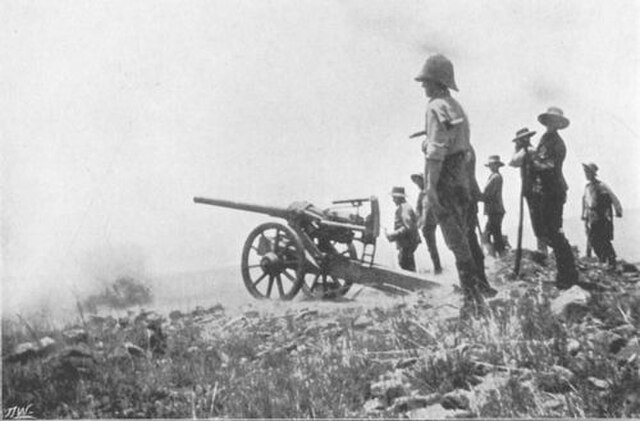
On 26 June 1902, Thomas returned home after two and a half years in South Africa during the Second Boer War. He had served under Sir Redvers Buller and was present at the Battle of Spion Kop. His return was marked by a striking display of local pride: the Rev. Cleife met him at Hardington Moor and gave up his carriage so that villagers could draw Thomas through the village themselves. For a labourer’s son from Hardington Marsh, this was a rare moment of public recognition.[2]
Civilian Life and the First World War
The surviving evidence for Thomas’s civilian life is limited. On 10 October 1910, Yeovil magistrates fined Thomas 2s 6d for being drunk in Hendford the previous Saturday night.[3]
At the outbreak of the First World War, he was probably recalled as a reservist, though he would have been 47 years old at that time. He was discharged on 14 February 1918, but the details of his wartime service remain unclear.
Later years
After his discharge, Thomas becomes difficult to trace. He has not been securely identified in the 1921 census or the 1939 Register. Whether he was lodging, moving between addresses, or already in institutional accommodation cannot yet be established.
On 2 August 1938, he travelled alone to Dorchester, where he drank heavily, and later continued by bus to Blandford. That evening, the police found him in a drunken state, lying on the pavement in Salisbury Street and took him to the police station by car. The following day, he told the magistrates that he had “a drop too much” at Dorchester and that he had no recollection of getting off the bus at Blandford. They fined him 10s or one day’s imprisonment. This incident, undertaken without any companions, suggests both mobility and a degree of social isolation.[4]
Thomas died in the former Yeovil Union Workhouse on 19 August 1944 from cancer of the fauces (throat) at the age of 77. It is unknown how long he had been a resident there; he may have entered only in the final stages of illness, although a longer period of institutional residence cannot be ruled out. The circumstances of his death stand in stark contrast to the reception he received in 1902.
References
[1] Death certificate of Charles Denty.
[2] Western Chronicle, 4 July 1902, p.5.
[3] Dorset County Chronicle, 13 October 1910, p.13.
[4] Western Gazette, 5 August 1938, p.4.