Introduction
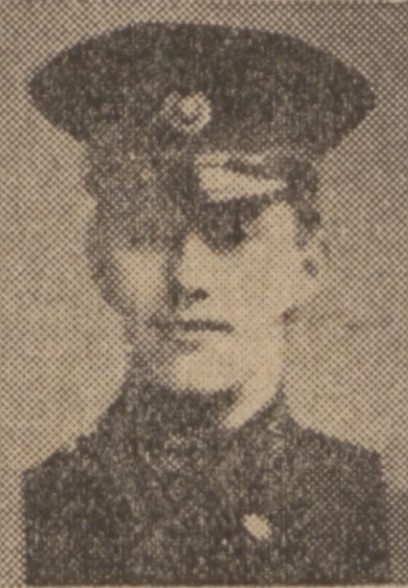
Wilfred Frank Slade, usually known as Frank, was born into a military family and served as a musician in the Royal Marine Band from 1912 to 1934 and from 1939 to 1945. Although he never lived at Hardington Mandeville, he is included on the Hardington Roll of Honour of January 1915, alongside his father, John, and his brother, Charles. Their connection to Hardington arose from John’s brief residence there in his youth and his marriage to Elizabeth Delamont, who was born and brought up in the village.
Early Years
Frank was born on 1 October 1896 at Devizes, where his father, John Slade, served with the Wiltshire Regiment at Le Marchant barracks.[1] Frank was baptised at St James’s Church, Southbroom, the official garrison church for the Wiltshire Regiment, on 25 October.[2] His mother, Elizabeth Susan (née Delamont), originally came from Hardington Mandeville.
By September 1899, the family had moved to Westbury and lived in the Drill Hall, where John served as a Colour Sergeant Drill Instructor.[3]
Military career
On 18 June 1912, Frank enlisted in the Royal Marine Band.[4] Although his service record described him as a schoolboy, the 1911 census, taken only a year earlier, recorded him as a kid glove worker. It also notes that he was five feet two and a half inches tall with brown hair, brown eyes and a fresh complexion. His record shows that he grew to five feet six inches.
He served as a band boy at the Royal Naval School of Music at Eastney Barracks, Portsmouth, until 23 August 1914, when he was posted as a musician to HMS Queen. He was serving on that ship when he was included in Hardington’s Roll of Honour in January 1915.[5] Three months later, the ship provided gunfire support during the Anzac landings at Gallipoli. Frank may have served as a stretcher-bearer or member of the ship’s Medical Aid Party, since Royal Marine bandsmen received training for those duties in addition to their musical role.
Frank returned to the School of Music from 23 February 1917 to 24 March 1917 before serving on HMS Zealandia. Further postings followed, interspersed with periods at the School of Music. He served on HMS King Alfred from December 1917 to May 1918, and the dreadnought battleship HMS Colossus from October 1918 to February 1919. This placed him in the North Sea and surrounding home waters during the final months of the war.
After the war, he served successively on Princess Royal, Iron Duke, Renown, Royal Sovereign, Hermes, St Vincent, and Queen Elizabeth. His postings placed him aboard many of the Royal Navy’s best-known capital ships, as well as the aircraft carrier Hermes, during the inter-war years, reflecting the varied duties of Royal Marine musicians across the fleet.
Several of these ships served as fleet flagships during the 1920s and 1930s and took part in royal tours and diplomatic cruises across the Empire. Hermes, the world’s first warship designed and built as an aircraft carrier, was at the forefront of early naval aviation.
While serving on HMS Royal Sovereign, he re-engaged on 14 June 1926 and completed twenty years’ adult service on 23 October 1934. Like many long-serving Royal Marines, he spent his final weeks at the Royal Navy School of Music completing the administrative and medical formalities of discharge.
Marriage
On 15 September 1934, Frank married Ivy Angeletta Tickner at St John’s, Gosport.[6] Ivy, who was eleven years younger than Frank, was the daughter of a dockyard labourer. They lived initially at 32 Ash Grove, Hendon, where they had two children: David Delamont John in 1936 and Elizabeth Ann in 1938.[7]
Second World War
By 29 September 1939, the family had moved to 11a Heaton Road, Gosport. Frank is not listed on the 1939 Register because he was mobilised on 16 September 1939 and served until 11 September 1945. He served at two shore establishments: HMS Royal Arthur, the Royal Navy training establishment created from the former Butlins holiday camp at Ingoldmells near Skegness, from September 1939 to November 1944 and HMS Gosling, a training camp near Warrington, from November 1944 until July 1945. His last nine weeks were spent at the Royal Navy School of Music.
Later life
After the war, Frank returned to Gosport, where he worked as a postman.[8]
On 4 November 1949, their eleven-year-old daughter, Elizabeth, died in the Royal Portsmouth Hospital from uraemia and acute nephritis. Frank registered her death the following day.[9]
In October 1961, he was awarded the Imperial Service Medal in recognition of long service with the Post Office.[10]
Frank died on 6 August 1963 at the age of sixty-six, leaving an estate valued at £3,749 19s, which was administered by Ivy. His last address was 13 Heaton Road, Gosport.[11] Ivy survived him by twenty-nine years, dying at Pell House Nursing Home, Woodcote Lane, Fareham, on 2 November 1992, at the age of eighty-five.[12]
Conclusion
Frank’s career was shaped by service rather than place. As a Royal Marine musician, he spent more than two decades at sea and later returned to uniform during the Second World War before beginning a second career with the Post Office. Although his connection with Hardington was indirect, three members of the Slade family appeared on the village Roll of Honour, reflecting the family’s long tradition of military service.
References
[1] Civil registration birth index; 1939 Register; Wiltshire Times and Trowbridge Advertiser, 26 October 1935, p.3.
[2] Baptism register of St James’s Church, Southbroom.
[3] Civil registration birth index; 1939 Register (records for Frank’s sister, Eileen Dorothy May Slade to establish the family’s move to Westbury).
[4] ADM 159/110/2020.
[5] Western Gazette, 26 March 1915, p.5.
[6] Wiltshire Times and Trowbridge Advertiser, 29 September 1934, p.3.
[7] Hendon electoral rolls.
[8] Death certificate of Elizabeth Ann Slade (for Frank’s occupation).
[9] Death certificate of Elizabeth Ann Slade.
[10] Portsmouth Evening News, 30 October 1961, p.4.
[11] National probate calendar.
[12] National probate calendar.