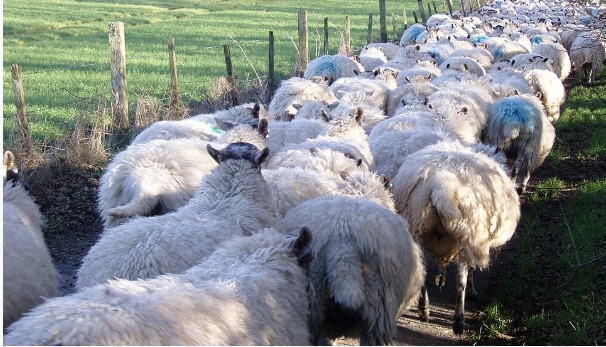
In the nineteenth century, flocks of sheep and their drovers were a common sight on the rural roads of England. The dealers and drovers who oversaw the work depended largely on their reputations for honesty and integrity. This 1865 court case, arising from an accusation that a drover and a dealer stole a sheep, paints a vivid picture of a sheep drive from Dorset into Somerset.

On a Spring day in 1865, a drover named John Taylor set out from Maiden Newton to take a flock of 124 sheep to Yeovil market. As he climbed Cattistock Hill, he met a fourteen-year-old boy walking from Weymouth to Yeovil, and offered him money, bread, cheese, and beer if he would help drive the sheep.
About a quarter of an hour later, the boy saw a sheep from an adjoining field push through a hedge into the road and join the flock. He asked Taylor whether he intended to catch it, but Taylor replied that he would not, as doing so might cause him to lose two or three of his own sheep. The stray sheep was marked with the letter “S”, making it easy to identify later.
Taylor and the boy took the flock to Holywell Farm, where they turned the sheep out into a field for the night. They then went to a public house near the railway station at Evershot before sleeping in a nearby paddock.
About four o’clock the following morning, they collected the sheep and drove them seven miles to Mr Burnell’s farm at Barwick. There, the owner of the flock. Jonathan Neale, a cattle dealer of Haselbury, inspected and counted them. Taylor told both Burnell and Neale about the extra sheep, to which Neale replied: “Never mind, it is a far deal better than losing one.”
Although the original intention had been to take the sheep to Yeovil market, Neale appears to have seen an opportunity to get a better price. He invited Lord Portman’s agent, Henry Parsons, to view the flock and the next day instructed Taylor to take the sheep to Bridge Close Farm, Hardington. Upon their arrival, the sheep were put in a barton with the help of the farm’s bailiff, George Marsh. A few days later, about twenty-five sheep were placed in a field near the farm rented by Neale, and the remainder were moved to Haselbury.
The matter might have ended there had Neale taken steps to return the stray sheep or compensate its owner, but for whatever reason, he failed to do so. On 27 April, the police heard of the matter and initiated a prosecution for theft. The sheep’s owner, Thomas Smith, a farmer of Cattistock, was unaware that any sheep was missing until the police informed him.
Taylor was arrested on 29 April and held in prison until the hearing at Cerne Abbas police court on 8 May. Neale was arrested on 1 May and held overnight before being released on bail.
The police managed to identify the young lad who had helped Taylor as James Charles Chapman and traced him to his father’s address in Salisbury. He proved to be a crucial witness, having seen what happened on Cattistock Hill and heard Taylor tell Neale, Burnell, and George Marsh about the stray sheep.
In the end, the magistrates were satisfied that no crime had been committed and, at the request of Neale’s solicitor, expressed the opinion that he left the court without a blemish on his character.
As for James Charles Chapman, he never received the money he was promised. After leaving the sheep at Bridge Close Farm, he and Taylor walked to Yeovil and visited the Choughs Tap, where Taylor bought him some cider. Taylor then said he was going out to purchase some plants for his father, who lived at Hilfield, but he did not return. Chapman wandered around the town for some time and, with the help of the police, found a bed for the night at the Mermaid Hotel.
The fact that Taylor’s father lived at Hilfield may provide a clue to Taylor’s identity. In May 1864, John Taylor, aged 22, of Leigh, was found guilty of stealing a spade. while his father, Thomas, aged 60, of Hilfield, was convicted of stealing wood. John received twenty-one days’ hard labour, and Thomas received seven. If this was the same man, his previous conviction might explain why the police treated the sheep incident with such seriousness.
In perspective
The case illustrates how established practice could come into conflict with the police and the courts. Driving sheep over long distances depended on informal practices, quick judgments, and a degree of tolerance when animals strayed or mingled. Taylor’s decision not to pursue the stray sheep and Neale’s casual remark that gaining one was preferable to losing one reflect a working culture based on practical convenience. Yet by the 1860s, that world was increasingly under closer scrutiny by police and magistrates. What might once have been settled quietly between neighbouring farmers instead became the subject of formal investigation, arrests, and a court hearing. The outcome—dismissal without blemish—suggests that the magistrates still recognised the realities of agricultural practice despite the changing legal landscape.