Introduction
Born into poverty in nearby Misterton, John Genge overcame an unpromising start through military service and steady manual employment. After marrying and settling in Hardington Mandeville, he worked in a succession of labouring occupations, including a position as an under-gardener at the rectory, before entering the building trade. During the 1920s, he achieved a modest level of security by purchasing his own cottage, becoming involved in parish affairs and spending the rest of his working life in the village.
Early life
John was born on 16 August 1872 at Misterton, the third of four children of Henry Genge and his wife, Rabinet (née Spurdle). His father had been born at Hardington but left the village after serving six months’ imprisonment with hard labour for assaulting a gamekeeper in 1860.[1] After settling at Misterton, Henry earned his living as a sawyer and married Rabinet, a widow with three young children, in 1867. Life was difficult for the family. Before her remarriage, two of Rabinet’s sons had spent time in the Stoke Abbott workhouse, illustrating the precarious circumstances from which John emerged.
Misfortune continued during John’s childhood. Henry died of phthisis in July 1878 at about forty-four years of age, leaving Rabinet to support the family with a combination of parish relief and work as a charwoman.[2] The following year, John’s sister Fanny died at the age of ten. Rabinet remained at Misterton until her own death in August 1890.
The following year, John enlisted in the Somerset Light Infantry, serving for about seven years.[3] Military service provided a degree of stability and opportunity that had been largely absent from his early life.
Marriage and working life
After leaving the army, John married Emily Higgins of Hardington and settled in her village. Their son, Henry John, was born on 21 April 1900.
By 1901 they were living at High Street Cottages, where John worked as a general labourer on Viscount Portman’s estate. Between about 1909 and 1912 he was employed as under-gardener at Hardington Rectory. His work extended beyond ordinary gardening, for newspaper reports often record him helping to decorate the parish church for Easter, Harvest Thanksgiving and Christmas, suggesting that he played a practical role in supporting the village’s religious life. [4]
Like many rural labourers, John supplemented his income whenever possible. In January 1914 he advertised a nanny goat for sale, and five years later he offered dressed building stone for sale, possibly disposing of surplus material or taking advantage of growing demand after the First World War.[5]
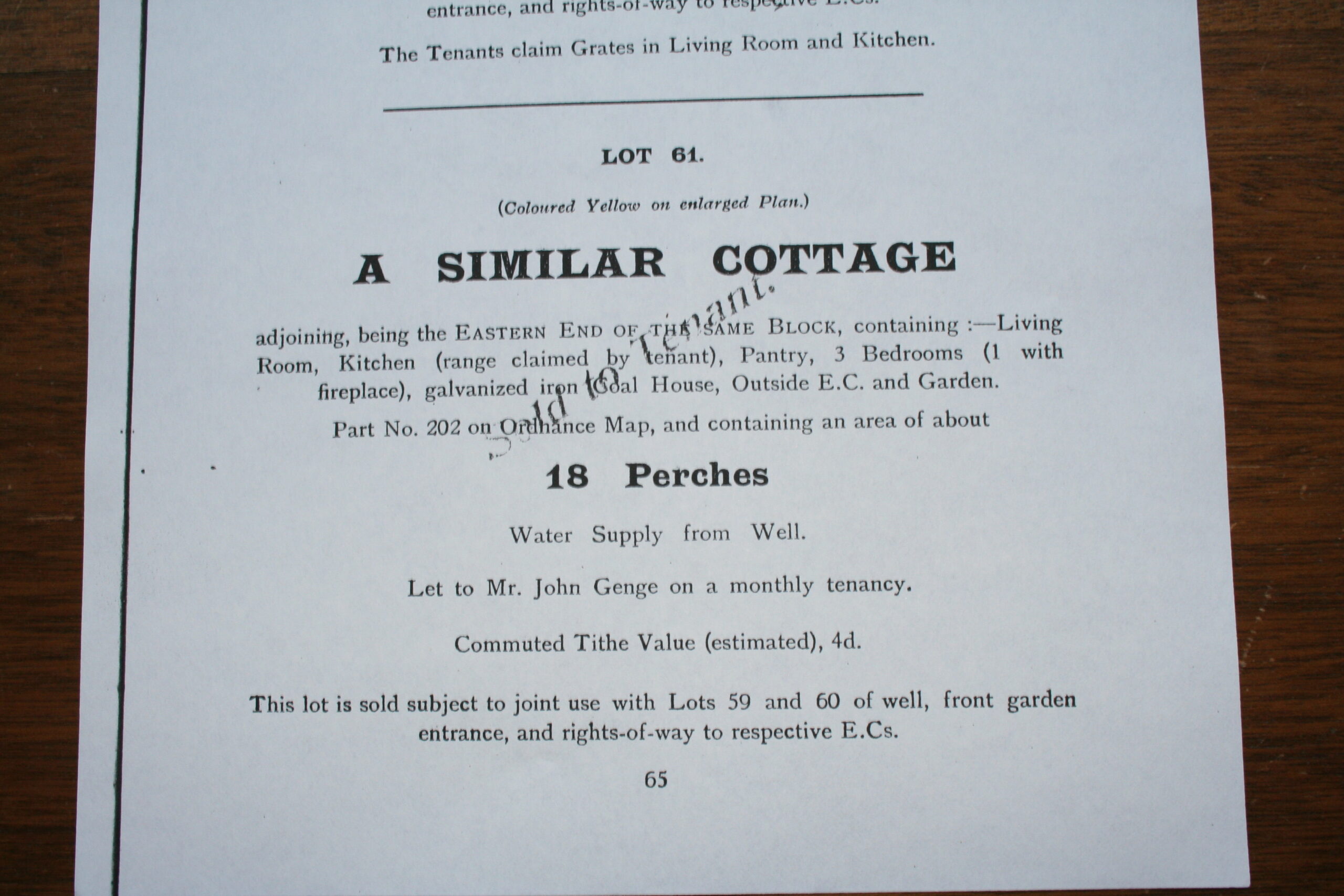
By October 1920, the family had moved to Rydon Cottages, the cottage nearest Broadstone, which John purchased at the Hardington estate sale.[6] Home ownership represented a significant step for someone who had grown up in poverty. The 1921 census recorded him as a general labourer employed by Arthur Charles Edwards at Moor Farm, while his son worked as a mason for Bird & Pippard of Yeovil. By 1926, John himself had become a builder’s labourer, probably working on construction projects in Yeovil alongside his son.[7]
John also showed an interest in local affairs. From 1919 onwards he repeatedly stood for election to Hardington Parish Council. Although he did not secure sufficient votes in 1919 and 1925, he was successful in 1921.[8] His willingness to stand for election suggests that he had become an established and respected member of village society.
Emily died on 9 July 1926 after suffering from breast cancer for about eighteen months. Although her death certificate listed her age as fifty-two, she was probably fifty-three or fifty-four.[9]
Second marriage and retirement
In 1928, Henry married Dorothy Heal of Coker Hill, and established his own household. The following year, John married Constance Louise Holwill, who was twenty years his junior.
Constance was born in Yeovil in June 1892 to Hubert Henry Holwill, a solicitor’s clerk, and his wife Bessie Emma. Her mother died when Constance was only two months old, after which her father remarried and raised a second family. During her childhood, the family moved to Teddington, where Hubert became a stationer, newsagent, and tobacconist. Constance later returned to Somerset and lived with her elder sister, Doris Richards, in Yeovil during the 1920s before her marriage to John.
In May 1937, John advertised Rydon Cottage for sale, and it was purchased by William Keen, a retired printer.[10] John and Constance subsequently moved first to Hill End, Hardington, before settling at Rose Villa, Hewish, near Crewkerne. The move may have reflected retirement and a desire for a smaller or more convenient home.
John died on 27 June 1954 at the age of eighty-one, leaving an estate valued at £346 9s 6d. He bequeathed £5 to each of his four grandchildren, one quarter of his estate to his son, and three quarters to Constance.[11] After his death, Constance moved to 39 West Street, Crewkerne. She died on 6 November 1959 at the age of sixty-seven, leaving an estate valued at £1,450 6s.[12]
Conclusion
John Genge’s life illustrates how steady employment could improve the circumstances of a rural labourer born into severe poverty. Military service provided an early opportunity to escape the insecurity of his childhood, while marriage rooted him in Hardington for almost forty years. Although he never rose above manual work, he achieved a degree of independence through home ownership, participation in parish life and long, continuous employment. His story reflects the quiet resilience of many working men whose fortunes improved slowly through steady persistence.
References
[1] Sherborne Mercury 31 July 1860 p. 5; Bridgwater Mercury 15 August 1860 p. 6; Western Daily Press 11 August 1860 p. 2.
[2] Death certificate of Henry Genge.
[3] Royal Hospital Chelsea: Soldiers’ Service Documents; Reference Number: WO 97.
[4] Western Chronicle 16 April 1909 p.6; Western Gazette, 21 April 1911, p.4; Western Chronicle 31 December 1909 p.6; Western Gazette 22 September 1911 p. 4; Western Gazette 29 December 1911 p. 2; Western Chronicle 12 April 1912 p. 6; Western Chronicle 20 September 1912 p.6; Western Chronicle, 3 January 1913, p.5.
[5] Western Gazette, 16 January 1914, p.7; Western Gazette, 11 April 1919, p.7.
[6] Eddy Colin Turner’s copy of the estate sale catalogue of October 1920.
[7] Death certificate of Emily Genge.
[8] Western Chronicle 21 March 1919, p. 3; 18 April 1919, p. 11; Western Chronicle 17 March 1922, p. 3; Western Chronicle 10 April 1925, p. 6.
[9] Death certificate of Emily Genge.
[10] Western Gazette, 7 May 1937, p.9.
[11] The will of John Genge dated 8 June 1954, proved at Bristol on 21 July 1954.
[12] National Probate Calendar.