Introduction
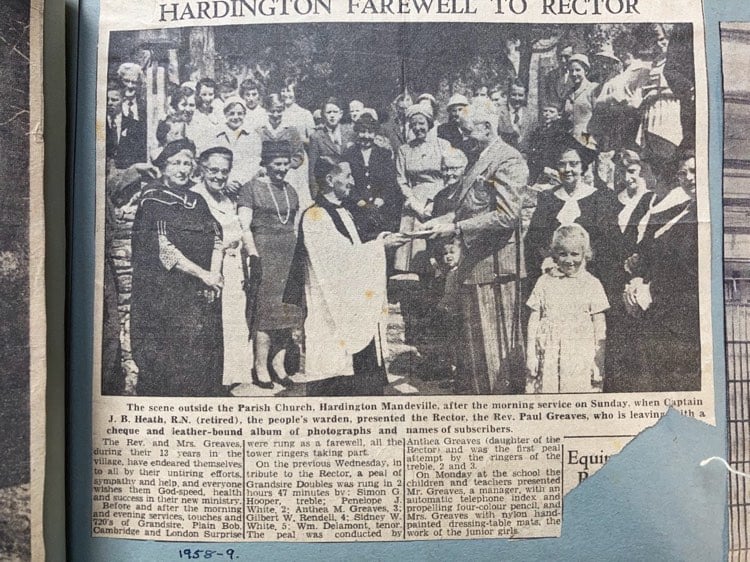
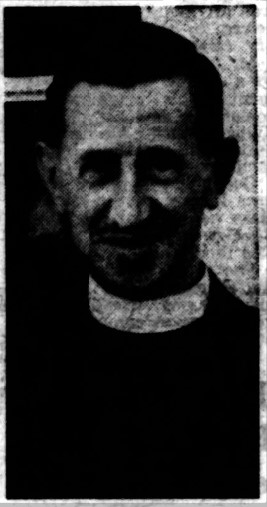
Paul Greaves was born into a coal mining family in a Derbyshire village. After moving to Bolton, he began training as an accountant but gave it up to become a Church of England priest. He served as the rector of Hardington Mandeville from 1946 to 1959, during which time he was especially active in evangelising among young people.
Childhood
Paul was born at Killamarsh, Derbyshire, on 26 June 1906, as the second child of Paul and Alice Greaves. He had a sister, Mary, who was three years older.
Killamarsh was a mining community located ten miles southeast of Sheffield, near the border with Yorkshire. In 1911, the parish had a population of 3,644.[1] The Greaves family had lived in Killamarsh and the adjoining parish of Eckington since at least the mid-eighteenth century, and Paul’s lineage includes a succession of ancestors named Paul Greaves, dating back to his great-great-grandfather, born around 1761.
Paul senior, like his brothers, Thomas and Harry, worked in the coal mining industry. He worked as a coal miner at Norwood Colliery, the village’s largest colliery, owned by the Sheepbridge Coal and Iron Company. From 1894 to 1902, he lived with his widowed mother in a four-room house at 3 Church Lane, near the parish church of St Giles. His brother Harry lived at number 7. Then, at forty, Paul married Alice Mullard.
Alice was the daughter of Paul’s cousin, Mary Greaves, who had left Killamarsh as a girl to work in domestic service. In July 1871, she married Thomas Mullard at Stokesay, Shropshire, and their first child, Alice, was born later that year at Winforton, Herefordshire. About five years later, the family moved to Sussex, where Thomas initially worked as a gamekeeper and later as a police constable until his death in 1896. By this time, Alice had entered domestic service. She was working as a housemaid for a retired colonel in Eastbourne by April 1891, and as a cook for an elderly widow in Kensington by March 1901.
Paul and Alice were married at St Giles church, Killamarsh, on 30 January 1902. The witnesses were Paul’s brother Harry and Alice’s sister Emma. The couple initially settled at 53 Mansfield Road, an area populated by industrial workers. Paul’s mother, Jane Greaves, and Alice’s mother, Mary Mullard, also lived with them.
Paul was a member of the Ancient Order of Foresters, and was inducted as Senior Woodward of Court Robin Hood in January 1904 he.[2]
On the morning of Tuesday, 19 May 1908, Paul went to work as usual. At about 9.30, Frederick Trueman, a stallman, heard Paul shouting about twenty yards away. When Trueman went to investigate, he found Paul pinned beneath a fall of coal and crying in pain. Working with others, he freed Paul and took him a mile and a half to the pit bottom, where a doctor examined him. The doctor and the mine deputy applied splints to his left leg and sent him to Chesterfield Hospital. The hospital staff discovered that Paul had a severe compound fracture in his right leg and that his left leg was badly crushed. No operation was performed, and although he initially seemed to be recovering, gangrene set in on his left leg on 25 May. Paul died the following day from blood poisoning at the age of forty-seven.
An inquest held at the hospital two days later included Mr A. H. Stokes, the chief inspector of mines for the Midland District. Alice appeared as the first witness, identifying her husband, and stating he had been in good health before the accident. Fred Trueman, who found Paul trapped in a fall of coal, testified that he asked Paul what had happened and that Paul replied that he knocked a sprag out and another one came too. When Stokes questioned him, Trueman said he did not know why Paul had knocked out the sprag. He had shouted to him to fire with the sprags in because he thought the shot might knock the timbers out. Paul had not replied.
The next witness, Arthur Reaney, a filler at the colliery, was considered an unsatisfactory witness and, in reply to Stokes, admitted that he had discussed the matter with Trueman, the previous witness. Benjamin Trueman, the deputy of the mine, described Paul as a very reliable man, in whom he had every confidence. He could not say why Paul had knocked out the sprag; in his opinion, it was completely unnecessary, and he had no business in doing it. The senior house surgeon at the hospital also gave evidence.
After reviewing the evidence, the coroner concluded that no one was to blame except the deceased, and the foreman of the jury agreed that it appeared to be an error of judgement. The jury returned a verdict that Paul died from blood poisoning caused by the accidental injuries. However, after the verdict, Stokes responded to a remark by one of the jurors by saying he wanted to inform them that, in many places, a charge was not allowed to be put in unless the shot firer had seen it. He added: “We are determined that the firer shall know what is in the charge before he fires it.”
The local newspapers accepted the official view, carrying headlines such as “Killamarsh Miner Responsible for His Own End.” However, this may distort the truth. Paul had eight or nine years of experience as a shot firer and would have known the dangers of removing sprags. Additionally, it seems implausible that Trueman would have explicitly reminded him. Most telling of all is Stokes’s observation at the end. His comment suggests that he had some concern about the procedures followed before the shot was fired. The official accident report may provide further evidence.
Paul’s death had a profound effect on his family. Alice was now responsible for making ends meet while caring for two children, aged five and one, as well as her mother and mother-in-law. The 1911 census recorded the three widows and two children living in a five-room house at 53 Belle Vue, Highmoor, an address that may refer to the same house as 53 Mansfield Road. Four months later, Jane Greaves died at the age of seventy-six.
Barrow Bridge, Bolton
After Jane’s death, the remaining family members moved to Barrow Bridge, Bolton. The move brought Alice closer to her father’s sister, Annie Pope, who lived at 51 Fifth Street, Barrow Bridge, as well as to Alice’s youngest sister, Ethel, who had married Annie’s son.
Alice’s mother, Mary Mullard, died at Bolton on 20 March 1920 at the age of seventy-two.[3] By June 1921, the family lived at 49c Fifth Street with four boarders. Alice worked as an ironer at the Smithill Laundry, Mary as a winder in a cotton mill, and Paul as a junior clerk for Liptrott and Jackson, a firm of estate agents and accountants with offices at 9 Mawdsley Street.
Soon after beginning a career in accountancy, Paul felt the call to take up church work.[4] How he prepared for this path is unclear, but he may have studied independently or through evening classes to meet the entry requirements for theological training. In October 1934, he passed the matriculation examination for the University of Durham and was admitted to study for a Licentiate in Theology, which, for a non-graduate, took six terms either at Durham itself or at an affiliated theological college.[5]
After obtaining the licentiate in 1936, he trained for one year at the Bible Missionary Training College at Clifton, Bristol (later known as Tyndale Hall), where he received practical ministerial training.[6] The college required its staff to subscribe to a strict statement of faith and accepted only students fully aligned with its conservative, missionary-focused theological beliefs. After leaving the college in 1937, he sat and passed the General Ordination Examination, set centrally by the Church of England. On 19 September 1937, at Liverpool Cathedral, the Bishop of Liverpool ordained him a deacon and licensed him to the curacy of SS Simon and Jude, Southport.[7] A year later, on 25 September 1938, at St Helens, the same bishop ordained him as a priest.[8] Paul’s mother, Alice, did not live to see this as she died in January 1938 at Townley Hospital, Farnworth, a public assistance hospital. The Rev. Percy Marr Davies conducted her funeral service at St Peter’s, Halliwell, on 19 January 1938.[9]
When the 1939 Register was taken on 29 September, Paul was staying with Davies at Little Dean on Dean Road, Smithhills, Bolton. He may have played an influential role in Paul’s early religious life. Born in Newton Heath, near Manchester, in 1872, Davies attended Corpus Christi College, Cambridge, where he gained a 1st class in the Natural Sciences Tripos, followed by studies at Ridley Hall, Cambridge, an evangelical theological college. He was ordained as a priest in 1912, and served as a Temporary Chaplain to the Forces during the First World War. He became the Chaplain of Smithills Hall in 1924 and the Vicar of St Peter’s, Halliwell, in 1930.[10]
Paul was evidently on good terms with Davies and probably met his future wife, Rose Edith Davey, through him or his immediate circle. Davies officiated at their wedding, and when Davies died in January 1947, Paul was one of his executors.
Rose Edith Davey
Rose Edith was born on 18 December 1908 at Colwyn, Wallands Park, Lewes in Sussex, the only daughter of William Russell Davey and his wife, Rose (née Foord).[11] Her mother died the day after Rose was born, and for several years, Rose was probably cared for by her father’s unmarried sister, Helena.
Rose’s family belonged to Lewes’ commercial middle class. Both her grandfathers came from humble backgrounds and prospered in their respective fields: William Davey as a builder and David Foord as a grocer.[12] Her father, William, ran his own building business, which he continued for several years after his wife’s death.
Rose’s family were initially religious nonconformists who belonged to the Calvinistic Jireh Chapel at Lewes. Her father officiated at a wedding at the chapel in April 1908, and around 1912 he became a full-time minister and was appointed to the Zion Independent Chapel in Morley, a market town near Leeds.[13] On 2 June 1915, he married Esther Elizabeth Stevenson, the daughter of a corn merchant, at the Providence Chapel, Church Street, Brighton. Rose was a bridesmaid.[14] In about 1923, William, Esther and Ruth moved to 54 Carshalton Park Road, Carshalton, where they lived until about 1932.
In 1932, after twenty years as a full-time nonconformist minister, William switched his allegiance to the Church of England. He was ordained as a deacon and licensed as a curate to St Peter’s, Halliwell. The following year, the Bishop of Manchester ordained him as a priest at Manchester Cathedral.[15] In 1937, William was appointed rector of St Catherine’s Church, Cheetham. He and his family lived in the rectory at 20 Heywood Street, Cheetham Hill, and by September 1939, Rose was working as a shorthand typist for the Inland Revenue.
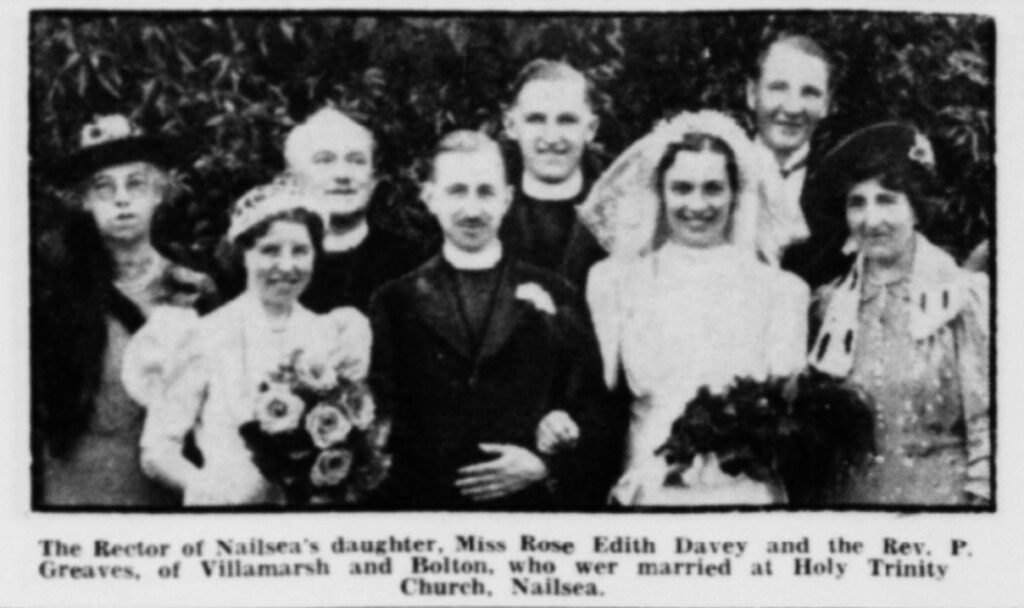
In 1940, the Martyrs’ Memorial Trust appointed William as the rector of Holy Trinity Church, Nailsea.[16] A few months later, on 6 June 1940, Paul and Rose were married at Holy Trinity Church. Rose wore an ivory satin gown and carried a bouquet of dark red roses. She also wore a veil her mother’s mother had worn at her wedding. Paul’s sister, Mary, was a bridesmaid and the Rev. James Edward Seddon, the curate of St Chrysostom, Everton, was the best man. After the ceremony, Paul and Rose left for a short honeymoon in Cornwall.[17]
Tipton and Whitewell
The following year, in July 1941, Paul was appointed as a curate at Tipton in Staffordshire. In reporting the appointment, a Liverpool newspaper noted that he had, for a time, been an organist at Smithills Chapel, a private chapel in Smithills Hall, Bolton.[18] He did not stay at Tipton long, as by 1942 he was the rector of Whitewell in Flintshire, where his first two daughters were born: Anthea Margaret, in 1942, and Rosemary Verity, in 1944.[19]
Hardington Mandeville
In 1946, Paul was appointed rector of Hardington Mandeville, and he and his family moved into the rectory at Hill End. In July 1946, he officiated at the funeral service for George William Partridge, a former resident of the village who had lived for many years at Corton Denham.[20]
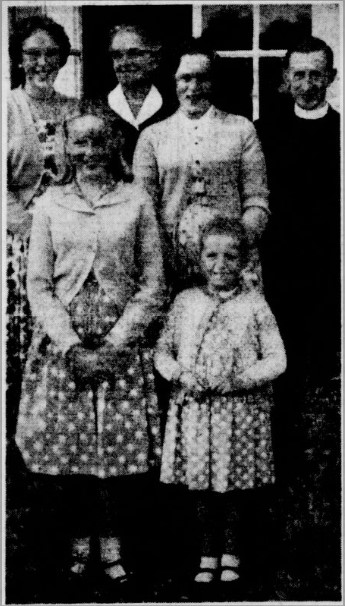
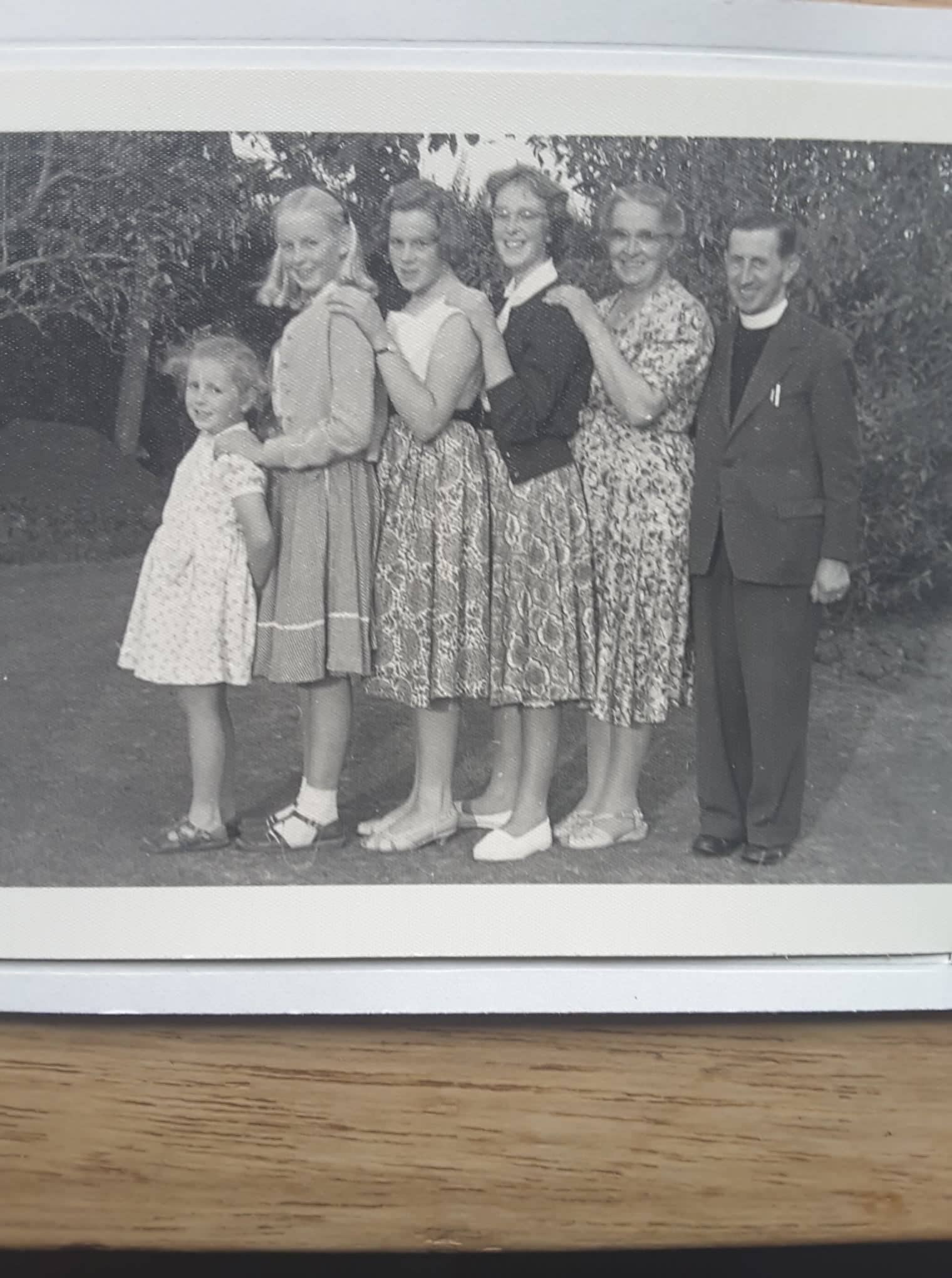
During his tenure at Hardington, Paul had two more daughters. Marion Esther Alice was born at Yeovil Maternity Home on 29 March 1947, and Rachel Mary was born in the Yeovil District in 1951.[21]
He was active in the Christian Endeavour movement, and in October 1948, he chaired a meeting of local members at Sherborne Baptist Church.[22] Janice Jackson and Roderick Marsh remember taking part in a Christian event in a marquee on the Hardington rectory lawn. Rod’s sister, Jennifer, fondly recalls participating in a village branch of a Christian youth movement called the Campaigners.
Paul’s normal clerical activities included witnessing the will of Louis Campbell, a retired tea plantation manager, on Boxing Day 1947; welcoming the Bishop of Bath and Wells to the church in May 1949; and officiating at the wedding of the journalist Graham Harry Quinton and Nora Joyce Marsh at Hardington parish church in October 1955. [23]
Paul also engaged in church matters further afield. In February 1947, he attended the funeral of the Rev. Charles David Day at Thornford, and in September 1947, he and his father-in-law attended the funeral of the Rev. William Morris, a former vicar of St Paul’s, Bolton, at Creech St Michael.[24] In September 1947, he travelled to Nailsea to help his father-in-law revive the harvest thanksgiving. [25] In September 1949, he attended the induction of Chiselborough’s new rector.[26]
His time at Hardington coincided with a move to unite benefices. In June 1948, he attended a ruridecanal conference at Stoke-sub-Hamdon to discuss a scheme of pastoral reorganisation. He opposed the scheme, calling it a defeatist policy. According to a newspaper report, he said, “At a time when statistics show increased populations, the Church is retrenching. If these proposals are only temporary, why take steps which are permanent in effect? We parsons come and go, and it is the people of our parishes who have to put up with all the alterations that are made. I wonder if they have been thought of to the same extent as the clergy?”[27]
In September 1955, Marion won two prize cups for her honey at Yeovil Show.[28]
In October 1958, the chairman of a rural deanery conference at Martock sent their good wishes to Paul, their Honorary Secretary, who was in hospital.[29]
Rougham
In July 1959, it was announced that Paul would succeed the Rev. V. H. Beaton as the rector of Rougham, Suffolk.[30] The Rural Dean inducted him on 15 September 1959.[31] On 27 September 1959, a quarter peal was rung at St Mary’s, Rougham, to welcome the new rector, and Anthea was one of the ringers.[32] Soon after, he was elected chairman of the newly formed North West District of the Suffolk Guild of Bell Ringers.[33]
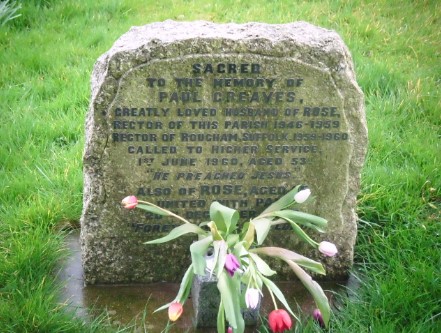
On 18 October, Paul conducted the Harvest Thanksgiving service, and on 20 December, he led a service of carols and lessons. However, he was unable to conduct a funeral service on 13 January 1960, and four days later he made his will, leaving his entire estate to Rose.[34] He died at Rougham rectory on 1 June 1960, at the age of fifty-three. His body was brought back to Hardington for burial on 4 June and a memorial service was held at Rougham on 10 June.[35] When Rose obtained probate of his will on 21 July, his estate was valued at £3,823 15s 7d. His family erected a headstone on his grave that quotes the words “He preached Jesus” from the Book of Acts.
Seven years after Paul’s death, the bell ringers of Rougham undertook a three-day excursion to Somerset, during which they rang at Hardington and attended morning service. The newspaper account notes that this was the former parish of the late Paul Greaves, suggesting that this connection had prompted the visit.[36]
Rose remained in Suffolk and died on 20 December 2003, aged ninety-five. She was laid to rest alongside her husband.
Conclusion
Paul Greaves’s life took him from a mining village in Derbyshire, through accountancy in Bolton, to ministry in the Church of England. His thirteen years at Hardington were particularly marked by his evangelical work with young people and his strong commitment to parish life.
References
[1] Kelly’s Directory of Derbyshire, 1912, p.320.
[2] Derbyshire Courier, Saturday, 23 January 1904, p.8.
[3] Mid Sussex Times, 30 March 1920, p.5.
[4] Bury Free Press, 3 June 1960, p.1.
[5] Sunderland Daily Echo and Shipping Gazette, 17 October 1934, p.2.
[6] Liverpool Daily Post, 5 August 1937, p.8.
[7] Formby Times, 25 September 1937, p.3.
[8] Liverpool Daily Post, Monday, 26 September 1938, p.5.
[9] Online transcription of the burials of St Peter, Halliwell.
[10] Crockford’s Clerical Directory, 1932, p. 327.
[11] Mid Sussex Times, 22 December 1908, p.4; civil registration birth index; 1939 Register.
[12] William Davey left an estate valued at £6,596 18s 9d when he died in 1928; David Foord left an estate valued at £7,088 3s 6d when he died in 1907.
[13] Sussex Express, 25 April 1908, p.4; Western Daily Press, 29 April 1940, p. 3; Yorkshire Post and Leeds Intelligencer, 19 March 1914, p.6.
[14] Sussex Express, 4 June 1915, p.7.
[15] Stockport Advertiser and Guardian, 16 June 1933, p.7.
[16] Western Daily Press, 29 April 1940, p.3.
[17] Western Daily Press, 7 June 1940. The report states that Rose’s grandmother married in 1869, when it was in fact 1860.
[18] Liverpool Evening Express, 24 July 1941, p.2.
[19] Civil registration birth index; Wellington Journal, 30 September 1944, p.5.
[20] Western Gazette, 2 August 1946, p.2.
[21] Western Gazette,18 April 1947, p.8; civil registration birth index.
[22] Western Gazette, 29 October 1948, p.2.
[23] Will of Louis Campbell, dated 26 December 1947; Wells Journal 13 May 1949, p. 7; Bristol Evening Post, 17 October 1955, p.11.
[24] Western Gazette, 28 February 1947, p.2; Taunton Courier and Western Advertiser, 4 October 1947, p.3; Taunton Courier and Western Advertiser, 21 July 1945, p.4; Crockford’s Clerical Directory, 1932, p.923.
[25] Western Daily Press, 15 September 1947, p.1.
[26] Taunton Courier and Western Advertiser, 17 September 1949, p.6.
[27] Taunton Courier and Western Advertiser, 26 June 1948, p.6.
[28] Bristol Evening Post, 9 September 1955, p.11.
[29] Taunton Courier and Western Advertiser, 29 November 1958, p.11.
[30] Bury Free Press, 3 July 1959, p.11.
[31] Suffolk Chronicle, 18 September 1959, p.1.
[32] Suffolk Chronicle, 2 October 1959, p.6.
[33] The Ringing World, 30 October 1959, p.638.
[34] Bury Free Press, 22 January 1960, p.6; the will of Paul Greaves, dated 17 January 1960, proved at Ipswich on 21 July 1960.
[35] Bury Free Press, 3 June 1960, p.1; Bury Free Press, 17 June 1960, p.6.
[36] Bury Free Press, 2 June 1967, p.20.