Introduction
Sidney Walter White was born into a building family at Hardington Mandeville and followed his father and grandfather into the trade. After serving his apprenticeship, he worked as a carpenter before spending several years in Birmingham during the city’s late-1930s building boom. Although he could have made a permanent life there, he eventually returned to his native village, where he remained for the rest of his life.
Early life
Sidney was born on 17 August 1906 at Hardington Mandeville, the second of six children born to George Walter White and his wife, Ellen Florence Leach (née Partridge).[1] His grandfather, George White, was a builder, while his father worked as a carpenter, making it likely that Sidney was expected to enter the family business.
Initially, the family lived in Rectory Lane but moved to Barry Lane around 1909.[2] Around 1912, they settled at Hardington Moor, where Sidney probably completed his education at the village school before leaving at about the age of fourteen.[3]
Apprenticeship and working life
The move to Hardington Moor probably brought the family into a house owned and partly occupied by Sidney’s widowed grandfather, George White, who continued to run the family’s building business. By the time of the 1921 census, three generations were involved in the enterprise. George remained at its head, while his son George Walter worked as a carpenter, and Sidney and his older brother William George were both employed as apprentice carpenters.
The family suffered a heavy blow in December 1922 when William died from scarlet fever aged only twenty-one. Sidney was present at his brother’s death and registered it, an experience that must have left a lasting impression on the sixteen-year-old apprentice.[4]
Upon completing his apprenticeship, Sidney became a journeyman carpenter.
Marriage
In 1933, Sidney married Daisy Lilian Adams of Hardington. He was twenty-seven, and she was twenty-two. Daisy was the daughter of Arthur Adams, a smallholder who had previously worked as a banksman in a South Wales coal mine.
Birmingham
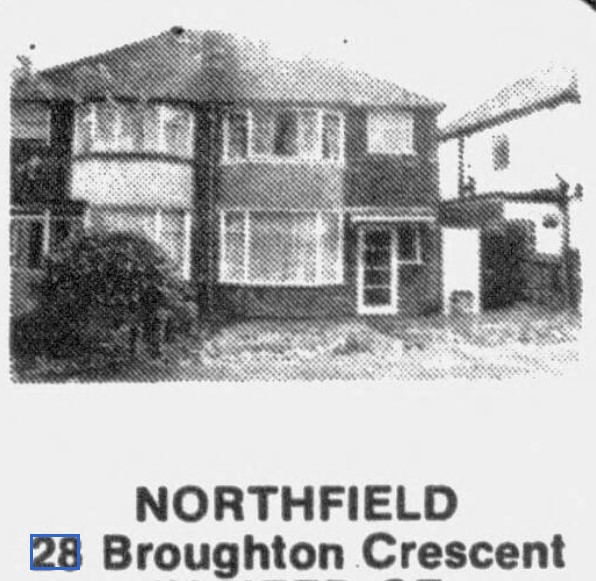
During the late 1930s, Sidney and Daisy moved to Birmingham, probably attracted by the plentiful and well-paid building work created by the Government’s rearmament programme and the city’s rapid suburban expansion. By the time the 1939 Register was compiled, Sidney was employed as a foreman carpenter, and the couple were living at 28 Broughton Crescent, Northfield, a modern three-bedroom semi-detached house.
The property was advertised for sale in July 1939 before being withdrawn a few weeks later. The advertisement stated that it was let at an inclusive rent of 21 shillings and 6 pence a week.[5] Although substantial, such a rent would have been within the means of a skilled foreman carpenter, who was probably earning between £4 5s and £5 10s each week.
Return to Hardington
Despite the opportunities Birmingham offered, Sidney and Daisy eventually returned to Hardington, possibly due to family commitments. After returning, Sidney began constructing a house or bungalow in an orchard opposite their cottage, but the project never progressed beyond the foundations.
They were resident in Rectory Lane by June 1951, when Daisy obtained probate for her father’s will.[6] Daisy’s mother died on 12 August 1963, leaving an estate valued at £498 13s 8d, which she bequeathed to Daisy.[7]
Sidney and Daisy spent the remainder of their lives in the village. Bellringing became one of Sidney’s principal interests, and in June 1963, he and Bill Turner were part of a band of six ringers who rang a Plain Bob Minor at All Saints’ Church, Kingsdon, to celebrate a silver wedding anniversary.[8]
Sidney died in 1978 at the age of seventy-two, and Daisy survived him by fifteen years, passing away on 2 February 1993 at the age of eighty-one.[9]
Conclusion
Sidney White left only a modest documentary record, but it reveals a man whose life was firmly rooted in the building trade inherited from his father and grandfather. His years in Birmingham exposed him to a rapidly expanding urban world and greater prosperity, yet he ultimately chose the familiarity of Hardington. Although his own building project remained unfinished, his life reflects the continuity of a village craftsman whose family contributed to the local landscape across several generations.
References
[1] Hardington School admissions register; family reconstitution.
[2] Hardington voters’ lists; guardian valuations.
[3] Hardington voters’ lists.
[4] Death certificate of William George White; Western Chronicle, 29 Dec 1922, p 3.
[5] Birmingham Daily Post, 1 July 1939, p. 3; 15 July 1939, p.3.
[6] Will of Arthur Adams, dated18 April 1934, proved at Bristol on 13 June 1951.
[7] Will of Ann Elizabeth Adams, dated 18 July 1951, proved at Bristol on 20 March 1964.
[8] Taunton Courier and Western Advertiser, 15 June 1963, p.10.
[9] National probate calendar.